






 Home
Home Products
29+ years in pharmaceutical machinery, covering capsule filling, tablet pressing, blister packaging, tablet and capsule counting, cartoning, GMP production, and overseas machine service.
Categories
New Blog
Tags
Are you wondering about the future potential of blister packaging machines in the pharmaceutical industry? Blister packaging machines have become indispensable assets for pharmaceutical manufacturers worldwide, offering unparalleled protection, compliance features, and consumer convenience for medication delivery.
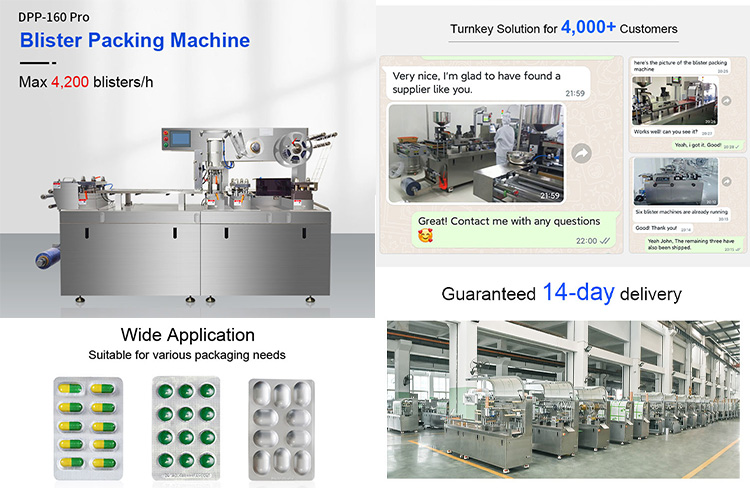
The global blister packaging machine market is experiencing robust growth, with the pharmaceutical sector acting as the primary driving force. Recent market analyses indicate that the global blister packaging machine market was valued at approximately $2.1 billion in 2023 and is projected to reach $3.4 billion by 2030, representing a compound annual growth rate (CAGR) of 6.8%.
This significant growth trajectory can be attributed to several factors. The pharmaceutical industry's expanding production capabilities, increasing regulations regarding product safety and tamper-evidence, and growing consumer demand for convenient packaging solutions all contribute to the rising adoption of blister packaging machines worldwide.
The blister packaging machine market exhibits varied penetration across different regions:
| Market Share | Key Drivers | Notable Characteristics | |
|---|---|---|---|
| North America | 35% | Stringent regulations, High technology adoption | Led by United States, Focus on innovation |
| Europe | 30% | Precision engineering, Advanced automation | Germany, Italy, and Switzerland as major contributors |
| Asia-Pacific | 20% (fastest growing at 8.5% CAGR) | Cost-effectiveness, Growing pharmaceutical sector | China and India emerging as manufacturing hubs |
| Rest of World | 15% | Developing pharmaceutical industries |
The global pharmaceutical industry continues to expand at a rapid pace. Annual pharmaceutical production has increased by approximately 5.8% globally over the past five years. This growth necessitates more efficient packaging solutions, with blister packaging emerging as the preferred choice for unit-dose medications.
Regulatory bodies worldwide, including the FDA in the United States and the EMA in Europe, have implemented increasingly stringent requirements for pharmaceutical packaging. These regulations emphasize:
Blister packaging machines capable of incorporating these features are seeing heightened demand as manufacturers strive to meet regulatory standards while maintaining production efficiency.
Patient adherence to medication regimens remains a significant challenge in healthcare. Studies indicate that approximately 50% of patients do not take their medications as prescribed. Blister packaging offers solutions through:
These compliance-enhancing features have made blister packaging increasingly popular among both healthcare providers and patients, subsequently driving demand for advanced blister packaging machinery.
Modern blister packaging machines have evolved significantly from their manual predecessors. Contemporary machines incorporate:
| Benefit | Productivity Impact | |
|---|---|---|
| Fully automated feeding systems | Reduced labor costs, Consistent product handling | 25-30% labor reduction |
| Vision inspection systems | Detection of product defects, Quality assurance | 99.9% defect detection rate |
| Integrated robotic components | Precise handling, Reduced contamination risk | 40% increase in handling precision |
| Seamless upstream/downstream integration | Streamlined production flow, Reduced transfer errors |
These advancements have resulted in productivity increases of up to 40% compared to previous-generation equipment, making them attractive investments for pharmaceutical manufacturers looking to optimize production efficiency.
The pharmaceutical market demands increasing flexibility in production lines. Next-generation blister packaging machines offer:
These features allow manufacturers to produce multiple product types on the same line, reducing capital investment requirements and increasing overall equipment utilization rates.
Environmental considerations are becoming increasingly important in pharmaceutical packaging. Modern blister packaging machines are being designed to accommodate:
Manufacturers report that these eco-friendly adaptations can reduce packaging material usage by up to 15% while maintaining required barrier properties and structural integrity.
| Market Share | Speed Capability | Investment Range | Ideal Application | |
|---|---|---|---|---|
| Rotary Blister Machines | 45% | Up to 1,200 blisters/min | $250,000-$850,000 | Large-volume production, High-speed requirements |
| Flat-Plate Machines | 35% | 300-600 blisters/min | $150,000-$350,000 | Mid-sized operations, Multiple product formats |
| Laboratory/Small-Scale | 20% | Up to 300 blisters/min | $50,000-$150,000 |
Rotary blister machines represent approximately 45% of the global market. These machines are characterized by:
The market for rotary machines is dominated by large pharmaceutical manufacturers producing high-volume generic medications and common over-the-counter products.
Flat-plate machines account for around 35% of the market. Their characteristics include:
These machines are particularly popular among mid-sized pharmaceutical companies and contract manufacturers requiring versatility for multiple product lines.
Small-scale machines represent approximately 20% of the market but are growing at the fastest rate. They feature:
This segment serves smaller pharmaceutical operations, clinical trial material preparation, and developing markets where capital investment capabilities may be limited.
Pharmaceutical manufacturers face rigorous validation requirements for all production equipment. Blister packaging machine vendors are addressing these challenges by:
These solutions can reduce validation timelines by up to 30%, allowing for faster implementation and return on investment.
The increasing technological sophistication of blister packaging machines requires skilled operators. The industry is responding with:
These approaches help address the skills gap while ensuring optimal machine performance even with varying operator expertise levels.
| Traditional Machines | Modern Blister Packaging Machines | Savings/Improvement | |
|---|---|---|---|
| Energy Consumption | Baseline | 15-25% reduction | $15,000-$25,000 annually* |
| Maintenance Requirements | Monthly scheduled maintenance | Predictive maintenance with 50% fewer interventions | 30-40% maintenance cost reduction |
| Machine Lifespan | 10-12 years | 15-18 years with modular upgrades | 50% extension of useful life |
| Overall Equipment Effectiveness | 65-75% | 85-95% | 20-30% productivity improvement |
| Waste Material | 3-5% of materials | 1-2% of materials |
Based on average production facility operating 16 hours/day, 5 days/week
The future of blister packaging machines lies in their integration with Industry 4.0 principles:
| Implementation in Blister Packaging | Business Impact | |
|---|---|---|
| IoT connectivity | Real-time monitoring, Remote diagnostics | 15-20% downtime reduction |
| Predictive maintenance | Algorithm-based maintenance scheduling | 30% maintenance cost reduction |
| Digital twin technology | Virtual process optimization, Simulation | 10-15% process optimization |
| Cloud-based analytics | Production data analysis, Performance benchmarking |
Early adopters of these technologies report efficiency improvements of 12-18% and downtime reductions of up to 30%.
As personalized medicine grows, blister packaging machines are evolving to accommodate:
This emerging segment is projected to grow at a CAGR of 12.5% through 2030, significantly outpacing the overall market growth rate.
| Implementation Complexity | Cost Impact | Security Level | Market Adoption Rate | |
|---|---|---|---|---|
| Basic serialization | Low | +2-5% | Moderate | 85% |
| RFID integration | Medium | +8-12% | High | 35% |
| Holographic features | Medium | +5-8% | High | 45% |
| Real-time verification | High | +10-15% | Very High | 20% |
| Blockchain tracking | Very High | +15-20% | Maximum |
These features not only protect consumers but also protect brand reputation and revenue streams for pharmaceutical manufacturers.
When evaluating blister packaging machine investments, pharmaceutical manufacturers should consider:
Properly matching machine capabilities to actual production requirements can prevent costly over-investment while ensuring sufficient capacity for growth.
The blister packaging machine vendor landscape includes approximately 200 global manufacturers with varying specializations. Key selection criteria should include:
| Importance Rating | Evaluation Metrics | |
|---|---|---|
| Technical capabilities | High | Compatibility with product requirements, Speed, Features |
| Service & support | Very High | Response time, Spare parts availability, Technical expertise |
| Validation assistance | High | Documentation quality, Regulatory expertise, Protocol availability |
| Industry experience | Medium | Years in industry, Similar installations, References |
| Cost structure | Medium | Initial investment, Service costs, Spare parts pricing |
| Innovation pipeline | Medium |
Leading global vendors typically provide comprehensive support packages that can significantly reduce implementation risks and ongoing operational challenges.
For manufacturers transitioning to new blister packaging technologies, phased approaches often prove most successful:
These approaches minimize production disruption while allowing for organizational learning and adaptation.
The prospect market for blister packaging machines in the pharmaceutical industry presents compelling opportunities for manufacturers seeking efficient, compliant, and consumer-friendly packaging solutions. With continuous technological advancements, increasing regulatory requirements, and growing consumer expectations, investments in modern blister packaging equipment represent strategic decisions for forward-thinking pharmaceutical companies.
Are you interested in learning more about specific blister packaging solutions for your pharmaceutical products? Contact our experts today for a personalized consultation to identify the optimal packaging system for your unique requirements.


Email : manager@richpacking.cn
Building D, No. 226, Beishan Qiaotou Street, Haizhu District, Guangzhou City, Guangdong Province, China


 IPv6 network supported