Sep 16, 2026
What Is a User Requirement Specification (URS) in Pharma? Examples, Template & Equipment Requirements
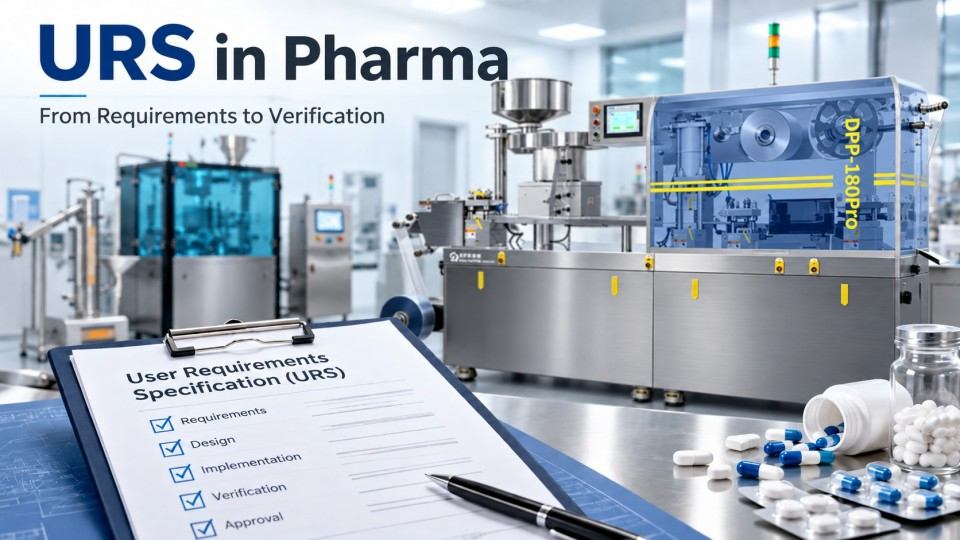
A user requirement specification (URS) defines what a pharmaceutical manufacturer expects a machine, production line, utility, or system to achieve before final equipment selection. A useful user requirement specification connects intended use, product range, performance, cleaning, changeover, utilities, controls, documentation, interfaces, maintenance, and acceptance criteria to the real process. A request such as “automatic blister packaging machine, high speed, GMP compliant” still leaves major gaps. The supplier does not yet know the tablet or capsule range, forming and lidding materials, blister dimensions, output under defined conditions, inspection functions, changeover scope, available utilities, cartoning interface, or qualification documents. If those points remain undefined, suppliers can quote different technical assumptions. The result is harder comparison, more design changes, unclear FAT acceptance, and problems that only appear during installation or qualification. A practical user requirement specification in pharma therefore gives production, engineering, QA, validation, maintenance, purchasing, and the equipment supplier one technical reference: process need → user requirement specification → supplier solution → verification This guide explains what a pharmaceutical equipment user requirement specification should include, how to write testable requirements, and how to build a user requirement specification example, user requirement specification template, URS format, and URS checklist without turning the document into an engineering design specification. Pharmaceutical equipment URS workflow from process need to supplier solution and verification Key Takeaways A user requirement specification should define intended use, product range, performance, utilities, cleaning, changeover, controls, documentation, interfaces, and acceptance expectations. Write requirements around what the equipment must achieve, under which conditions, and how critical requirements will be verified. Use requirement IDs and traceability for quality-, safety-, and process-critical requirements. Separate mandatory requirements from preferences so supplier comparisons remain meaningful. A concise, specific user requirement specification is more useful than a long document filled with generic statements. 1. What Is a User Requirement Specification in Pharma? A User Requirement Specification, defines what the user needs a machine, system, facility, or utility to accomplish for its intended use. EU GMP Annex 15 places the user requirement specification near the beginning of the qualification lifecycle. It links the URS with functional specifications, Design Qualification, FAT/SAT, and later qualification activities where applicable. The basic boundary is simple: Document Main Question User Requirement Specification What must the system achieve? ...
View More





 IPv6 network supported






 Home
Home Products