< img height="1" width="1" style="display:none" src="https://www.facebook.com/tr?id=860012012932429&ev=PageView&noscript=1" />
capsule counting machine
  • Apr 05, 2026 Monomaterial Packaging vs. Multilayer Packaging: What to Compare Before You Choose
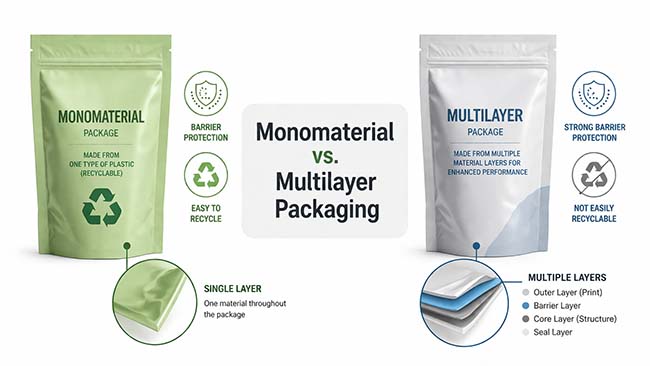
    Packaging decisions now carry more pressure than before. A pack has to protect the product, support shelf life, control cost, fit the market, and respond to growing expectations around recyclability. That is why Monomaterial Packaging vs. Multilayer Packaging has become a common discussion across packaging development, sourcing, and production teams. A monomaterial structure is often easier to explain and easier to connect with material simplification goals. A multilayer structure is often kept because it can combine barrier performance, sealability, stiffness, appearance, and process stability in one pack. Neither route is automatically better. The better choice depends on the product, the protection target, the market, and the production conditions.     Why Monomaterial Packaging Is Getting More Attention   Monomaterial packaging is receiving more attention because packaging teams are being pushed to reduce structural complexity. A pack built mainly from one material family is easier to describe in recyclability discussions than a structure made from several functional layers. That gives brand teams a clearer sustainability message and makes it easier to align packaging development with design-for-recycling goals. Another reason is that more packaging projects now begin with a simplification question. Instead of assuming that a multilayer structure is the default answer, teams increasingly ask whether a less complex construction can still do the same job. That shift does not guarantee a switch, but it changes the starting point. Monomaterial packaging enters the discussion earlier, and in more categories, than it did a few years ago. A simpler structure also carries an internal advantage. Non-technical stakeholders can understand it more easily. When a company wants to show progress on reducing material complexity, a monomaterial pack is easier to present than a pack built from several layers with separate roles. That communication value does not settle the technical question, but it helps explain why interest has spread beyond sustainability teams into procurement, development, and management discussions.   Why Multilayer Packaging Is Still Widely Used   Multilayer packaging remains common because it solves several packaging problems at once. One layer may support barrier protection, another sealability, another stiffness, puncture resistance, print quality, or appearance. That combined performance is often harder to match with a simpler structure when the application is more demanding. This matters most when moisture, oxygen, light, or aroma control is critical. In those situations, the structure is not chosen only because of material preference. It is chosen because the product has to remain stable during storage, transport, retail handling, and normal use. A less complex pack may still fail if it cannot hold the same protection level long enough. Shelf-life targets keep many multilayer formats in place for the ...
    View More
  • Apr 03, 2026 How Are Capsules Sealed: 5 Capsule Sealing Methods You Need To Know
      Have you ever observed the structure of capsules? Some gel capsules appear to have no trace of adhesive, yet they are completely leak-proof. How is this achieved? In the nutritional supplement and pharmaceutical manufacturing industry, capsule sealing plays a crucial role in product quality assurance. Any gap between the capsule cap and the capsule body can cause leakage, significantly reducing the efficacy of the medication. This is especially true for liquid products like omega-3 capsules, where the requirements for capsule sealing are even more stringent. For different contents, capsule sealing methods vary widely. This article will reveal the techniques behind perfectly sealed capsules and will show how capsules are sealed more effectively in real production.   Key Takeaways ● Capsule sealing definition and why it matters ● The differences between hard capsules, softgels, and liquid-filled hard capsules ● Common capsule sealing methods with rationale, pros, and cons ● Step-by-step process of how capsules are sealed in real manufacturing ● Machines used for capsule sealing and how they work ● Key challenges in liquid capsule sealing and how Rich Packing addresses them     1. What Is Capsule Sealing?   Capsule sealing refers to the formation of a strong, closed structure between the capsule cap and the capsule body, acting like a protective shield to prevent external interference with medication or the efficacy of the active ingredient. This basic capsule definition is especially important when the product contains oils, liquids, or moisture-sensitive powders. A good seal helps prevent leakage, oxidation, odor diffusion, and moisture absorption. When people ask how capsules are sealed, they usually mean one of two things: Locking and sealing double-layered hard capsules sealing a one-piece soft capsule, such as a softgel, during or after forming   Two-Piece Hard Capsules Two-piece hard capsules, a traditional capsule type, consist of a body and a cap. With records dating back to the mid-19th century, these capsules are commonly seen in medication sold in pharmacies and hospitals like domino seal capsules; other capsules, such as HPMC capsules, also adopt this structure. As long as the filler is solid, these capsules generally do not require secondary sealing. The cap's structural design allows the capsule to close relatively tightly after passing through the locking station. In some applications, however, manufacturers may still seal hard gelatin capsules to improve tamper evidence or reduce the risk of separation during transport.   Liquid-Filled Hard Capsules Liquid-filled hard capsules are a branch of two-piece capsules. They are widely used to fill oily or water-based health supplements. Supplement products like fish oil capsules, omega-3 capsules, and fat-soluble vitamins use this structure. Sin...
    View More
  • Mar 25, 2026 What Is a Solid Dosage Form? Types, Benefits, and How It Affects Manufacturing
    A solid dosage form is one of the most common ways medicines and supplements are made and delivered. Tablets, capsules, powders, and granules all fall into this category. For manufacturers, buyers, and first-time project planners, this matters because the dosage form does not only affect how a product looks or how a user takes it. It also affects formulation options, production steps, packaging routes, storage conditions, and equipment selection. WHO guidance describes oral solid dosage forms as a broad group ranging from powders to coated tablets, and notes typical advantages such as improved stability, good dosage uniformity, and convenient packaging and transport.   This is why solid dosage form is a useful starting concept. Many people first notice the finished product, such as a tablet in a blister pack or a capsule in a bottle. But behind that finished product is a full manufacturing logic. A powder that needs precise filling behaves differently from a tablet that must be compressed and sometimes coated. A capsule line has different process needs from a granule filling line. Once the dosage form changes, the production path usually changes with it.   For beginners, this topic can also be confusing because different terms are often used too loosely. Some people use “tablet” as if it means all oral drug products. Others use “capsule” as a general label for anything taken by mouth. In practice, solid dosage forms cover a wider group of formats, each with its own strengths, limits, and downstream packaging implications.   For a pharmaceutical or nutraceutical manufacturer, choosing the right format is rarely just a marketing decision. It usually involves balancing dose accuracy, material flow, stability, moisture sensitivity, swallowing experience, output targets, and packaging style. Understanding this category first makes later decisions on machine selection, line design, and packaging much clearer.     What Is a Solid Dosage Form?   A solid dosage form is a pharmaceutical or nutraceutical product presented in a solid physical state, with the active ingredient and excipients prepared in a measured form for use. In simple terms, it means the product is not delivered as a liquid, suspension, cream, or semi-solid. Instead, it is made and supplied as a solid unit or solid measured quantity.   The most familiar examples are tablets and capsules, but the concept is broader than that. Powders and granules are also common formats in this category, especially when the product is meant to be packed into sachets, stick packs, bottles, or unit-dose containers. In some cases, pellets, lozenges, and similar oral forms can also belong to this wider group, depending on the product design and application. FDA dosage-form terminology separately recognizes forms such as capsules and tablets, while WHO guidance explicitly includes powders, coated tablets, chewable tablets, orally...
    View More

  • Mar 19, 2026 What Is Unit Dose Packaging? Types, Uses, and Equipment Explained
    Introduction Unit dose packaging means one dose is packed as one ready-to-use unit. Instead of taking medicine from a larger bottle or bulk pack at the moment of use, the dose is already separated, packed, and identified in advance. In drug packaging, that usually means the medicine can be given directly from its immediate pack as a single administration unit.   A simple example is one tablet sealed in its own labeled blister cavity. The same idea can also apply to a small packet, cup, vial, or other single-use presentation prepared for one dose. The package format can change, but the basic purpose stays the same: one prepared dose, clear identification, and less extra handling before administration. (U.S. Food and Drug Administration)   This matters because unit dose packaging is not one specific machine type or one fixed package style. It is a packaging approach used to control how each dose is presented, labeled, handled, and protected until use. Demand for repackaging solid oral products into unit-dose containers has also increased across healthcare settings, which helps explain why the term shows up so often in hospital pharmacy and medication-packaging discussions.     What Is Unit Dose Packaging? Unit dose packaging is built around one administration unit. The medicine is packed in a non-reusable container, and that container is used directly when the dose is given. The key point is not only that the pack is small. The key point is that the dose has already been separated and identified before it reaches the point of use.   In practice, this can be very simple. One tablet in one blister cavity can be a unit dose package. A measured amount of liquid in a single-use container can also be a unit dose package. Guidance from hospital pharmacy standards adds an important detail: a single unit package contains one discrete dosage form, while a unit dose package contains the particular dose ordered for the patient. In many cases those are the same thing, but not always. A unit dose package can contain more than one tablet if that is the dose to be given. (ASHP)   This helps clear up one common misunderstanding. Not every small pack is a true unit dose package. A compact retail pack can still hold a full treatment quantity rather than one administration unit. Unit dose packaging is narrower than that. It is designed around each individual dose and the information needed to keep that dose clearly identified and protected until use.   That difference matters for packaging work. Once the product is separated into individual doses, the immediate pack has to support clear labeling, readable identification, and reliable protection of the dosage form. So when people talk about unit dose packaging, they are not only talking about pack size. They are talking about dose-level presentation and control.   Unit Dose Packaging vs Unit-of-Use Packaging Unit dose packaging and unit-of-use packaging are related, but they are ...
    View More
  • Mar 10, 2026 Creatine Gummies Explained: Why They’re Booming and What It Means for Packaging
    Introduction Creatine has been around for a long time, but the way it is sold is changing. Powder still feels like the standard format. Capsules and tablets are familiar too. Gummies move the product into a different space. They look less technical, feel more approachable, and fit naturally into a supplement shelf where chewable products are already common.   That shift is one reason this category is getting more attention. It is not only about a popular ingredient. It is also about format. A chewable piece changes how the product is seen, how it is used, and what needs more attention later in storage, counting, and final pack choice.   This also explains why the topic matters beyond consumer interest. A powder product is mostly discussed in terms of fill weight, moisture control, and container choice. A gummy product brings in more questions about piece consistency, surface condition, count accuracy, and pack presentation. Once the format changes, the downstream packaging logic changes with it.   Some of the interest also comes from a wider market shift. Gummies are now common across vitamins, botanicals, beauty products, and daily wellness lines. As chewable supplements became more accepted, it was easy for creatine to move into the same format. That made the category more visible, but it also raised more practical questions about quality, stability, and packaging fit.     What Are Creatine Gummies?   Creatine gummies are chewable supplement pieces that deliver creatine in a soft, pre-portioned form. Instead of measuring powder or taking a capsule, the user takes one or more pieces as the serving format. The ingredient is familiar, but the finished product behaves differently because the physical form is different.   Powder is a loose-fill product. Capsules and tablets are firm units with stable shape. Gummies sit somewhere else. They are softer, more sensitive to temperature and humidity, and more affected by surface finish and contact between pieces. Those differences matter because they influence storage, handling, and packaging later.   This is also where the category becomes more interesting from a packaging point of view. A gummy may look simple in the bottle, but piece shape, firmness, and surface condition can all affect how well it separates, counts, and moves into the final pack. That does not make the format unusually difficult. It just means it cannot be treated exactly like powder, capsules, or tablets.   From a market angle, the format also sits between traditional sports nutrition and mainstream chewable supplements. It carries a familiar ingredient, but the product looks closer to a modern wellness gummy than to a classic creatine tub. That makes it easier for some shoppers to notice and easier for brands to place in a crowded category.   The best way to understand the format is to start with that basic point: this is a chewable delivery form with its own handling, storage, ...
    View More
  • Mar 07, 2026 Labeling Machines: Key Branding Applications for Product Packaging
    Introduction You naturally pick up a soft drink bottle in the supermarket as usual. It sounds so random. But the fact is, the product might have very similar smell, taste and similar customer experience with others. Still you choose the one that looks better and brightens up in the shelf. The secret lies not in the soft drink itself, but in its perfect and high-end looking label. Labeling seems to be a very easy step in production. However, it is a significant role in attracting the market. Various brand positioning, brand values, as well as customer experiences can be seen through different labels. This is just like what the old quote: “A small sign indicates a great trend”. The significance in labeling is worth a reassessment, because it is closely related to the market results. Therefore, we need stable and reliable equipment (for pharmaceutical, chemical and nutraceutical purposes only) to manifest our brand standard.   1. Applications of Labeling       1.1 Pharmaceutical and Nutraceutical Industry This industry is a “big buyer” regarding fully-automatic labeling machine. Enterprises are very strict in choosing the right machines with high speed, high precision, and high international standards. They have systematic requirements in the labeling consumable materials.   1.2 Cosmetics and Daily Necessities 1.2.1 Flat Cases Open-shelf cosmetics are often packaged in flat cases, for example, eye shadows, contour powder, eyebrow powder and other pressed powder or paste. There are one-sided or double-sided labels on the cases. 1.2.2 Round Bottles     For products like toner, foundation, or washing powder, round bottles are widely used. Tracking labeling / wraparound labeling is up. A precise labeling can leave consumers with good impression. 1.2.3 Other Bottles Some brands want to stand out with customized design of their bottles, like a streamlined bottle or a conical bottle. These bottles requires labeling with bubble exclusion or degassing so as to make sure the label adhere well to the product.   1.3 Electronic Industry Labels on an electronic product is often smaller in size with larger amount of precise information. Every label acts like a corresponding point to a certain product, storing its identity.   1.4 Chemical Industry In the chemical industry, labels are larger in size, as products like lubricating oil, and chemical raw materials are stored in barrels and drums. The flatness of the labels, and the power take-off of the applicator are factors that needed to be considered.   1.5 Logistics and E-Commerce For logistics and e-commerce, as it has dynamic information in every moment, we need instant printing and instant labeling. Scenarios that require labeling are as listed below. 1.5.1 E-Commerce Packages 1.5.2 Warehouse Sorting 1.5.3 Delivery   1.6 Other Industries There are lab...
    View More
  • Mar 07, 2026 How Blister Packs for Medication Are Made: A Step-by-Step Guide
    Are you planning to make blister packs by yourself instead of relying on a partner packaging vendor? For many pharmaceutical and nutritional supplement manufacturers, shifting from outsourcing to in-house medicine blister pack making is like moving from renting an apartment to building your own house. It requires a solid knowledge base and the suitable equipment. Whether you’re a small probiotic supplement brand looking to package small batches or a growing pharmaceutical manufacturer looking to achieve large-scale production, understanding how to make blister packs by yourself is key to achieving higher profit and faster time to market. This guide delves into the mechanical principles, materials, and maintenance methods required to manufacture meds blister packs.     Key Takeaways ● An overview of blister packs for medication: structure & types ● The reasons why making it by yourself blister pack meds. ● Step-by-step instructions on the blister pack making process: from material to blistering machines. ● Maintenance protocols to maximize equipment longevity.   1. What is A Blister Pack for Medication?   Before we delve into "how to do it," we must first understand blister packaging meaning. A blister pack for medication is a type of packaging commonly used for unit doses, where tablets and capsules are individually packaged in equal quantities within single "bubbles". This type of medication bubble packaging primarily serves to protect against moisture and oxidation, ensuring the longevity of the medication efficacy.   Blister sheets are ubiquitous in our lives. You might see them on pharmacy shelves, in television commercials, or online. The fact that this product, dating back to the mid-20th century, remains popular in this era of rapid advancements in medicine and science proves that it is far more than just plastic and aluminum foil; it is a carefully designed barrier system intended to ensure the stability of chemical substances.   A Blister Pack Structure   To make it straightforward, we can divide a common bubble pack meds into several layers. It is like a sandwich, where every layer has a specific job. Below gives you an overview of blister pack for medication structure.     Lidding Material: is commonly aluminum foil. This is the "push-through" layer. Heat Seal Coating:A sticky layer that combine the lid and the base together. Forming Film:The cavity holding the pill (PVC, PVDC, or Cold Form Alu). Working together, these layers form a perfect shelter for pills. Yet it’s worth noted that each layer directly affect the quality of a medication bubble pack. For example, if the heat seal coating is too thick, the meds blister pack becomes impossible to open; while it’s too thin, the sealing fails to protect the pills against the moisture and oxygen. &nb...
    View More
  • Mar 06, 2026 Types of Capsules: The Complete Breakdown of Format, Shell Material, Release, and Manufacturing
    As an oral dosage form, capsules are extensively utilized across pharmaceutical and nutraceutical products. At the simplest level, a capsule is a shell holding a fill—often powders, granules, or pellets, and in some formats, liquids or semi-solids.   Most decisions about types of capsules fall into three layers: format (hard capsule vs softgel), shell material (gelatin vs HPMC), and release goal (immediate, enteric, or modified/extended). Once these three are clear, it becomes much easier to match a capsule design to stability needs and to keep production consistent.       Types of Capsules: Why They’re So Popular   Capsules remain popular because they offer a clean user experience while staying flexible in pharmaceutical and nutraceutical manufacturing.   For users, capsules are usually smooth to swallow and can reduce taste or odor issues from certain ingredients. That matters for formulas with strong flavors, lingering aftertaste, or sensitive actives where a cleaner intake experience helps.   For manufacturers, capsules handle a wider range of fills than many other oral forms. Hard capsules commonly carry powders, granules, or pellet systems. Softgels are widely used for oils and liquid-like fills. This flexibility is useful when a formula doesn’t compress well into tablets, or when the blend may change later while the dose form stays consistent.     From a production standpoint, hard-capsule products scale efficiently because the filling and closing steps can be automated on a fully automatic capsule filling machine, helping maintain repeatability as output increases. The goal is not speed alone—it’s consistent dosing and stable handling from batch to batch.   Common Types of Capsules   A simple way to understand types of capsules is to start with format, then look at shell material, then clarify what “release” means in real products.   Hard capsules   Hard capsules are the classic two-piece design (cap and body). They are widely used in both supplements and pharmaceuticals because they are adaptable and straightforward to run at scale. Powders, granules, or pellets/beads are commonly used as the filling material in hard capsules. Powders are common for blends and extracts. Granules are chosen when flow and dust control matter. Pellets/beads are often used when the product needs a delayed or controlled release behavior. Hard capsules also support many “special” product designs, such as combining different particle types in one dose, or separating ingredients that shouldn’t interact during storage.   Softgel capsules   Softgels are one-piece and sealed. They are often used for oils, liquids, and semi-solids, which is why they show up so often in omega-3 products, vitamin D/K oils, and other oil-based formulas. Softgels typically require a different manufacturing route than ha...
    View More
  • Mar 02, 2026 Capsule Filling Machine Steals Show: Precise Needs Matching Big Health Industry
    Introduction Health Supplements   The global health supplements and nutraceutical market continues to expand, according to the latest STASTICA report, the global market is expected to be worth USD 300 billion by 2028 (from PubMed Central). Within this vast market, capsule dosage forms (for pharmaceutical and nutraceutical) , known for their precise dosing, good stability, and convenient consumption experience, consistently hold a crucial share of nearly 30%. For companies looking to enter or already operating in this arena, selecting a capsule filling machine that closely matches their current stage of development is fundamental to building product strength, controlling costs, and achieving scalable growth.   Faced with a diverse range of equipment from semi-automatic to fully-automatic, the core of the decision lies in a rational analysis of one's own production capacity needs, product roadmap, budget framework, and long-term strategy. There is no absolute best choice, only the solution that best fits the present and foreseeable future.     1 The Global Market: Why You Need to Choose the Right Machine 1.1 Global Market Recently, there’s an obvious trend in health supplement consumption. Many people are seeking for standardized products with high quality. We can see influencers or online buyers talking about supplements for audience of different age groups in live-streaming; new supplement brands displaying in the market shelves on the most prominent position; and consumers looking for segmented types of supplements in the counter. As a respond to this growing market, companies and manufacturers in this industry - no matter they are starters or industry leaders - are grasping the chance to upgrade their equipment.   1.2 Role of the Equipment in the Big Health Industry Segmented health supplements means different machine requirements. Capsules, as they are convenient to take, with precise supplement filling, they always have a big proportion in the big health industry consumption - up to 38.5% among millennials and Gen X consumers. There are different choices in capsule filling machines: manual, semi-automatic, fully-automatic, and combined lines. The semi-automatic and fully-automatic ones have been top-selling machines with mature systems. A machine that suits the need of a company is essential. We should take standard certifications (cGMP, CE, FOB, DEA, etc.), capability, stability, efficiency cost, dimensions, and even business flexibility into consideration when we upgrade our machines.   If an enterprise is in the pursuit of making a wise investment, making sense of the different features of different machines is the key step. We shouldn’t only take cost-competitiveness into consideration, but also how to match the precise needs of an enterprise to the machines.   2 Semi-Automatic Capsule Filling Machines: Flexibility and Control CGNT-209 Semi Automatic Capsule Filling Machin...
    View More
1 ... 7 8 9 10 11 ... 27

A total of 27 pages

Leave A Message
Leave A Message
Please tell us your requirements such as product, model, speed, etc. We will contact you immediately and give you equipment information and quotation。

Service Online

WhatsApp

Email