






 Home
Home Products
29+ years in pharmaceutical machinery, covering capsule filling, tablet pressing, blister packaging, tablet and capsule counting, cartoning, GMP production, and overseas machine service.


Can you open a capsule and take the powder? Sometimes, but being able to pull a capsule apart does not automatically mean the contents are suitable for use outside the shell.
What matters most is what is inside. Some hard capsules contain powder or granules. Others contain coated pellets or particles designed to control how the contents are released. Softgels are different because they usually contain liquid or semi-solid material.
So there is no simple rule that applies to every capsule. Some are designed so the shell can be opened, while others need to remain intact. The formulation and the instructions for the specific product provide the answer. NHS guidance also advises checking before altering capsules rather than deciding from their appearance alone.
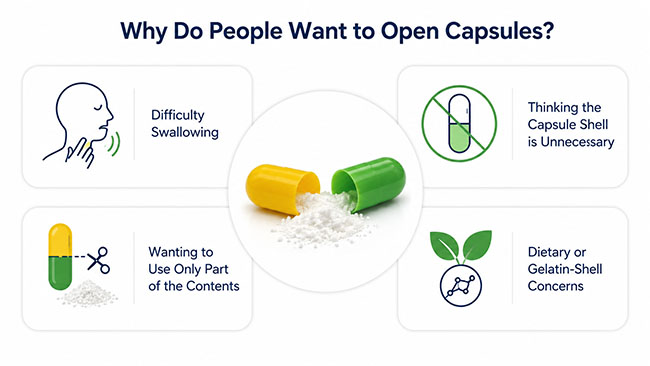
People usually consider opening capsules for a few practical reasons. Understanding these reasons also helps explain why the answer is not always as simple as “yes” or “no.”
Some people find larger hard capsules difficult or uncomfortable to swallow. They therefore wonder whether they can open the capsule and take the contents separately.
This is a common reason for asking the question, but swallowing difficulty does not determine whether a particular capsule can be opened. That still depends on the formulation inside.
Some people are unsure what capsule shells are made from or assume the shell is just an unnecessary outer layer. If a two-piece hard capsule can be pulled apart easily, it can seem reasonable to ask why the powder inside cannot simply be taken on its own.
But the shell does have a purpose. It keeps the fill together, makes the capsule easier to handle, and allows the complete contents to be delivered as one unit.
In some products, the shell mainly acts as a container. In others, the overall formulation is more complex. A shell being easy to open does not mean it has no function.
Another reason is wanting to use only part of what is inside the capsule.
Opening a capsule, however, does not turn the contents into an accurate measuring system. A powder fill can contain several blended components, while granules or pellets can be present in a defined quantity or distribution.
Dividing the contents by sight does not reproduce the fill control used during manufacturing. The desire to use a smaller amount therefore explains why someone might open a capsule, but it does not mean the contents are suitable for accurate splitting.
Traditional hard capsule shells are often made from gelatin, which can come from animal sources. This can matter to people with vegetarian preferences, religious requirements, or concerns about animal-derived ingredients.
Non-gelatin hard capsules, including HPMC capsules, are also widely used.
However, avoiding a gelatin shell and deciding whether the contents can be taken outside that shell are two different questions. The shell material does not tell you how the formulation inside should be handled.
These four reasons all lead back to the main question: can you open a capsule and take the powder? To answer it, you need to look at the capsule type and what is inside.
A two-piece hard capsule can often be physically opened. NHS Specialist Pharmacy Service guidance notes that hard capsules can often, but not always, be opened.
The important word is often.
The shell may separate easily while the contents still need to remain intact.
Immediate-release hard capsules are not designed to provide deliberately prolonged release. They commonly contain powder, granules, or another solid fill.
Some products allow the shell to be opened. Others do not. The instructions for the specific formulation should therefore be checked first.
The basic distinction is simple:
A capsule being easy to open tells you how the shell is built. It does not tell you whether the contents are suitable for use outside it.
Modified-release capsules need more attention because the release-control system can be inside the capsule rather than in the outer shell.
They can contain coated pellets, beads, granules, or combinations of particles. The shell may simply hold these particles together.
In some cases, the outer capsule can be opened while the pellets or granules inside still need to stay intact. NHS SPS specifically notes that some modified-release capsules contain granules, beads, or pellets that should not be crushed or chewed even when the capsule itself can be opened.
So there are really two separate questions:
Can the shell be opened?
And:
Can the contents be altered?
The answer to one does not automatically answer the other.
Delayed-release and gastro-resistant formulations are designed to release their contents under different conditions from conventional immediate-release products.
In some designs, coated granules or pellets inside the capsule provide that function. Damaging those particles can change how they perform even if opening the outer capsule itself is permitted.
EMA guidance includes gastro-resistant products within modified-release dosage forms and links their performance to formulation and manufacturing design.
This is why broad rules such as “all delayed-release capsules can be opened” or “none can be opened” are not useful. The specific formulation matters.
|
Capsule Type |
Typical Contents |
Can the Shell Be Opened? |
Main Point to Check |
|
Immediate-release hard capsule |
Powder or granules |
Sometimes |
Formulation and specific instructions |
|
Modified-release hard capsule |
Pellets, beads, or granules |
Sometimes |
Internal particles may need to stay intact |
|
Delayed-release / gastro-resistant capsule |
Protected granules or pellets |
Product-dependent |
Where the release-control function is located |
Opening a capsule changes how the contents are handled. The effect depends on what the capsule contains.
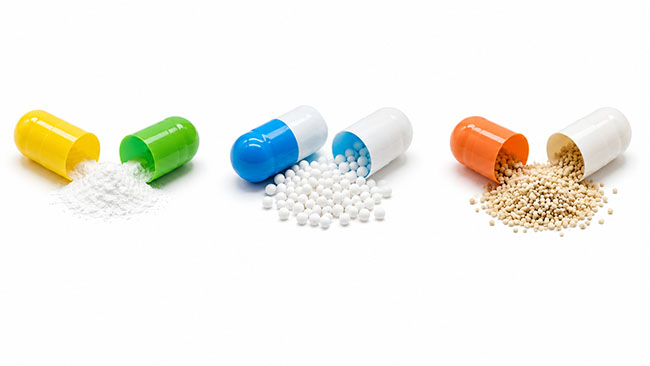
When people talk about taking powder out of capsules, they often assume everything inside is loose powder.
Hard capsules can actually contain:
A conventional powder and a coated pellet do not behave in the same way. A pellet can carry a functional coating, while an ordinary powder does not rely on the same structure.
So before treating the contents as “powder,” it helps to know what is actually inside.
During production, each capsule is filled as one complete unit.
The formulation is prepared first, and a controlled quantity is placed into the capsule body before it is closed.
Opening the capsule does not mean the contents can then be divided accurately by sight. Powder blends can contain multiple components, while granule and pellet fills can depend on a defined distribution of material.
Fill control takes place during manufacturing, not after the finished capsule has been opened.
The shell keeps the contents together and reduces direct handling, although it is not a complete barrier against moisture, air, light, or other environmental conditions.
After opening, the formulation has more direct contact with its surroundings.
How important that is depends on the material and storage conditions. Opened contents should therefore not automatically be assumed to have the same handling or storage conditions as the intact finished capsule.
Fine powders can spill easily, and some capsule contents have a noticeable taste, odor, or texture once they are outside the shell.
These practical differences are another reason capsule shells are useful even when the shell itself is not controlling release.
Can you open capsules and mix with water? Sometimes, but only when the formulation is suitable for that method.
Putting capsule contents into water does not automatically make them dissolve.
Different fill materials behave differently in water.
A soluble powder can dissolve, while another powder may only disperse. Granules and coated pellets can remain visible because they are designed to stay intact.
So the important question is not simply whether the contents can be poured into water. It is whether that particular formulation is designed to be used with water.
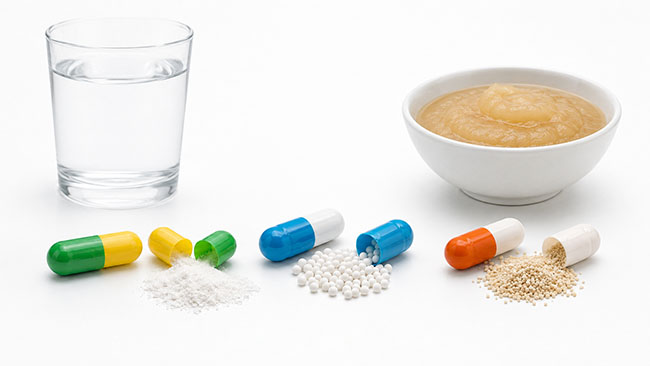
The same principle applies to food.
Some capsule formulations can be used with suitable soft food when the product instructions specifically allow it. NHS SPS guidance recommends checking product-specific information instead of assuming the same method works for every capsule.
This is especially important when the contents include coated granules or pellets that need to remain intact.
Understanding what can be filled into a hard capsule explains why opening one does not always produce a simple pile of powder.
Powder is a common hard-capsule fill.
During production, properties such as powder flowability, bulk density, particle-size distribution, and blend consistency affect how easily the material can be handled and filled.
Granules are larger agglomerated particles rather than very fine powder.
They can provide different flow and handling characteristics and can also form part of a formulation designed for a particular release pattern.
Pellets are small, relatively uniform particles that can be filled into hard capsules.
Some pellets carry functional coatings. This is why seeing small particles after opening a capsule is different from seeing ordinary loose powder.
Powders, granules, and pellets have different physical properties, so manufacturers have to match the filling process to the material.
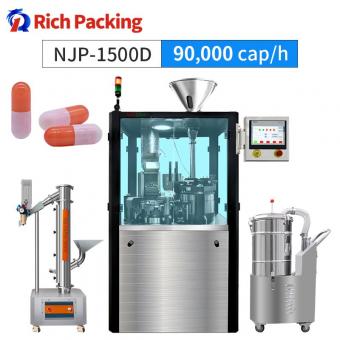
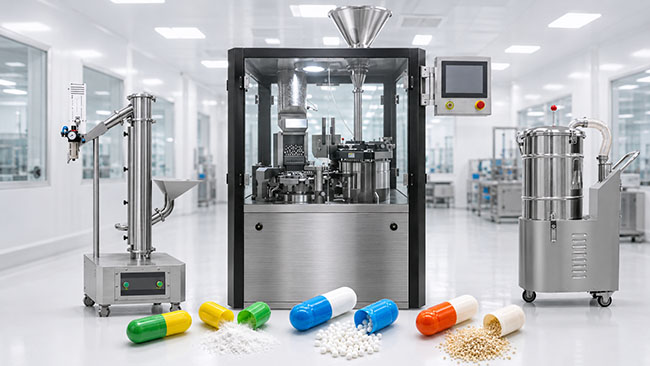
An automatic capsule filling machine for powder, granule, and pellet applications typically feeds empty capsules, separates the cap and body, doses the fill material, closes the capsule, rejects incomplete units, and discharges the finished capsules.
The machine alone does not determine fill consistency. Material properties, formulation preparation, equipment setup, production conditions, and in-process control all affect filling performance.
As a pharmaceutical and packaging equipment manufacturer, Rich Packing supplies capsule filling equipment for powder, granule, and pellet applications. The equipment configuration needs to match the material being processed rather than treating every capsule fill as the same type of powder.
Can you open a capsule and take the powder? Sometimes, but the answer starts with what is inside the capsule.
People may want to open capsules because they are difficult to swallow, because they think the shell is unnecessary, because they want to use only part of the contents, or because they have dietary or religious concerns about gelatin. None of these reasons by itself tells you whether the contents are suitable for use outside the shell.
Immediate-release powder, modified-release pellets, delayed-release granules are different formulations. A capsule shell can sometimes be opened while the material inside still needs to remain intact.
The clearest rule is simple: do not judge a capsule only by how easily its shell opens. Check the formulation and the specific product instructions.
Sometimes, but a hard capsule that can be physically opened is not automatically suitable for use without its shell. Check the formulation and specific instructions first.
Some formulations allow this. Powders, granules, and coated pellets behave differently in water, so the specific instructions matter.
Some capsule contents can be mixed with suitable soft food when specifically permitted. This does not apply to every capsule.
A two-piece hard gelatin capsule can often be pulled apart. Whether the contents are suitable for use outside the shell is a separate question.
No. Hard capsules can contain powder, granules, pellets, coated particles, or combinations of these materials.

29+ years in pharmaceutical machinery, covering capsule filling, tablet pressing, blister packaging, tablet and capsule counting, cartoning, GMP production, and overseas machine service.

Email : manager@richpacking.cn
Building D, No. 226, Beishan Qiaotou Street, Haizhu District, Guangzhou City, Guangdong Province, China


 IPv6 network supported