






 Home
Home Products
29+ years in pharmaceutical machinery, covering capsule filling, tablet pressing, blister packaging, tablet and capsule counting, cartoning, GMP production, and overseas machine service.

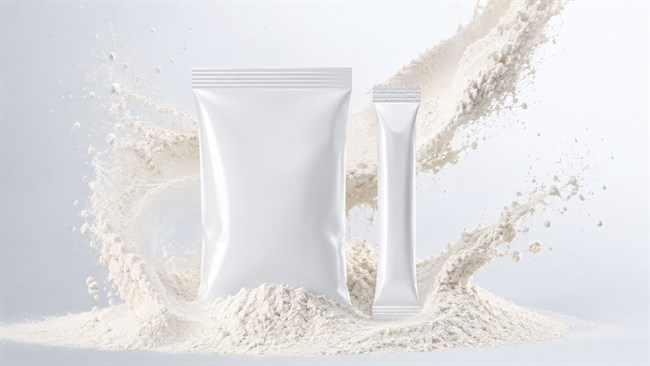
Powder sachet packaging requires more than simply filling powder into a small bag. Stable production depends on how the powder moves through the sachet packing machine, how accurately each dose is measured, and whether the package can maintain a reliable seal after production.
Different powders behave differently during packaging. Pharmaceutical powders, probiotics, electrolyte blends, coffee, nutritional supplements, and seasoning powders can vary greatly in flowability, density, moisture sensitivity, and dust generation. These differences directly affect filling accuracy, seal quality, production efficiency, and finished-pack reliability.
A successful powder sachet packaging process depends on seven critical control areas: powder flowability, bulk density and particle size, moisture and dust behavior, filling method, pack format, film and sealing control, and multi-lane consistency. Understanding these factors helps manufacturers reduce weight variation, leakage problems, product waste, and unnecessary downtime.
Powder sachet packaging is a form-fill-seal process used to divide powders or granules into individual small packs. During production, packaging film is unwound, formed into the required shape, filled with a measured dose, sealed, and cut into finished sachets.
This packaging method is widely used for pharmaceutical powders, nutritional supplements, electrolyte products, instant coffee, drink mixes, spices, and other single-dose products.
A sachet usually provides a wider package with more printing space and flexibility for different dose volumes. A stick pack has a narrow and elongated structure, making it suitable for smaller portions that need controlled pouring into cups or bottles.
However, the packaging format is only one part of the process. Product behavior, filling technology, film selection, sealing conditions, and production stability all determine whether the final package performs well.
Powders are often more difficult to handle than liquids or larger particles because their physical properties can change during production.
Fine powders can generate dust during filling and contaminate sealing areas. Some products absorb moisture and lose their original flowability. Others create static electricity and stick to sachet filling machine surfaces or packaging film.
Because of these differences, a powder sachet filling machine that performs well with one powder may not achieve the same results with another product. Stable powder sachet packaging requires understanding the relationship between the material, filling system, and packaging process.
The following seven factors determine whether a production line can achieve accurate filling, clean sealing, and consistent output.
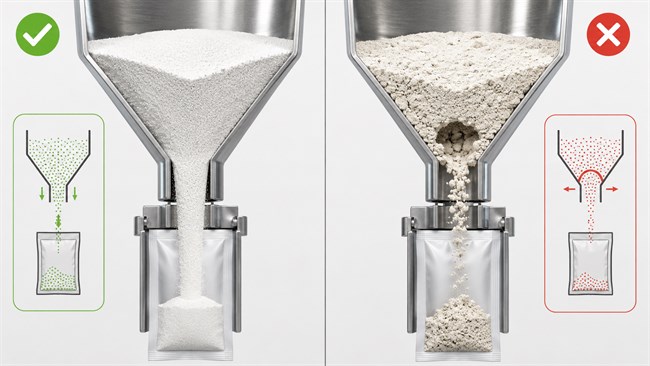
Powder flowability determines how easily the product moves from the hopper into the filling system. A powder with good flowability enters the dosing unit consistently, while a powder with poor flowability may bridge, stick to internal surfaces, or feed unevenly.
Unstable powder movement directly affects filling accuracy. When the product supply changes during production, the machine may produce inconsistent weights, empty packs, or require frequent operator adjustments.
Flowability depends on particle size, moisture content, formulation, particle shape, and electrostatic behavior. Even the same product can behave differently after long production periods because vibration and pressure inside the hopper can change powder movement.
Before selecting a powder sachet packaging machine, manufacturers should test the actual product under realistic conditions. The goal is to confirm whether the powder can maintain stable feeding throughout the production cycle.
Bulk density affects how much space a powder occupies and directly influences filling volume, sachet size, and dosing stability.
Two products with the same target weight may require different package dimensions because their densities are different. A low-density powder needs more space, while a compact powder requires less volume. If the package is too small, powder can remain close to the sealing area and increase the risk of contamination.
Density can also change during production. Powder near the bottom of a hopper may become more compact than material near the top. For volumetric filling systems, this can create weight variation because the machine measures volume rather than actual mass.
Particle size also affects packaging performance. Fine particles are more likely to create dust and stick to film surfaces, while inconsistent particle distribution can cause segregation during feeding.
Understanding density and particle size helps manufacturers choose suitable dosing methods, package dimensions, and operating parameters.
Moisture, static electricity, and dust generation are closely connected to powder packaging stability.
Moisture-sensitive powders can absorb water from the environment, causing clumping, reduced flowability, and inconsistent feeding. Production conditions such as humidity, storage time, and product exposure during filling can influence these changes.
Static electricity creates another challenge. Fine particles may attach to the hopper, auger, forming tube, or packaging film, increasing cleaning requirements and affecting dose consistency.
Dust is especially important because it directly influences sachet sealing. During filling, fine particles can remain around the product drop area. If they enter the sealing zone, they prevent the film layers from making complete contact and can create weak seals.
Effective powder dust control focuses on reducing unnecessary powder movement, controlling airflow, and ensuring enough time between filling and sealing. The goal is to maintain accurate dosing while keeping sealing surfaces clean.
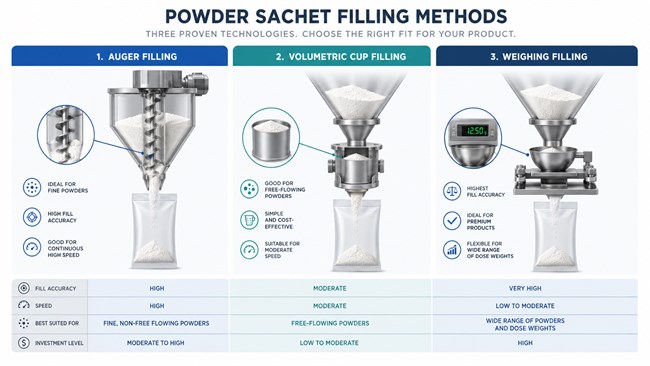
The filling method determines how the machine measures and transfers each powder dose into the sachet. Different powders require different filling technologies.
An auger filler is commonly used for fine or less free-flowing powders. A rotating screw controls the amount of product delivered into each pack. Its performance depends on auger design, rotation speed, powder density, and hopper conditions.
A volumetric cup filler measures powder by volume. It is often suitable for free-flowing powders and granules because of its simple structure and high-speed operation. However, changes in density can affect final weight.
Weighing systems measure actual product mass and can provide better control for applications with strict weight requirements. The disadvantage is usually higher system complexity.
|
Filling method |
Suitable products |
Main advantage |
Main limitation |
|
Auger filler |
Fine or cohesive powders |
Stable dosing control |
Requires product calibration |
|
Volumetric cup filler |
Free-flowing powders and granules |
Simple and fast |
Sensitive to density changes |
|
Weighing filler |
High-value products |
Direct weight measurement |
More complex |
The correct filling method should be selected according to powder characteristics, required accuracy, cleaning needs, and production goals rather than speed alone.
Sachets and stick packs are both common formats for single-dose powder packaging, but their structures support different product requirements.
A sachet usually provides a wider package with more printing space and greater flexibility for different dose volumes. It is often selected when products need more information on the pack, a larger opening, or a wider range of filling volumes.
A stick pack has a narrow and elongated shape. It is commonly used for smaller doses such as electrolyte powders, coffee, supplements, and drink mixes. The narrow structure allows users to pour the product into a bottle or cup with better control.
The choice between sachet and stick pack should consider powder volume, bulk density, user experience, film consumption, printing requirements, and production capacity.
|
Selection factor |
Sachet |
Stick pack |
|
Shape |
Wider and flatter |
Narrow and elongated |
|
Dose flexibility |
Suitable for more dose ranges |
Better for smaller portions |
|
Printing area |
Larger |
More limited |
|
Pouring experience |
Depends on opening design |
Controlled pouring |
Neither format is automatically better. The suitable choice depends on the product characteristics and the final usage requirements.
Packaging film and sealing conditions determine whether a sachet can protect the product during storage and transportation.
A typical film structure may include printing layers, barrier layers, and a heat-seal layer. The selected material should match the product requirements. Moisture-sensitive powders need effective moisture protection, while some products require stronger oxygen or light barriers.
One of the most common causes of powder sachet leakage is contamination in the sealing area. During filling, fine powder particles may enter between the film layers. When the sealing jaws close, the powder prevents complete contact and creates weak areas.
Other factors affecting sealing performance include sealing temperature, pressure, sealing time, film tension, and film compatibility.
Increasing sealing temperature alone cannot solve all sealing problems. If powder remains in the seal area, excessive heat may damage the film without creating a reliable seal.
Stable sachet sealing requires testing the actual powder, packaging film, sachet packing machine(or stick packing machine) speed, and sealing parameters together.
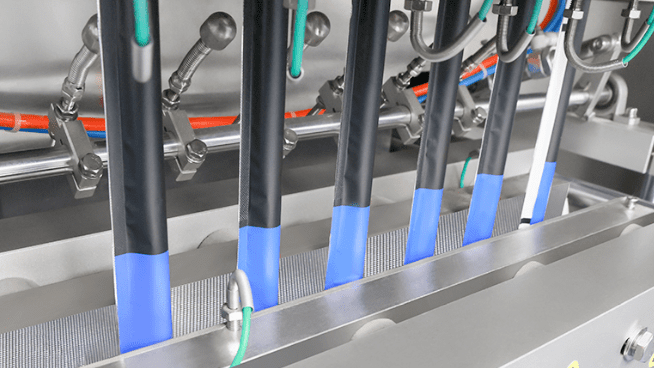
A multi-lane powder sachet packaging machine(or multi-lane stick filling machine) increases production output by forming and filling several packs during each cycle. However, higher output also requires stronger control of consistency.
Each lane needs stable feeding, filling accuracy, film positioning, sealing performance, and cutting accuracy. A machine may achieve an acceptable overall average while one lane repeatedly produces overweight or underweight packs.
For this reason, quality inspection should evaluate not only total production results but also differences between individual lanes.
The same applies to sealing. Temperature distribution, pressure, or film movement can vary across a wide sealing system and create different seal quality between lanes.
Production performance should be measured by qualified output rather than maximum machine speed alone. Reject rate, film waste, cleaning time, changeover time, and unplanned downtime all influence real production efficiency.
Weight variation in powder sachet filling usually comes from several connected factors.
Changes in powder density can affect volumetric dosing. Hopper level changes can influence feeding conditions. Powder bridging or unstable agitation can interrupt the product flow into the filling system.
Machine speed can also influence accuracy. At higher speeds, the available time for powder movement and stabilization becomes shorter. If the product does not feed consistently, weight variation may increase.
Different raw material batches may also have differences in moisture, particle size, and density. Therefore, production settings should always be verified when product conditions change.
The solution is not only adjusting the target weight. Stable filling requires control of powder properties, feeding conditions, and machine parameters together.
Finished sachets should be checked for filling accuracy, seal quality, appearance, and package condition.
Weight inspection should evaluate both average weight and variation between individual packs. For multi-lane machines, samples from each lane should be checked to identify differences that may be hidden by overall averages.
Seal quality inspection can include visual checks, seal strength testing, compression testing, or leakage testing depending on the product requirements.
Appearance checks should confirm:
● Correct sachet dimensions;
● Stable seal width;
● Accurate cutting position;
● Correct printing and coding;
● No visible powder contamination.
A sachet that looks acceptable immediately after production can still fail during transportation or storage. Testing should consider vibration, stacking pressure, humidity, and temperature changes.
Choosing a powder sachet packaging machine requires understanding both the product and production requirements.
Important factors include powder flowability, bulk density, particle size, moisture sensitivity, dust generation, target dose, acceptable weight variation, packaging film structure, required output, and cleaning requirements.
The number of lanes should be selected according to realistic production needs. More lanes can increase capacity, but they also require better control of filling, sealing, and inspection.
Whenever possible, the actual powder and packaging film should be tested before final machine selection. A short test may not reveal problems that appear during longer production runs.
A proper evaluation should confirm filling stability, sealing performance, cleaning requirements, changeover efficiency, and finished-pack quality.
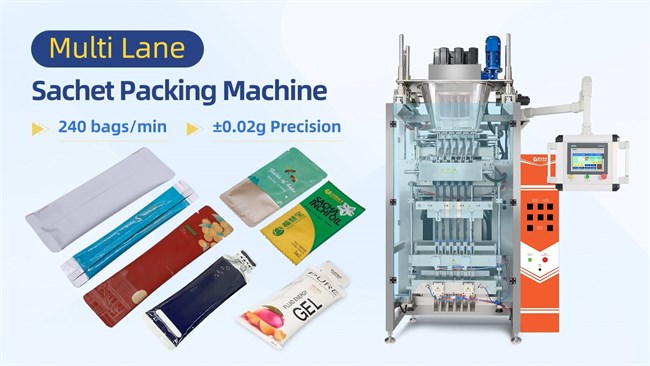
Reliable powder sachet packaging depends on the connection between powder characteristics, filling technology, packaging materials, and production control.
Powder flowability affects feeding stability. Bulk density and particle size influence dosing performance. Moisture, static, and dust behavior affect cleanliness and sealing. The filling method determines dose accuracy. Pack format influences material usage and user experience. Film and sealing control protect package integrity. Multi-lane consistency determines whether high-speed production can maintain stable quality.
Manufacturers should evaluate filling accuracy, seal reliability, production efficiency, and long-term stability together. Selecting equipment based only on maximum speed can lead to more waste, downtime, and quality issues.
Backed by more than 29 years of packaging machinery experience and projects delivered to customers worldwide, Rich Packing understands how powder characteristics, packaging materials, and production requirements influence equipment performance.
Powder Sachet Packaging FAQ
What is powder sachet packaging?
Powder sachet packaging is a form-fill-seal process that measures powder into individual sachets or stick packs before sealing and cutting each package.
Which filling method is suitable for fine powder?
Auger filling is commonly used for fine or less free-flowing powders. The final choice depends on product density, flowability, dose requirements, and accuracy targets.
Why do powder sachets leak?
Leakage often occurs when powder contaminates the sealing area. Incorrect sealing temperature, pressure, time, film selection, or film tracking can also reduce seal strength.
Are stick packs suitable for every powder?
No. The correct format depends on powder volume, flowability, dose size, pouring requirements, and packaging information.
How can powder filling accuracy be improved?
Accuracy improves when powder properties, hopper conditions, filling settings, machine speed, and production conditions remain stable.
References
1. United States Pharmacopeia (USP) - Pharmaceutical quality standards and guidance
https://www.usp.org
2. U.S. Food & Drug Administration (FDA) - Guidance documents for pharmaceutical manufacturing and quality requirements
https://www.fda.gov/regulatory-information/search-fda-guidance-documents

29+ years in pharmaceutical machinery, covering capsule filling, tablet pressing, blister packaging, tablet and capsule counting, cartoning, GMP production, and overseas machine service.

Email : manager@richpacking.cn
Building D, No. 226, Beishan Qiaotou Street, Haizhu District, Guangzhou City, Guangdong Province, China


 IPv6 network supported