






 Home
Home Products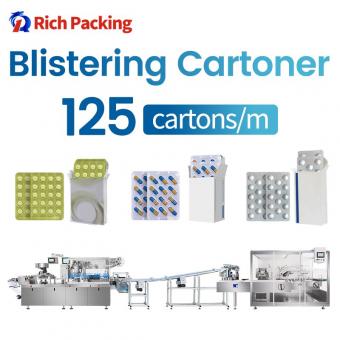
29+ years in pharmaceutical machinery, covering capsule filling, tablet pressing, blister packaging, tablet and capsule counting, cartoning, GMP production, and overseas machine service.

IQ OQ PQ validation gives pharmaceutical teams documented evidence that equipment is installed correctly, operates within defined limits, and performs consistently under real production conditions. In pharmaceutical equipment qualification, this evidence matters before a machine is released for GMP production, before a new packaging line starts batch work, and before QA signs off on equipment that can affect product quality, traceability, or batch release.
The three stages have different jobs. IQ confirms that the equipment is installed as specified. OQ confirms that the machine functions across its intended operating range. PQ confirms that the equipment performs reliably with real product, real packaging materials, trained operators, and approved procedures.
This sequence applies to capsule filling machine, tablet press, blister packaging machine, tablet and capsule counting machine, cartoning machine, induction sealing machine, labeling system, inspection unit, and other production or packaging equipment. The details change by machine type, but the qualification logic stays the same: prove the equipment is suitable for its intended use, and document the proof clearly enough for production, QA, engineering, and audit review.
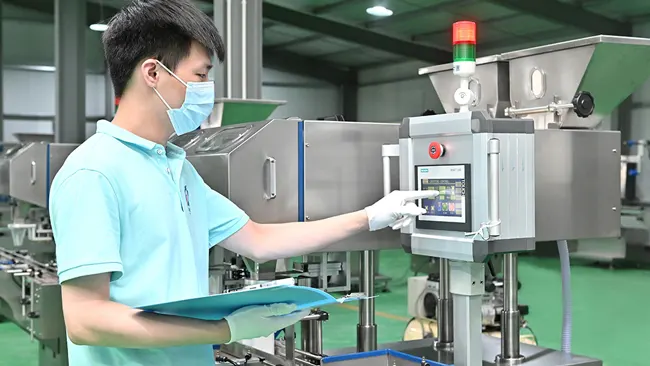
In pharma, qualification is the documented process of showing that equipment, utilities, systems, or facilities are suitable for their intended use. IQ OQ PQ validation sits inside that wider qualification and validation lifecycle. It does not replace process validation, cleaning validation, preventive maintenance, batch records, or daily GMP checks. It creates the equipment evidence that those later controls depend on.
A useful qualification plan starts with one question: what does this equipment need to do in real production?
A capsule filling machine needs to dose powder, pellets, or granules into capsules within acceptable limits. A tablet press needs to compress tablets at the required hardness, thickness, weight, and output speed. A blister packaging machine needs to form cavities, feed products, seal lidding material, print or code correctly, and cut finished blister cards. A counting line needs to separate, count, fill, cap, seal, label, and reject bottles accurately. A cartoning machine needs to open cartons, insert products and leaflets, close cartons, and maintain code readability.
Because each machine has different quality risks, pharmaceutical equipment qualification should not be copied from one project to another. The acceptance criteria should match the product, packaging material, machine design, output target, inspection points, and GMP risk level.
The title promises 7 critical checks, so the qualification logic should be clear from the start. These checks are not separate from IQ, OQ, and PQ. They are the practical points that should be covered across the three qualification stages.
|
Critical Check |
Main Stage |
What It Proves |
|
1. Intended use and URS match |
Before IQ / IQ |
The machine matches the approved user requirement and production purpose |
|
2. Installation and utilities |
IQ |
The machine is installed correctly with proper power, air, layout, and environment |
|
3. Documentation and calibration |
IQ |
Manuals, drawings, certificates, and calibrated instruments are available |
|
4. Safety, alarms, and interlocks |
OQ |
Operators and product flow are protected by verified machine functions |
|
5. Operating range and challenge tests |
OQ |
The equipment works at defined speeds, limits, and process settings |
|
6. Product quality and reject control |
OQ / PQ |
Bad packs, wrong counts, missing items, or unreadable codes can be detected and rejected |
|
7. Real production consistency |
PQ |
The equipment performs consistently during actual production runs |
These 7 checks make IQ OQ PQ validation practical instead of only theoretical. A missing calibration certificate, weak reject confirmation, unstable sealing parameter, or untested machine alarm can become a batch problem later. For QA and engineering teams, the value of equipment qualification is not the number of pages in the file. It is whether the file proves the machine was installed correctly, challenged properly, and released with defensible evidence.
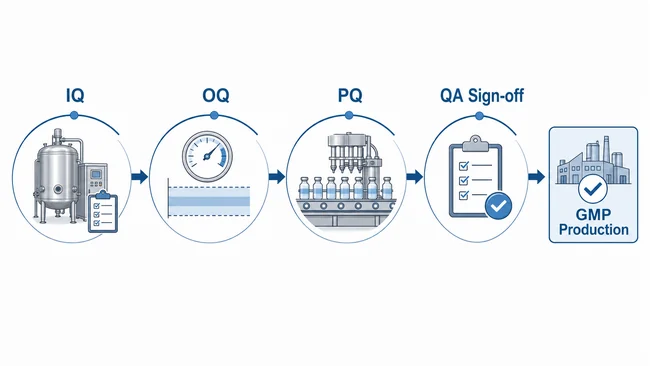
Installation Qualification, or IQ, proves that equipment has been delivered, installed, connected, and documented according to approved requirements. IQ is usually completed before operational testing begins.
For pharma equipment, IQ should confirm the basics first: machine model, serial number, installation location, utilities, layout, electrical connection, compressed air supply, safety guarding, and environmental requirements. If the equipment needs vacuum, chilled water, dust extraction, clean compressed air, or network connection, those items should be checked and recorded.
IQ also covers documentation. This includes operation manuals, maintenance manuals, electrical drawings, pneumatic diagrams, spare parts lists, material certificates where relevant, FAT or SAT records, calibration certificates, and supplier documents. For imported equipment or complex packaging lines, this documentation matters because engineering and QA teams need a reliable reference when troubleshooting, validating, training operators, or answering audit questions.
For example, a blister packaging machine IQ should confirm forming, sealing, feeding, coding, cutting, and waste collection modules are installed according to specification. A counting line IQ should confirm the bottle unscrambler, electronic counter, desiccant inserter, capping machine, induction sealer, labeling machine, and reject system are correctly positioned and connected. A cartoning machine IQ should confirm carton magazine setup, product feeding path, leaflet feeder, coding unit, guarding, sensors, and discharge area.
The goal of IQ is not to prove full production performance. It proves that the equipment is physically and technically ready for functional testing.
Operational Qualification, or OQ, proves that the equipment operates as intended across its approved operating range. If IQ answers whether the machine was installed correctly, OQ answers whether the machine functions correctly before real production begins.
For pharmaceutical equipment qualification, OQ should test normal functions, boundary conditions, alarms, interlocks, controls, and operator settings. The team should not only press the start button and watch the machine run. They should test whether the equipment responds correctly when speed changes, sensors detect abnormal conditions, doors open, guards are removed, air pressure drops, reject points are triggered, or parameters move toward defined limits.
On a blister packaging machine, OQ can include forming temperature range, sealing pressure, sealing temperature, web alignment, coding function, cutting accuracy, batch code readability, and reject response. On a tablet and capsule counting line, OQ should check counting sensor response, bottle indexing, no-bottle-no-fill logic, cap detection, aluminum foil sealing response, labeling position, and reject confirmation. On a cartoning machine, OQ should test carton opening, leaflet feeding, product presence detection, carton closing, missing leaflet rejection, overload protection, and emergency stop response.
OQ is also where HMI settings and access control become important. If operators can freely change speed, temperature, count quantity, recipe data, or alarm settings without control, the equipment can create GMP risk after qualification. Strong OQ acceptance criteria are measurable. A better criterion states the approved speed range, sensor response, alarm condition, reject accuracy, temperature tolerance, pressure range, or repeatability requirement.
Performance Qualification, or PQ, proves that the qualified equipment performs consistently with real product, real packaging material, trained operators, and approved procedures. PQ is closer to production reality than IQ or OQ. It should show that the equipment can deliver acceptable output under routine operating conditions.
For packaging equipment, PQ usually focuses on finished-pack quality and repeatability. The team should check product count, fill accuracy, blister seal integrity, coding readability, carton closure, label placement, reject accuracy, line speed stability, downtime patterns, and final pack appearance. The exact checks depend on the machine and product.
A capsule filling machine PQ can focus on capsule weight consistency, capsule locking, powder leakage, damaged capsules, and stable operation at the selected production speed. A tablet press PQ can check tablet weight, hardness, thickness, friability, appearance, and compression stability. A blister packaging machine PQ can check cavity forming, product feeding, sealing quality, perforation, cutting, batch coding, and leak test results. A counting line PQ can check bottle count accuracy, cap tightness, induction seal quality, label position, and rejected-bottle records.
PQ should reflect routine production: approved material, trained staff, normal line settings, actual batch documents, and reasonable run duration. If the machine only works during a short supplier demonstration but becomes unstable during continuous operation, the qualification has not answered the real production question.
IQ OQ PQ validation becomes clearer when applied to actual machines.
For a capsule filling machine, IQ checks installation, vacuum connection, compressed air, tooling, manuals, calibration, and safety guards. OQ tests dosing station movement, filling settings, capsule separation, capsule locking, alarms, and speed range. PQ confirms that filled capsules meet weight, appearance, locking, and output consistency requirements.
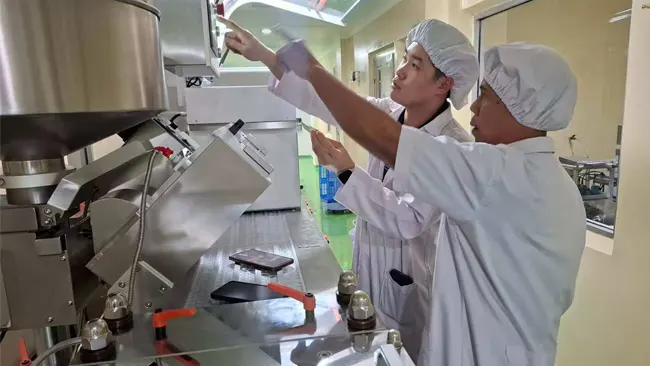
Format change should also be considered in qualification planning. Rich Packing capsule filling machines use a Quick-Change Filling Rod design, with mold change time around 15 minutes under proper operating conditions. During IQ OQ PQ validation, the point is not only faster changeover. The team should also confirm that tooling can be installed repeatedly, locked correctly, and returned to stable filling accuracy after changeover.
For a tablet press, IQ verifies installation, electrical connection, turret, punches and dies, guarding, lubrication points, and documentation. OQ tests pre-compression, main compression, force monitoring, speed range, reject function, emergency stop, and alarm logic. PQ proves tablet weight, hardness, thickness, friability, and appearance remain within specification during production.
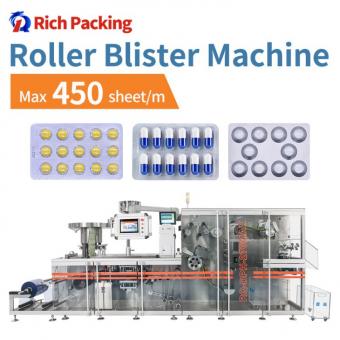
For a blister packaging machine, IQ confirms forming, sealing, feeding, coding, cutting, and waste modules are installed correctly. OQ tests temperature, pressure, alignment, coding, alarm response, and reject logic. PQ proves finished blisters meet seal integrity, appearance, coding, cutting, and product presence requirements. On blister equipment with drawer-slot modular molds, full mold installation can be reduced to about 10 minutes. Qualification should still verify that forming, sealing, coding, cutting, and alignment return to repeatable positions after mold reinstallation.
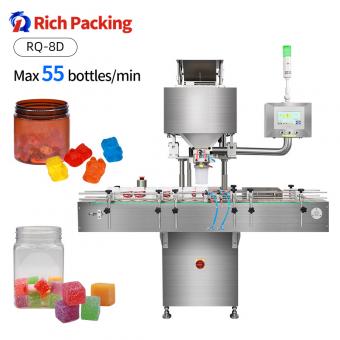
For a tablet and capsule counting line, IQ checks each connected unit: bottle unscrambler, counter, desiccant inserter, capping machine, induction sealer, labeling machine, and reject station. OQ tests bottle handling, counting sensors, no-bottle-no-fill logic, cap detection, seal response, label position, and rejection. PQ confirms count accuracy, sealed bottle quality, label accuracy, and stable line output.
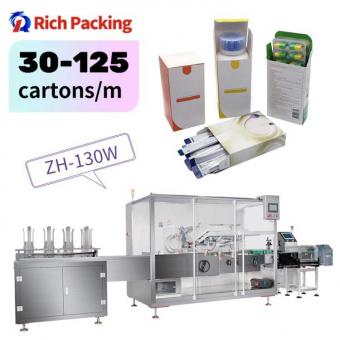
For a cartoning machine, IQ checks carton magazine, product feeder, leaflet feeder, coding unit, sensors, guards, and discharge area. OQ tests carton opening, product loading, leaflet insertion, carton closing, missing-product rejection, and machine alarms. Rich Packing cartoning equipment can handle some product size changes with about 3 to 5 main change parts, depending on carton and product format. OQ should still verify carton opening, leaflet insertion, product loading, carton closing, and rejection after each approved format setup.
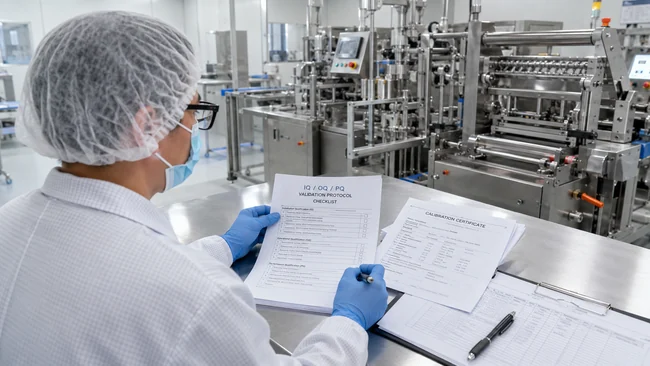
IQ OQ PQ validation is only useful when the documents are complete, traceable, and easy to review. Before QA approves pharmaceutical equipment qualification, the file should show what was planned, what was tested, what passed, what failed, and how deviations were handled.
A practical qualification file usually includes the approved protocol, user requirement specification, supplier documents, FAT or SAT records, installation records, calibration certificates, test data, raw observations, deviation reports, training records, maintenance requirements, and final qualification report. For equipment with recipes, software controls, audit trails, or electronic records, access control and data integrity checks should also be reviewed.
Based on Rich Packing's 29 years in pharmaceutical packaging equipment and overseas commissioning work, qualification delays often come from small practical gaps: utility conditions that differ from the approved layout, incomplete calibration records, unstable feeding, unclear reject confirmation, or operator settings that are not controlled. This is why FAT/SAT records, machine manuals, spare parts lists, format-change checks, and operator training should be prepared before the qualification file reaches QA review.
QA should pay close attention to acceptance criteria. If criteria were changed after testing, the reason must be justified. If a deviation occurred, the report should explain the impact on product quality and whether retesting was required. If a test was skipped, the file should explain why the omission was acceptable.
A clean qualification package does not need to be large for the sake of size. It needs to be defensible.
IQ OQ PQ is a three-stage qualification process used to document that pharmaceutical equipment is installed correctly, operates as intended, and performs consistently under real production conditions. IQ checks installation, OQ checks machine functions and operating limits, and PQ checks real production performance.
For GMP-regulated pharmaceutical production, equipment that can affect product quality, safety, traceability, or batch release should be qualified before routine use. The exact qualification scope depends on the equipment, product risk, regulatory market, and company validation policy.
Equipment qualification proves that a machine or system is suitable for its intended use. Process validation proves that the overall process consistently produces product meeting predetermined quality requirements. Equipment qualification usually supports process validation, but it does not replace it.
FAT can support IQ or OQ when the tests are relevant, documented, and not affected by transport or site installation. However, site-specific checks such as utilities, layout, environmental conditions, final connections, and local operating procedures usually still need on-site verification.
The number of PQ runs depends on company procedure, product risk, equipment complexity, and regulatory expectations. Many teams use multiple successful runs to show consistency, but the acceptance criteria, sampling plan, and justification matter more than copying a fixed number without risk assessment.
IQ OQ PQ validation gives structure to pharmaceutical equipment qualification. IQ proves that the equipment is installed correctly. OQ proves that functions, alarms, limits, and controls work as intended. PQ proves that the machine performs consistently with real product and approved procedures. For production, QA, and engineering teams, the strongest qualification files are not the longest files. They are the ones that clearly prove the equipment is ready for GMP production.

29+ years in pharmaceutical machinery, covering capsule filling, tablet pressing, blister packaging, tablet and capsule counting, cartoning, GMP production, and overseas machine service.

Email : manager@richpacking.cn
Building D, No. 226, Beishan Qiaotou Street, Haizhu District, Guangzhou City, Guangdong Province, China


 IPv6 network supported