






 Home
Home Products
29+ years in pharmaceutical machinery, covering capsule filling, tablet pressing, blister packaging, tablet and capsule counting, cartoning, GMP production, and overseas machine service.

In pharmaceutical, food, and daily chemical packaging production, blister hot sealing wrinkles are one of the most common and troublesome quality issues. Many manufacturers are plagued by uneven sealing surfaces, oblique creases, and irregular folds during high-volume blister packaging production. These subtle yet problematic wrinkles not only ruin the aesthetic appearance of finished products but also lead to a series of practical production losses. Worse still, unqualified sealing quality may fail industrial standard inspections, affect product compliance, and damage brand credibility in the long run.
Most conventional aluminum PVC blister packing machines cannot solve the wrinkle problem fundamentally. Their unstable mechanical performance and outdated structural design make production highly dependent on skilled workers’ manual debugging and operating experience. Production quality fluctuates greatly, and it is difficult to maintain consistent, wrinkle-free sealing results in long-term continuous operation.
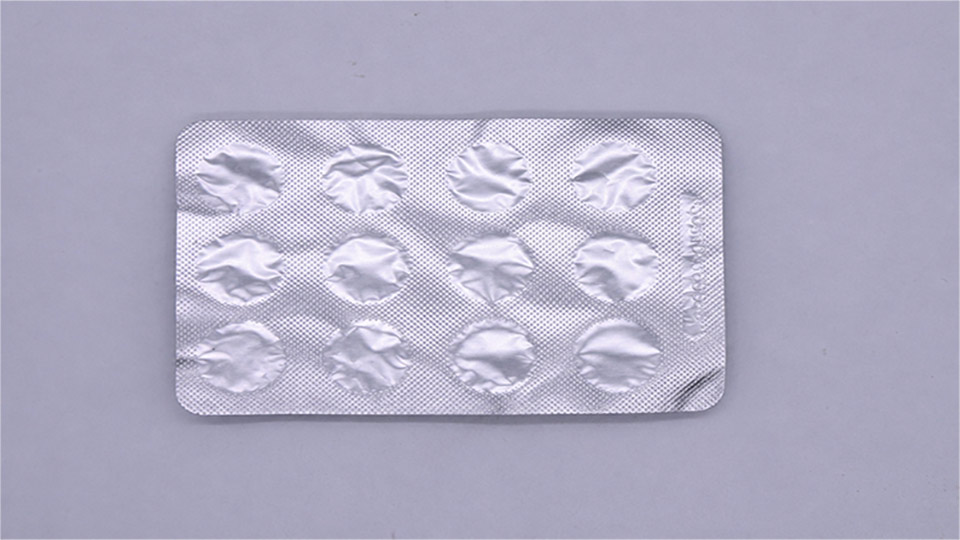 Aluminum foil wrinkle
To fundamentally eliminate wrinkles, it is essential to figure out why they occur during the hot sealing process. The main reasons are summarized as follows:
Traditional tablet blister packing machines adopt single-point heating or simple plate heating structures without precise regional temperature calibration. During continuous high-speed production, the sealing plate suffers from obvious temperature fluctuation, local overheating or insufficient heating. Different packaging materials including medicinal aluminum foil, rigid PVC and barrier PVDC films have distinct thermal expansion coefficients. Uneven heat distribution leads to inconsistent melting and softening degrees across the sealing area. Overheated areas produce excessive material shrinkage, while underheated areas fail to bond evenly, eventually forming irregular thermal wrinkles and wavy sealing edges.
Traditional blister sealing stations are difficult to achieve uniform and balanced pressure across the entire sealing surface. Uneven pressing force leads to partial over-extrusion and partial insufficient lamination during hot sealing. Unstable mechanical pressure directly causes extrusion creases, unclear sealing texture and irreversible pressure wrinkles, which cannot be completely eliminated by repeated manual debugging.
2.3 Unfixed aluminum foil tension caused by variable roll diameter
Aluminum foil features high density and heavy self-weight, making its unwinding tension extremely sensitive to roll diameter changes. During continuous production, the aluminum foil roll diameter gradually decreases, bringing continuous changes to unwinding gravity and traction resistance. Traditional fixed-tension structures cannot output adaptive tension compensation. The mismatched traction force causes tight-loose alternating feeding status, resulting in unbalanced surface stress, aluminum foil deviation, slack deformation and transverse wrinkles, which are the most stubborn quality defects in aluminum-plastic sealing production.
PVC presents inconsistent shrinkage rates and tensile resistance before and after heating, which is a natural material characteristic that traditional capsule blister packing machines fail to adapt to. Equipped only with ordinary fixed-speed motors without electronic induction correction and segmented servo traction, conventional blister packing machine cannot distinguish the tension requirements of unheated and heated PVC. Unstable vertical conveying and unbalanced pendulum tension lead to slack feeding, left-right deviation and material jitter. The offset and loose PVC materials are fixed in deformed status after hot pressing, forming regular oblique wrinkles, edge sagging folds and uneven molding defects.
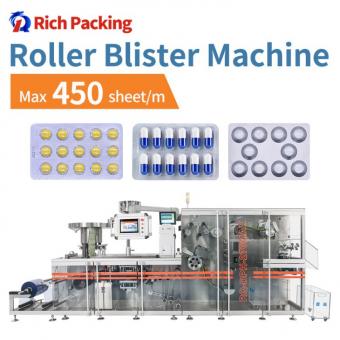
Corresponding to the four major causes of wrinkles, RQ-DPH-270MAX roller plate blister machine adopts four sets of professional and mature technical optimizations to achieve zero-wrinkle hot sealing.
Equipped with an advanced PID temperature control algorithm, our heating station adopts a multi-zone linear heating mode to deliver precise, stable and energy-efficient heating performance. Unlike traditional single-point heating with severe temperature deviation, the multi-section linear heating structure ensures uniform heat distribution across the entire sealing plate, featuring fast heating response and high thermal efficiency while effectively reducing power consumption.
The heating plate adopts an adjustable modular structure, which can flexibly adapt to molds of different sizes and specifications, realizing strong production compatibility. In addition, the heating surface is coated with high-quality Teflon flat coating, which greatly improves overall thermal conduction efficiency, ensures consistent material softening and melting, and completely avoids thermal deformation wrinkles and wavy sealing edges caused by local overheating or uneven heating.
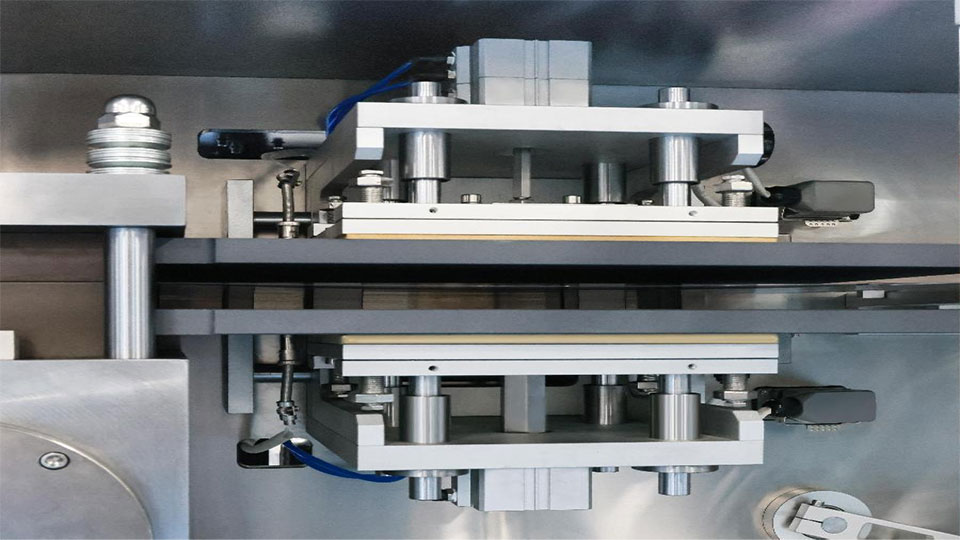
PID Heating System
Unlike traditional tablet blister packing machines that rely on cumbersome screw and nut manual adjustment for up-and-down pressure calibration, our blister packing machine adopts an automatic cylinder pressure adjustment design for the hot sealing station. The cylinder completes precise pressure adjustment automatically, which is simple, fast and highly efficient. It avoids inconsistent pressure and human errors caused by manual screw debugging. The balanced and stable sealing pressure ensures clear and neat sealing texture without extrusion deformation or creases, completely solving pressure-induced wrinkling defects and delivering flat, high-quality sealing results in continuous production.
Due to the high density and heavy weight of aluminum foil, the unwinding pressure and tension vary greatly with the remaining roll diameter during production. The changing roll size leads to unstable traction force, which easily causes tension deviation and permanent foil wrinkles. To tackle this industry pain point, RQ-DPH-270MAX blister sealing packing machine adopts an advanced cylinder module to output continuously variable and adaptive tension. The system automatically compensates tension differences caused by different aluminum foil roll diameters, maintaining constant and balanced working pressure under all operating scenarios. It realizes intelligent automatic tension adjustment for aluminum foil unwinding, completely eliminating foil slack, tension deviation and thermal deformation, and ensuring zero-wrinkle and stable aluminum foil feeding throughout long-term production.
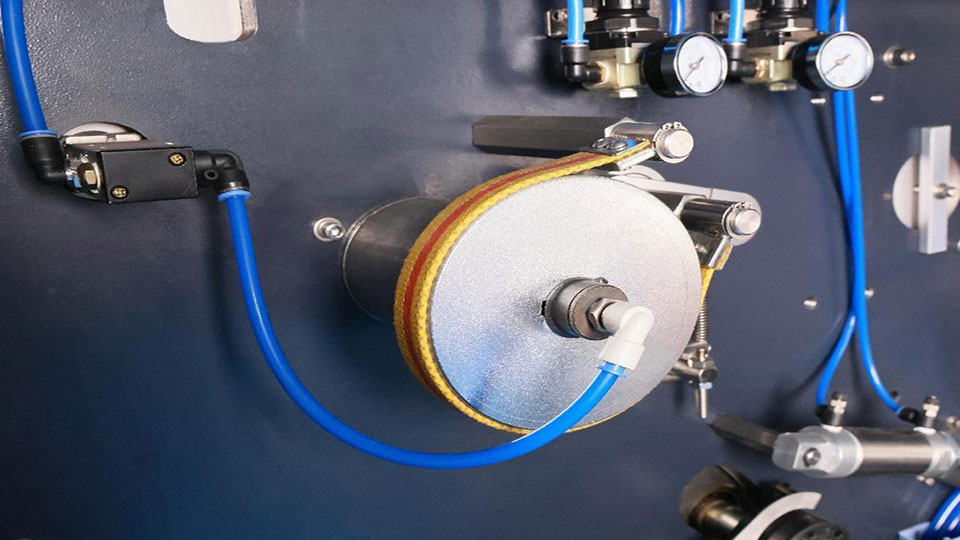
Constant Tension Control for Aluminum Foil Station
PVC material features different shrinkage ratios and tensile resistance before and after heating, which is the key cause of feeding deviation and wrinkling in traditional blistering machines. To solve this structural defect, our high speed blister packing machine is equipped with a professional electronic induction automatic feeding and deviation correction system. For unheated PVC materials, the feeding motor provides stable power support, while the continuous tension balance pendulum with a counterweight hammer realizes 90℃ vertical conveying.
This structure maintains constant and balanced tension for raw PVC materials, keeping the material flat and completely avoiding slack deformation and offset wrinkles before heating. For heated PVC materials with changed shrinkage and toughness, high-precision servo motors are adopted for synchronous traction and conveying. It realizes stable, fast and accurate material transmission and molding for materials with different thermal shrinkage characteristics, effectively eliminating feeding wrinkles, material deviation and uneven molding caused by inconsistent tension before and after heating.
The technical optimizations of this automatic blister packing machine bring direct and considerable economic benefits to packaging factories, helping you upgrade production quality and reduce comprehensive costs.
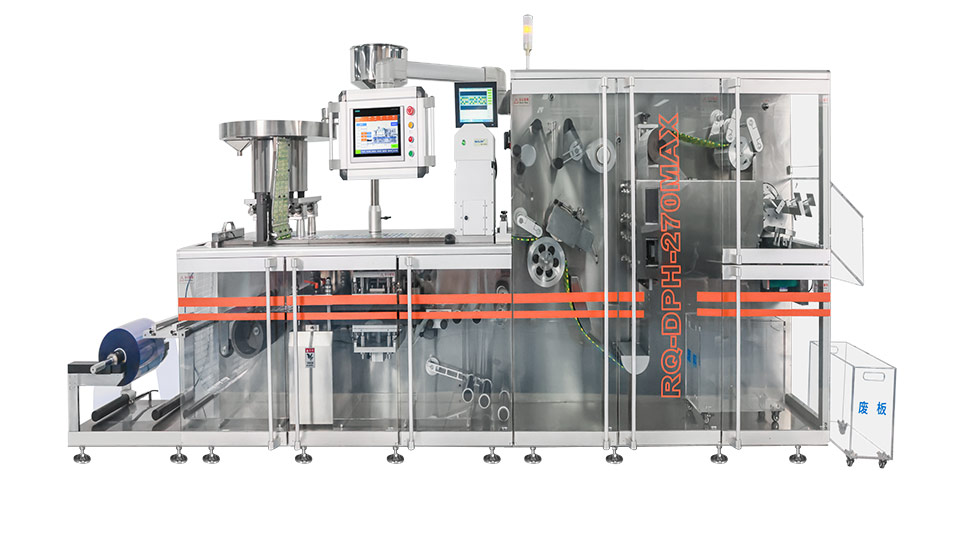 RQ-DPH-270MAX roller plate blister machine
Supported by four core technologies including precise PID constant temperature heating, automatic cylinder pressure stabilization, accurate PVC deviation correction and high-efficiency exhaust, this alu-PVC blister packing machine achieves fully flat sealing without bubbles, creases or concave-convex deformation. The finished blister packs feature uniform sealing edges and clear texture, fully meeting GMP medical standards, high-end food and daily chemical packaging specifications, and strict cross-border brand appearance requirements. It effectively improves product grade and market premium, helping manufacturers build a high-end brand image.
It completely eliminates common defects of traditional blistering machines such as thermal wrinkles, poor sealing and material deviation scrap, greatly reducing defective rates and raw material waste. Featuring automatic pressure adjustment, intelligent feeding correction and energy-saving heating control, the tablet blister packing machine no longer relies on senior technicians for repeated manual debugging and rework, significantly cutting labor cost, maintenance cost and production loss, and lowering overall factory operating expenses in long-term mass production.
The capsule blister packing machine supports long-term uninterrupted high-speed operation with fully intelligent control of temperature, pressure, tension and exhaust. It avoids frequent production stops, rework and line stagnation caused by unstable sealing quality. While maintaining 100% wrinkle-free high-standard sealing performance, it ensures continuous high-efficiency output, balancing high production speed and high qualification rate, and greatly improving factory shipment efficiency and order delivery capacity.
Equipped with an adjustable modular heating structure, segmented servo traction and self-adaptive pressure system, the pharmaceutical blistering machine is compatible with various packaging materials such as PVC, PET and aluminum foil, adapting to different material thicknesses, specifications and shrinkage rates. It is widely used for blister packaging of medical tablets, capsules, and daily chemical products. With flexible and fast parameter switching, it perfectly meets diversified and flexible production requirements of modern packaging factories.
 Capsule tablet softgel blister packing
Sealing wrinkles are no longer an unavoidable industry defect. Most blister wrinkle problems are caused by outdated equipment design rather than improper manual operation. By optimizing temperature control, pressure balance, tension stability and air exhaust efficiency, our professional aluminum plastic blister machine completely solves the core pain point of hot sealing wrinkles, helping packaging manufacturers achieve standardized, stable and high-quality automated production.
If you are troubled by blister sealing wrinkles, high defective rates and unstable production quality, welcome to contact us for free sample testing, parameter customization and factory inspection. We provide one-stop professional blister packaging solutions tailored to your production needs.

29+ years in pharmaceutical machinery, covering capsule filling, tablet pressing, blister packaging, tablet and capsule counting, cartoning, GMP production, and overseas machine service.

Email : manager@richpacking.cn
Building D, No. 226, Beishan Qiaotou Street, Haizhu District, Guangzhou City, Guangdong Province, China


 IPv6 network supported