






 Home
Home Products
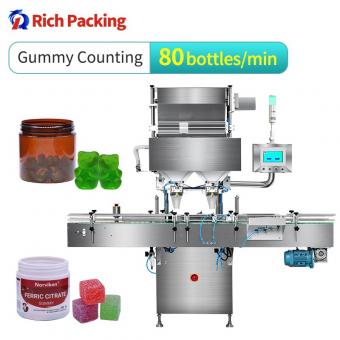
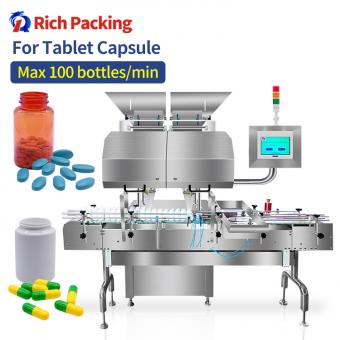
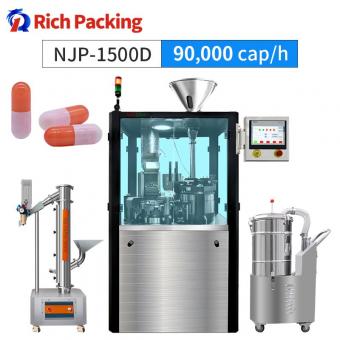
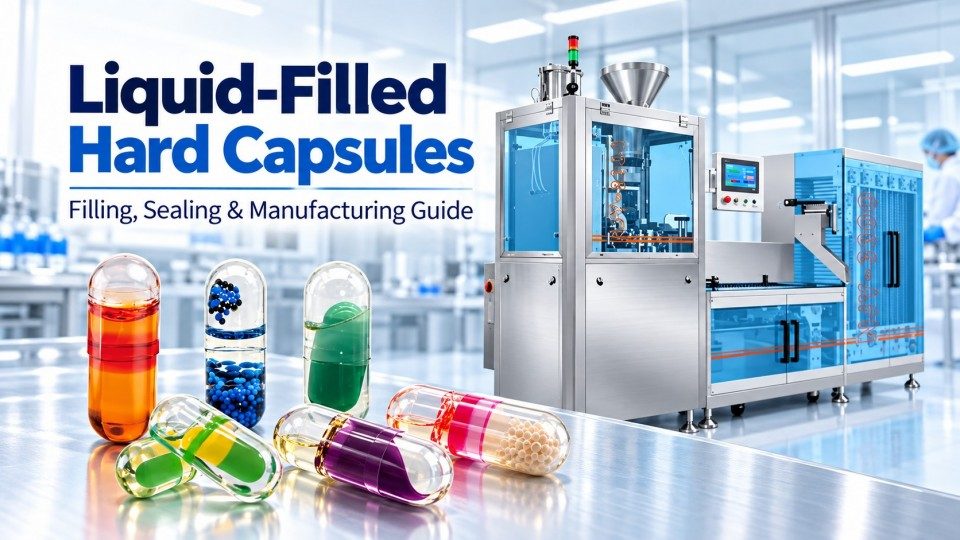
Liquid-filled hard capsules use a two-piece hard shell to hold compatible liquids, suspensions, or semisolids. After dosing, the cap and body are locked and, where the formulation requires it, sealed at the cap-body joint. Unlike powder filling, liquid capsule production puts tighter control on formulation flow, shell compatibility, dose repeatability, and seal integrity.
In liquid-filled hard capsule production, the formulation, dosing system, capsule shell, sealing method, and post-sealing conditions have to work together. This guide follows that process from formulation selection and filling through locking, sealing, drying or curing, inspection, and equipment choice.
What Are Liquid-Filled Hard Capsules?
Liquid-filled hard capsules (LFHCs) are preformed two-piece capsules with a longer body for the fill and a shorter cap that closes over it. They can use hard gelatin or polymer shells such as HPMC, but the formulation and process must be compatible with the selected shell.
Structure of a Liquid-Filled Hard Capsule
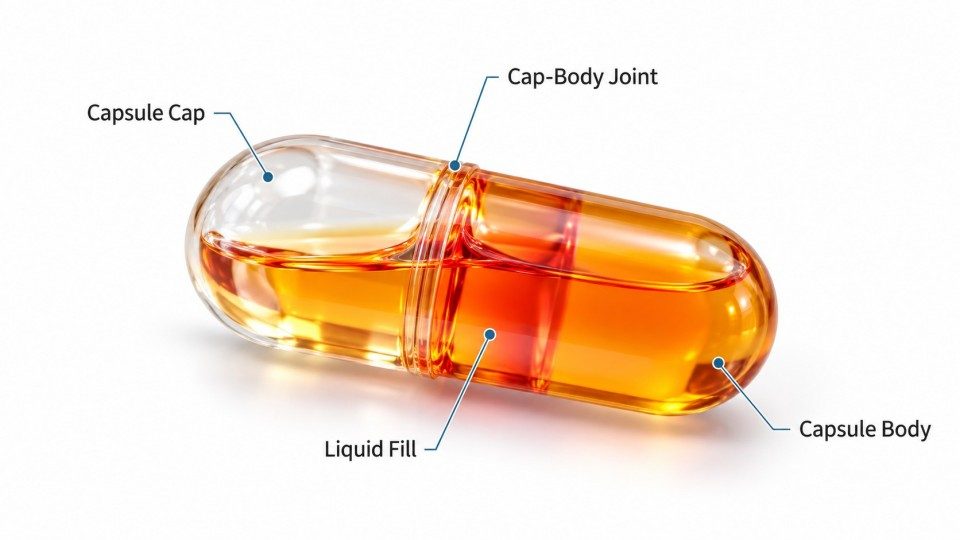
A liquid-filled hard capsule has four working parts:
- Capsule body: holds the metered formulation.
- Capsule cap: closes over the filled body.
- Liquid or semi-solid fill: the dosed formulation.
- Cap-body joint: the overlapping interface that provides mechanical closure and, when needed, receives the seal.
Locking joins the cap and body; sealing closes off the joint. For liquid fills, that extra seal can reduce leakage through the cap-body interface and limit unwanted ingress during handling and storage.
Gelatin vs HPMC Capsule Shells
Gelatin and HPMC do not behave the same around every liquid formulation. Moisture, solvents, excipients, and storage conditions can change shell brittleness, deformation, mass, or integrity, so shell choice has to be tested with the actual formulation.
In practice, neither gelatin nor HPMC is automatically the better option. Their moisture behavior and mechanical response differ, while full formulation-shell compatibility is evaluated in the next section.
Liquid-Filled Hard Capsules vs Softgels
Both LFHCs and softgels can carry liquids or semisolids, but they are made differently. A softgel forms a flexible shell around the fill during encapsulation; an LFHC starts with a preformed two-piece hard shell.
That difference changes the filling equipment, dosing method, shell behavior, and sealing step. LFHCs are useful when a product needs a hard-capsule format with a compatible liquid or semisolid fill.
What Can Be Filled Into Hard Capsules?
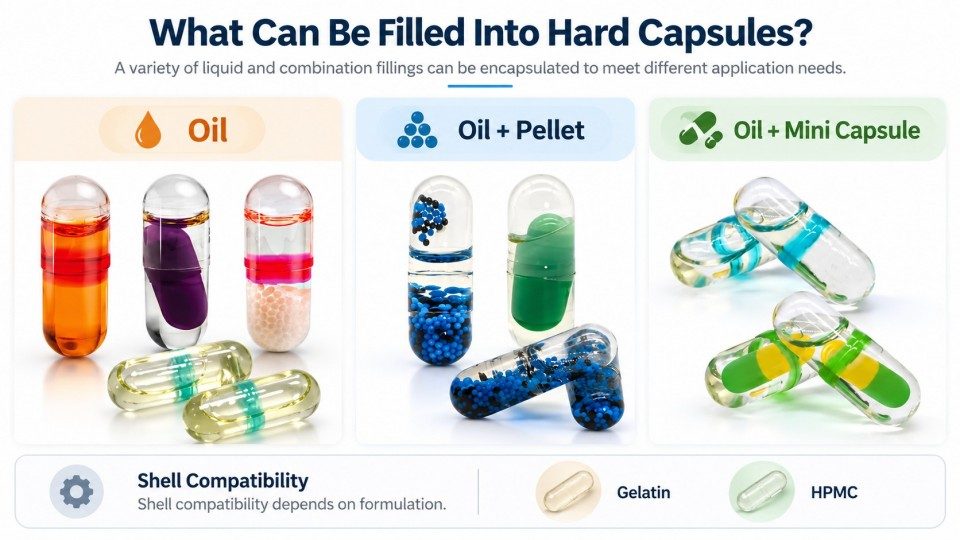
Hard capsules can hold oils, non-aqueous solutions, suspensions, and selected semisolids or pastes, but the formulation still has to be compatible with the shell, dosing system, and sealing process.
Oils and Lipid-Based Formulations
Oils and lipid-based fills are common LFHC applications because positive-displacement dosing can meter them accurately when their flow remains stable. But an oil is not automatically compatible with every hard capsule shell.
Lipid composition, surfactants, hygroscopicity, viscosity, and shell interaction can all change capsule integrity. Confirm compatibility with the intended formulation rather than the formulation category alone.
Solutions and Suspensions
Solutions are usually easier to dose when viscosity and composition stay stable. Suspensions add another control point: solids must remain evenly dispersed so the material reaching the pump and nozzle still represents the intended formulation.
For suspension filling, control mixing, residence time, settling, nozzle behavior, and dose repeatability. Once the formulation loses homogeneity, the liquid capsule filling machine cannot correct the composition difference downstream.
Semi-Solids and Pastes
Semi-solids and pastes can also be filled into hard capsules, but temperature and shear can change their flow quickly. Select the dosing system around the formulation's actual rheology, not its product label.
Ceramic or other positive-displacement pumps can suit viscous fills, but pump type, nozzle design, and operating conditions still need product-specific trials.
Formulation and Capsule Shell Compatibility
Before selecting the shell or machine, screen the formulation for the factors most likely to affect filling and capsule integrity:
- moisture and water activity;
- hygroscopicity;
- solvent compatibility;
- lipid and surfactant composition;
- viscosity and flow behavior;
- formulation temperature;
- shell deformation or brittleness;
- potential interaction between formulation and shell.
This screening matters because formulation components can change hard-capsule mechanical properties and integrity during filling and storage.
Formulations That Require Special Evaluation
Flag a formulation for extra testing when it is highly hygroscopic, has high water activity, contains shell-reactive solvents, changes viscosity sharply with temperature, contains suspended particles, entrains air, or strings at the nozzle. High water activity can soften or deform gelatin shells, so aqueous or strongly hygroscopic fills need especially careful compatibility work.
Do not choose the shell or liquid hard capsule filling machine from the formulation category alone. Evaluate the actual formulation, shell, dosing system, sealing method, and storage conditions as one process.
How Are Liquid-Filled Hard Capsules Manufactured?
Liquid filled capsule manufacturing follows a clear sequence: prepare the formulation, separate the capsule, meter the fill, and lock the shell, seal the joint, dry or cure the seal, inspect the capsule, and discharge the accepted product. Machines differ, but these control points remain closely linked.
Step 1: Formulation Preparation
Before production, characterize viscosity, homogeneity, temperature sensitivity, settling, air entrainment, and shell compatibility. These properties determine how the formulation behaves in the hopper, pump, nozzle, and capsule body.
Suspensions need stable dispersion throughout the run. Viscous fills need dosing conditions that limit stringing, dripping, and slow pump recovery.
Step 2: Empty Capsule Feeding and Separation
Empty hard capsules are fed, oriented, and separated into cap and body. The body must reach the filling position correctly while the cap is retained for locking after dosing. Reject capsules that fail to separate before dosing.
Step 3: Liquid Dosing and Filling
The dosing system meters the formulation into each capsule body. Positive-displacement systems, including piston and ceramic-pump designs, are common choices when they match the formulation's flow behavior.
Viscosity directly changes dosing behavior in hard capsule liquid filling: pump response, nozzle dripping, stringing, filling speed, and dose repeatability can all move with it. There is no useful universal viscosity or temperature limit; the operating window depends on the formulation, pump/nozzle design, and validated machine process.
During production, watch formulation condition, pump response, nozzle shutoff, capsule position, and fill consistency together. FDA guidance emphasizes controlled manufacturing conditions and appropriate in-process testing for capsule operations.
Step 4: Capsule Closing and Locking
After dosing, the machine brings the cap and body together to form the basic closed capsule.
Locking is not sealing. Mechanical locking holds the two shell parts together, but a liquid can still find a leakage path through the cap-body interface if the joint is not adequately sealed.
Step 5: Capsule Sealing
Sealing adds a barrier at the cap-body joint. Depending on the capsule and process, this may be an external band or another seam/fusion-type sealing method.
Step 6: Drying, Curing and Cooling
After sealing, the joint needs controlled conditions to dry, set, or cure. Cooling becomes a separate process need when a heated or thermosoftening fill must return to its target physical state; routine oils, solutions, and suspensions do not automatically need a distinct cooling step.
The liquid hard capsule filling system uses a vertical air-drying/cooling arrangement. Stabilize the seal without deforming the shell, disturbing the joint, or changing the fill state.
Step 7: Inspection and Rejection
Inspection should target defects that matter to product quality or line stability. Depending on the installed sensors, a line may check capsule presence, orientation, cap-body separation, closure, visible deformation, leakage, or seal appearance.
Step 8: Finished Capsule Discharge
Accepted capsules then move to downstream handling or packaging. Depending on the product, that can include capsule polishing, capsule sorting, capsule counting and bottling, blistering, or cartoning.
|
Manufacturing step |
Main control point |
|
Formulation preparation |
Homogeneity, viscosity, compatibility, air entrainment |
|
Capsule separation |
Correct cap/body separation and rejection of failures |
|
Liquid dosing |
Pump behavior, nozzle performance, dose consistency |
|
Closing/locking |
Cap-body alignment and mechanical closure |
|
Sealing |
Sealant condition, application uniformity, joint coverage |
|
Drying/curing/cooling |
Seal setting or curing; cooling when required by heated or thermosoftening fills |
|
Inspection |
Leakage, deformation, closure and process defects |
|
Discharge |
Controlled transfer to downstream operations |
How Are Liquid-Filled Hard Capsules Sealed?
Sealing protects the cap-body joint; it is a separate operation from simply locking the capsule.
Why Liquid-Filled Hard Capsules Require Sealing
A mechanically locked capsule still has an overlapping cap-body interface. With a liquid fill, that interface can become a leakage path, so the sealing process is used to reduce liquid escape and limit environmental ingress.
Where Sealing Glue Is Applied
In glue-based sealing, the material is applied around the cap-body joint or capsule seam. The exact contact area and application pattern depend on the shell and sealing technology.
External banding wraps a sealing band around the outside of the joint. Other processes apply sealing liquid directly at the seam and use controlled conditions to form an integrated closure. They solve the same problem, but they are not the same process.
How Sealing Glue Creates the Capsule Seal
The sealing material must reach and uniformly wet or interact with the target shell surfaces, then set, dry, or fuse into the intended barrier. Sealant condition, joint geometry, shell material, application pressure, and post-sealing treatment all affect the result.
What matters is uniform joint coverage and repeatable seal formation—not simply whether sealant is present.
Sealing-Glue Temperature and Application Uniformity
Where sealing liquid is temperature controlled, four variables matter together: sealant chemistry, viscosity, temperature, and application uniformity. If the sealant is too thick, too fluid, poorly conditioned, or unevenly applied, joint coverage becomes inconsistent. Set the working window for the actual shell, sealing formulation, and machine process.
Do not copy a sealing temperature from another capsule system. Validate the sealant condition on the formulation and machine actually being used.
Capsule Shell Compatibility During Sealing
The shell has to tolerate both the formulation and the sealing process. Moisture, solvents, heat, and drying conditions can alter shell behavior, so seal development and shell compatibility should be evaluated together.
Drying and Curing After Sealing
Post-sealing drying or curing brings the sealant to its intended physical state. The required time and conditions depend on the sealing chemistry, shell material, equipment, and formulation.
For process control, follow the seal in this order:
sealant condition → application uniformity → joint coverage → drying/curing → seal integrity
Common Liquid Capsule Filling and Sealing Problems
Start troubleshooting from the defect you can see, then trace it back to the process variable that can actually cause it.
|
Problem / symptom |
Likely causes |
First checks |
|
Fill-volume or fill-mass variation |
Pump instability, viscosity change, inconsistent formulation feed, capsule positioning |
Check formulation condition, pump response, nozzle timing and capsule positioning |
|
Liquid dripping |
Nozzle behavior, formulation viscosity, excessive stringing, poor shutoff |
Inspect nozzle, dosing timing, formulation condition and pump shutoff |
|
Capsule leakage |
Incomplete seal, poor joint coverage, shell incompatibility, damaged shell |
Inspect the cap-body joint, sealant application and shell condition |
|
Weak or uneven seals |
Sealant condition, uneven application, incorrect shell/process combination |
Check sealant preparation, application uniformity and post-sealing setting |
|
Capsule deformation or sticking |
Shell condition, formulation interaction, handling or drying conditions |
Check shell compatibility, environmental conditions and transfer points |
|
Feeding/separation failures |
Capsule orientation, shell variation, mechanical adjustment |
Check capsule feeding, separation detection and handling alignment |
Use the table below as a first-check guide; final settings still need to follow the validated product and machine process.
What Equipment Is Used for Liquid-Filled Hard Capsules?
A liquid capsule filling machine combines the handling, dosing, locking, and—on integrated lines—sealing and post-sealing steps needed for LFHC production. For projects requiring validation support, Rich Packing can provide FAT/SAT, IQ/OQ documentation, and operator training.
Liquid Capsule Filling Machine
The main machine feeds and separates empty capsules, meters the liquid, locks the shell, and, on integrated systems, passes capsules into sealing and post-sealing handling.
Liquid Dosing System
The dosing system controls how consistently the formulation reaches each capsule. Rich Packing liquid capsule filling machine uses servo-driven liquid dosing with ceramic-pump configurations; The configuration offers an output of up to 60,000 capsules/hour and filling error of ≤2% for that configuration.
Capsule Sealing System
The sealing system applies the selected sealant or performs the required seam-sealing operation. Its design has to match the capsule shell, formulation, sealant, and validated production conditions.
Drying, Curing and Cooling System
Post-sealing handling gives the joint time to dry, set, or cure before the capsule moves downstream. Cooling matters when the fill or sealing process uses heat
FAQ
Can hard capsules be filled with liquid?
Yes. Hard capsules can hold suitable liquids, solutions, suspensions, and selected semisolids when the formulation, shell, dosing process, and sealing method are compatible.
What liquids can be filled into hard capsules?
Common candidates include oils, lipid-based formulations, non-aqueous solutions, suspensions, and selected semisolids. Pumpability alone is not enough; shell compatibility and process stability still have to be confirmed.
Do liquid-filled hard capsules need to be sealed?
Usually, yes. Liquid-filled hard capsules commonly need an additional sealing step to reduce leakage risk at the cap-body joint. Mechanical locking and sealing are separate operations, and the sealing method depends on the capsule and process.
How are liquid-filled hard capsules sealed?
Common methods include external banding and seam/fusion-type sealing. In glue-based systems, sealing material is applied at the cap-body joint and then dried, set, or otherwise processed to form the seal.
Can HPMC capsules be used for liquid filling?
Yes, when the formulation and process are compatible with HPMC. Shell response can change with excipient composition, hygroscopicity, and storage humidity, so the intended formulation-shell combination should be tested under relevant conditions.
What is the difference between liquid-filled hard capsules and softgels?
Liquid-filled hard capsules use a preformed two-piece hard shell that is filled, locked, and sealed. Softgels form a flexible shell around the liquid or semisolid fill during encapsulation, so the equipment and manufacturing process are different.
What machine is used to fill liquid-filled hard capsules?
A liquid capsule filling machine meters the formulation into separated hard capsule bodies and integrate sealing, drying/cooling, inspection, and discharge. The right configuration depends on the formulation, shell, production scale, and sealing technology.
References
[1] Ma JH, Yang M, Zeng M, Chen XM, Lan J. A review on liquid-filled hard gelatin capsules. Zhongguo Zhong Yao Za Zhi. 2008;33(5):602-605. PubMed: https://pubmed.ncbi.nlm.nih.gov/18536390/
[2] Grüne L, Bunjes H. Suitability of phosphatidylcholine-based formulations for liquid filling in hard capsules. European Journal of Pharmaceutical Sciences. 2020;153:105470. https://doi.org/10.1016/j.ejps.2020.105470
[3] Nirale P, Arora S, Solanki A, Bhat J, Singh RK, Yadav KS. Liquid Filled Hard Shell Capsules: Current Drug Delivery Influencing Pharmaceutical Technology. Current Drug Delivery. 2022;19(2):238-249. https://doi.org/10.2174/1567201818666210301094400
[4] Koehl NJ, Shah S, Djouka Tenekam I, et al. Lipid Based Formulations in Hard Gelatin and HPMC Capsules: a Physical Compatibility Study. Pharmaceutical Research. 2021;38(8):1439-1454. https://doi.org/10.1007/s11095-021-03088-8
[5] U.S. Food and Drug Administration. Dosage Form Drug Manufacturers cGMPs: Guide to Inspections of Dosage Form Drug Manufacturers. FDA. https://www.fda.gov/inspections-compliance-enforcement-and-criminal-investigations/inspection-guides/dosage-form-drug-manufacturers-cgmps-1093


 IPv6 network supported