






 Home
Home Products
29+ years in pharmaceutical machinery, covering capsule filling, tablet pressing, blister packaging, tablet and capsule counting, cartoning, GMP production, and overseas machine service.

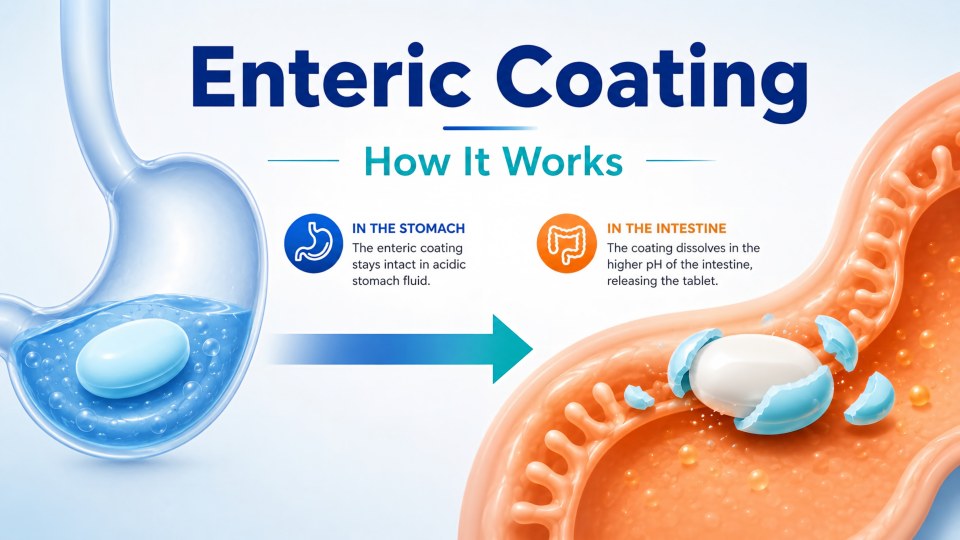
Enteric coating is a functional protective layer designed to keep a dosage form intact while it passes through the acidic environment of the stomach. After it reaches a suitable intestinal environment, the coating is designed to disintegrate, disrupt, or dissolve so the contents can be released. Enteric coating is most commonly associated with enteric-coated tablets, but the same principle also applies to pellets, granules, capsules, and other multiparticulate forms.
This type of coating is useful when a formulation should not release its contents in the stomach. Depending on the product design, it protects acid-sensitive ingredients, prevents premature release, or moves the start of release beyond the stomach. Achieving that function requires more than simply adding a film to the surface. The coating material, tablet or particle surface, film thickness, spraying, drying, and final film formation all contribute to how the finished enteric system performs.
This guide explains how enteric coating works, why it is used, the materials that create its acid-resistant behavior, and how the coating is applied during pharmaceutical production.
An enteric coating is a type of functional film coating specifically designed to resist gastric fluid. Unlike a conventional film applied mainly for appearance, handling, moisture protection, or taste masking, an enteric film has an additional job: it acts as a temporary barrier during the gastric stage and then allows release later in the gastrointestinal tract.
The broader question of film coating vs sugar coating vs enteric coating is mainly about coating purpose; here, the focus is how the enteric barrier functions. IUPAC defines enteric coating as a coating used on tablets, granules, pellets, and capsules to provide resistance to gastric fluids while allowing the dosage form to break down after entering the duodenum.
The key to this behavior is usually a pH-responsive polymer.
Many enteric polymers have very limited solubility under acidic conditions. When an enteric-coated tablet enters the stomach, the polymer film therefore remains largely intact and separates the tablet core from the surrounding gastric fluid.
As the dosage form moves into an environment with a higher pH, ionizable groups within the polymer change state and its solubility rises. Once conditions match the selected coating system, the film begins to dissolve or lose its integrity, allowing fluid to reach the tablet core and release to begin.
The basic sequence is:
Enteric-coated dosage form → stomach: coating remains intact → intestinal environment: pH changes → coating loses its barrier function → contents are released
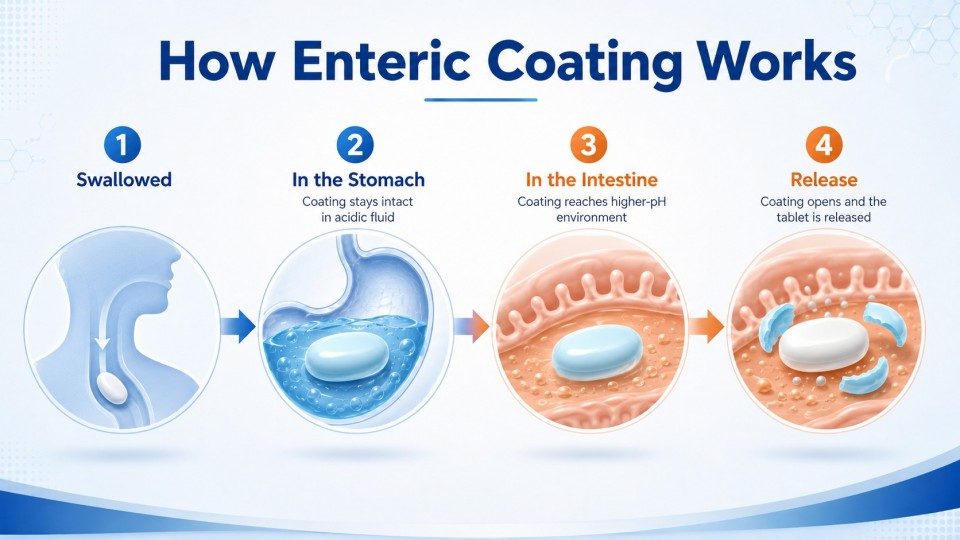
The exact point at which this happens is not identical for every enteric-coated product. Different polymer systems have different dissolution characteristics, and coating thickness, formulation design, processing conditions, and the surrounding gastrointestinal environment also affect performance. For this reason, enteric coating should not be described as a film that opens at one universal pH value.
It is also important to distinguish enteric coating from extended-release coating. Enteric coating primarily delays when or where release begins. Once the enteric barrier has opened, the contents can release relatively quickly unless another formulation feature is designed to slow the subsequent release.
Extended-release systems, by contrast, are specifically designed to reduce the rate of release over a longer period. The International Pharmacopoeia classifies gastro-resistant or enteric-coated tablets as delayed-release tablets, separate from sustained-release tablets.
This distinction explains why the term delayed release is closely associated with enteric coating, while it should not automatically be interpreted as slow or prolonged release.
This functional coating is used when the release location matters. The coating creates a temporary barrier so the formulation can pass through the stomach before release begins. In practice, the main purposes fall into three groups.
First, the coating protects ingredients that are unstable in strongly acidic conditions. Keeping the dosage form sealed during the gastric stage limits direct contact with the acidic environment.
Second, it prevents release in the stomach when the formulation is designed to begin releasing farther along the gastrointestinal tract. This is a location-control function rather than a slow-release function.
Third, enteric protection can be built into different dosage-form designs. A tablet core can receive a functional film, individual pellets or granules can be coated before further processing, and a capsule can use a gastro-resistant shell or contain enteric-coated particles.
|
Dosage form |
How enteric protection is applied |
Main production purpose |
|
Tablet |
A continuous enteric film surrounds the tablet core |
Keep the core protected during the gastric stage and start release later |
|
Pellet |
Individual pellets receive a functional coating |
Create a multiparticulate delayed-release system |
|
Granule |
Granules are coated before final dosage-form assembly |
Protect many small particles individually |
|
Capsule |
A gastro-resistant shell, external coating, or coated contents provide the barrier |
Achieve delayed release through the shell or capsule contents |
A tablet normally receives the functional layer after compression, while pellets or granules are coated as smaller individual units.
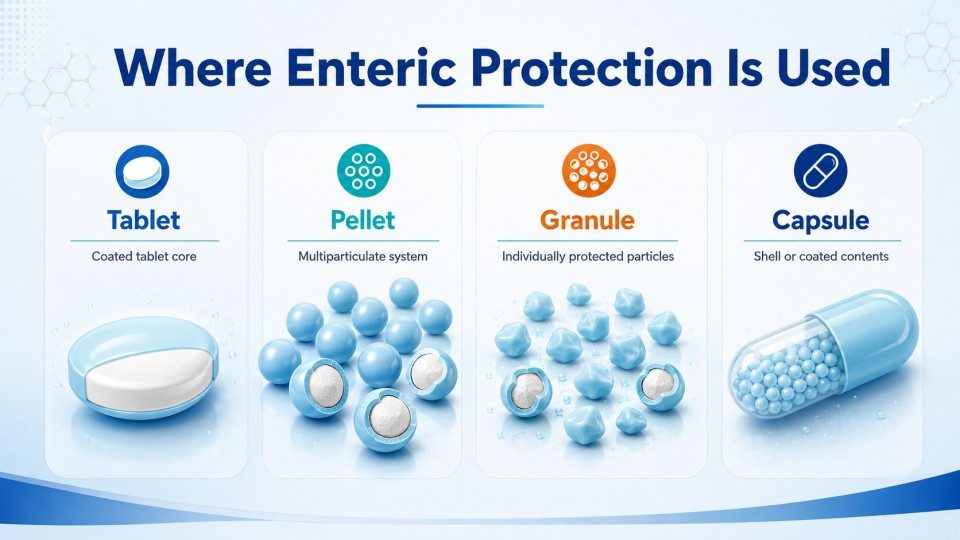
These coating materials are selected for their ability to remain relatively insoluble under acidic conditions and become more soluble when the surrounding pH rises. This pH-dependent behavior comes from ionizable groups in the polymer structure.
The selected polymer therefore determines an important part of the release window, but it does not determine finished performance by itself.
Common enteric polymers include:
The polymer is only one part of the coating formulation. A coating system also includes other components chosen for film formation and processing.
Plasticizers improve flexibility and reduce the tendency of a brittle film to crack. The liquid vehicle carries or disperses the coating solids during spraying. Other excipients support anti-tacking behavior, appearance, or processing when the formulation requires them.
Material selection has to consider the intended release conditions, compatibility with the substrate, film flexibility, sprayability, drying behavior, and the final acid-resistance and release requirements.
A polymer with suitable pH-dependent solubility still performs poorly if the film is incomplete, cracked, uneven, or insufficiently formed. Surface condition, moisture, plasticizer level, coating build-up, and drying conditions all influence the finished barrier.
For tablets, the enteric layer is commonly applied through a spray film-coating process. The general sequence is coating-formulation preparation, product loading, establishment of suitable bed and air conditions, atomized spraying, simultaneous drying, controlled film build-up, and final drying or curing when the selected system requires it.
In a perforated pharmaceutical tablet coating machine, tablets move continuously through a rotating bed. Spray guns atomize the coating liquid into droplets and direct them toward the moving tablets. Heated process air removes the liquid vehicle as the droplets spread and form a film.
Repeated passes through the spray zone gradually build a continuous coating around the tablet surface.
The key is balance. Spraying and drying cannot be treated as separate settings.
If liquid arrives faster than the process can remove it, the tablet bed becomes too wet. That increases the risk of sticking, picking, local film damage, and non-uniform coating.
If drying is too aggressive, droplets can lose too much liquid before they spread properly on the surface, producing roughness or weak film formation. Spray rate, atomization, inlet air, product temperature, pan speed, coating-liquid properties, and gun position therefore work as one process system.
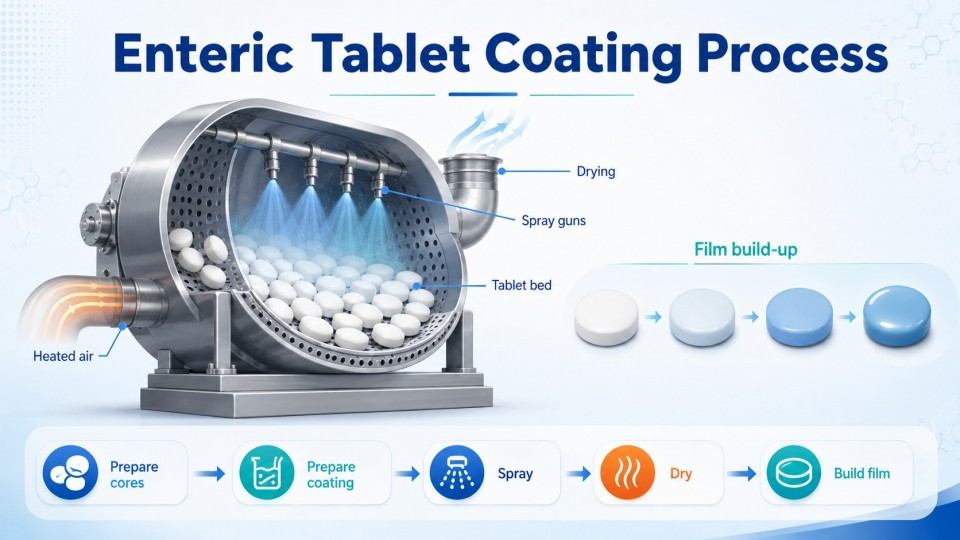
A typical tablet coating process follows these steps:
Rich Packing supplies automatic tablet coating machines for pharmaceutical production, including applications that require film coating and enteric coating processes. The equipment is designed to support controlled tablet movement, atomized spraying, airflow, and drying so manufacturers can establish repeatable coating conditions for different product requirements.
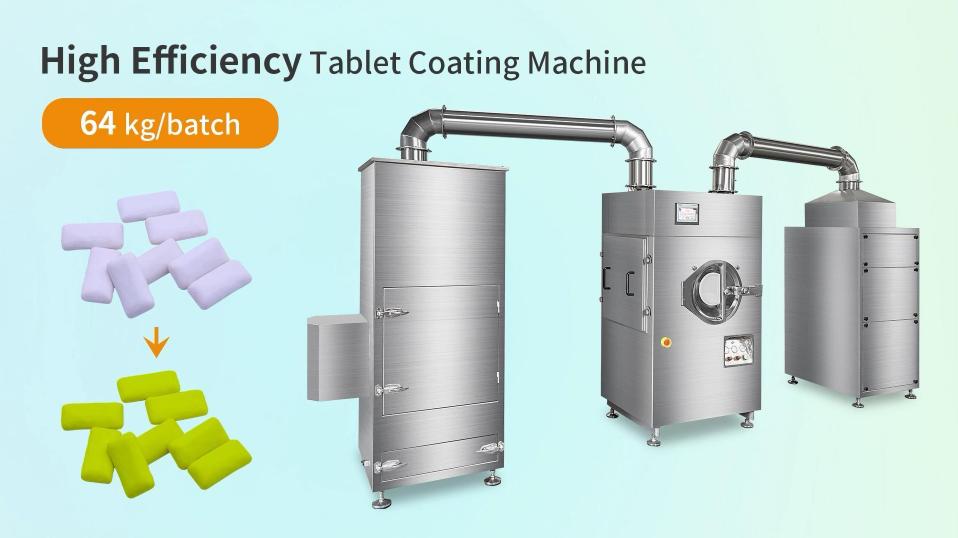 Rich Packing Tablet Coating Machine
A successful enteric film has to do two things in sequence: remain an effective barrier during the gastric stage and then permit the intended later release. Visual uniformity is useful, but appearance alone does not prove functional performance.
The main influences can be grouped into tablet or substrate factors, coating-formulation factors, and process factors.
|
Factor group |
Examples |
Why it matters |
|
Tablet or substrate |
Surface condition, porosity, moisture, mechanical strength |
Affects film adhesion, wetting, integrity, and resistance to handling |
|
Coating formulation |
Polymer, plasticizer, solids level, viscosity, film flexibility |
Affects spray behavior, film formation, cracking resistance, and pH response |
|
Spraying |
Spray rate, droplet size, atomization, gun position |
Affects wetting, distribution, coating efficiency, and uniformity |
|
Drying |
Inlet air, airflow, bed temperature, exhaust conditions |
Controls liquid removal and the balance between overwetting and spray drying |
|
Film build-up |
Coating amount, distribution, curing where required |
Determines whether the finished barrier is continuous and functionally adequate |
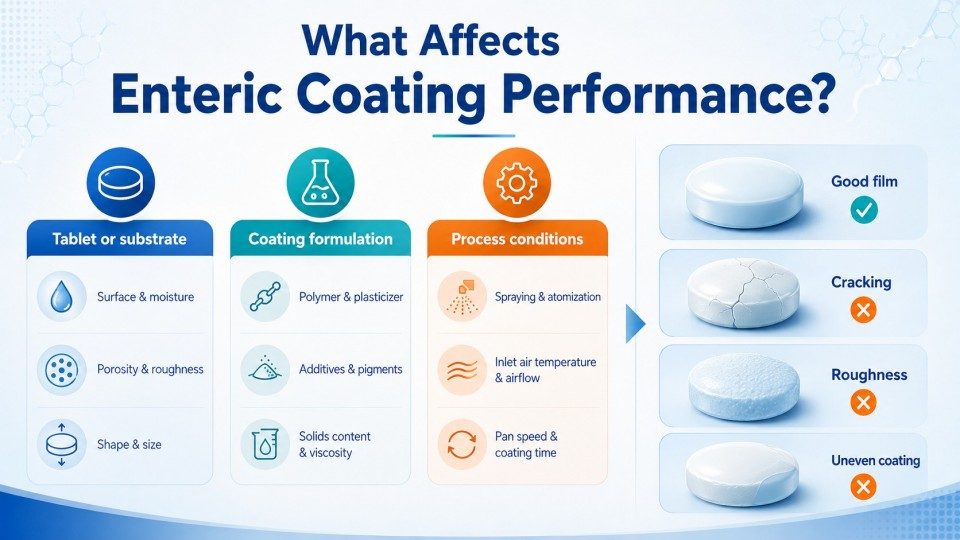
Common coating problems reflect these interactions.
Excessive wetting contributes to sticking and picking. Poor atomization or spray distribution creates uneven deposition. Excessive drying produces roughness when droplets partially dry before spreading, while a brittle film is more vulnerable to cracking or peeling.
For enteric systems, these defects can alter acid resistance or the later release profile. Poor coverage creates a weak point in the barrier, while excessive or poorly conditioned film build-up can shift release later than intended.
The correct target comes from the product specification and coating-system design rather than one universal coating-weight value.
Performance testing follows the same functional logic. Delayed-release dosage forms are evaluated through an acidic stage by a later-stage medium under the applicable method.
This distinction matters: a common industry procedure should not be presented as one fixed rule for every enteric-coated product.
Enteric coating means a gastro-resistant functional layer designed to remain intact during the gastric stage and allow release after the dosage form reaches a suitable intestinal environment.
The coating is designed to lose its barrier function after leaving the stomach. The exact dissolution or disruption conditions depend on the selected polymer system and product design rather than one universal pH value.
Enteric coating is a common way to create delayed release. Delayed release describes when or where release begins, while enteric coating describes the gastro-resistant barrier used to achieve that result.
Common enteric coating materials include CAP, HPMCP, HPMCAS, PVAP, and methacrylic-acid-based copolymers. The full coating formulation also includes components needed for film formation and processing.
Yes. Enteric protection is used on tablets, pellets, granules, and capsules. The barrier can be applied directly to the dosage form, to smaller particles, or through a gastro-resistant capsule system.
Enteric coating works when material selection, dosage-form design, spraying, drying, and film formation are controlled as one system. For enteric-coated tablets, the finished coating has to resist gastric conditions and then permit the intended later release. That full sequence connects material choice, coating process control, and final performance.

29+ years in pharmaceutical machinery, covering capsule filling, tablet pressing, blister packaging, tablet and capsule counting, cartoning, GMP production, and overseas machine service.

Email : manager@richpacking.cn
Building D, No. 226, Beishan Qiaotou Street, Haizhu District, Guangzhou City, Guangdong Province, China


 IPv6 network supported