< img height="1" width="1" style="display:none" src="https://www.facebook.com/tr?id=860012012932429&ev=PageView&noscript=1" />
capsule counting machine
  • May 27, 2026 Medicine Label Codes Explained: Expiry Date, Batch Number, and Barcode
    A medicine label carries more than a product name. It may show the product strength, dosage form, expiry date, batch number, lot number, barcode, storage instructions, and manufacturer information. For users, pharmacists, distributors, and packaging teams, these details support product identification and traceability.   A label can help confirm product information, but it should not be used alone to decide whether a medicine is safe to take. If the package is damaged, the expiry date is unclear, or the printed information looks wrong, follow the original package instructions and ask a pharmacist or qualified professional.   For pharmaceutical packaging teams, medicine label codes are part of a quality control chain. A wrong batch number, unreadable barcode, unclear expiry date, or bottle-carton mismatch can affect inventory control, traceability, recall handling, and final product release.     What Information Is Found on a Medicine Label?   Medicine label content depends on the market, dosage form, pack size, and local requirements. Still, several items appear often across medicine packaging: product name, strength, dosage form, batch or lot number, expiry date, barcode, storage instructions, and manufacturer details.   The same information may appear on more than one packaging level. A bottle label, blister foil, carton, bundle, or shipping case may all carry product identity or traceability data. If these levels do not match, the issue becomes a packaging line control problem, not just a label design problem.   Label item What it shows Packaging line check Product name Medicine identity Correct label or carton used Strength Amount per dose Match with product and carton Dosage form Tablet, capsule, liquid, powder, etc. Correct package route Expiry date Use period assigned by the manufacturer Clear date code and correct format Batch number Production batch identity Match across bottle, blister, label, and carton Lot number Lot-level traceability code Consistency with records Barcode Machine-readable product data Scannability and data match Storage instructions Handling and storage condition Clear print on label or carton   Readability depends on more than artwork. Label position, print contrast, barcode placement, bottle shape, carton folding, ink quality, and inspection setup all affect the final package.     Expiry Date on Medicine Labels   The expiry date tells users, distributors, and packaging teams the time limit assigned to a medicine under defined storage conditions. In some markets, the term expiration date is used instead. The exact wording and date format can vary by country and product type.   A clear expiry date supports inventory rotation, warehouse checks, distribution control, and product release. On a packaging line, the date must be printed in the right place, in the correct format, and with enough contrast to remain readable after handling and transport.   Common...
    View More
  • May 21, 2026 Tamper Evident Packaging in Pharma: 7 Essential Types Buyers Should Know
    Tamper evident packaging gives medicine, OTC, supplement, and nutraceutical products a clear sign when a pack has been opened, damaged, or interfered with before use. The feature may sit on the bottle mouth, bottle neck, blister cavity, pouch seal, carton flap, or label surface. A foil seal under a bottle cap is one familiar example, but it is only one part of a wider packaging strategy.   For buyers, the choice is not only about adding a seal. Product form, container material, closure design, sealing method, label position, line speed, and inspection setup all affect whether the feature still works after filling, packing, shipping, and retail handling. A strong design should show first opening clearly without blocking the product name, strength, batch number, expiry date, barcode, or dosage instructions.   The focus here is medicine, OTC products, supplements, and nutraceutical products packed in bottles, blisters, pouches, cartons, or labeled containers.     What Is Tamper Evident Packaging? Tamper evident packaging is packaging designed to show visible evidence after possible opening or interference. Its main job is not to make a pack impossible to open. Its job is to make opening clear.   A bottle foil seal shows this well. When the seal is intact, the user can see that the bottle mouth has not been opened. Once the seal is removed, punctured, or torn, the pack no longer looks untouched. A shrink band works in a similar way around the cap or neck area. A blister pack shows opening when the lidding foil is pushed through. A carton seal or void label shows interference when it tears, leaves a mark, or cannot be reapplied cleanly.   This is different from child-resistant packaging. A child-resistant cap is designed to make opening harder for young children. A tamper-evident feature is designed to show whether the pack has already been opened or altered. One product can use both, such as a medicine bottle with a push-and-turn cap plus an induction foil seal.   The term tamper resistant packaging is related, but the practical focus is different. Tamper resistant usually points to a pack design that makes interference harder or more controlled. Tamper evident focuses on the evidence left after interference. FDA rules for certain OTC human drug products define a tamper-evident package as one with indicators or barriers to entry that can give visible evidence to consumers if tampering has occurred.   A good feature also needs to survive normal production and distribution. If a foil seal bonds unevenly, a shrink band shifts, or a security label covers batch information, the package may create confusion instead of clarity.   Why Tamper Evident Packaging Matters for Medicine and Supplements   Medicine and supplement products often pass through several hands before they reach the user. A pack may move from production to storage, export handling, distribution, pharmacy shelves, clinics, retail stores, or e...
    View More
  • May 17, 2026 The Ultimate Guide to Choosing a Blister Packing Machine: Roller, Flat-Plate, or Roller-Plate?
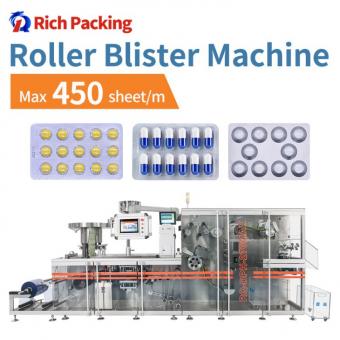
    Every production manager faces a tough question when investing in packaging equipment: which type of blister packing machine actually delivers the best results for my product? The wrong choice leads to slow output, high material waste, and constant mold changes. Micro-stoppages and changeover losses alone can consume 15% to 25% of a high-speed packaging line's theoretical capacity.   This guide removes the guesswork. We will break down the three core technologies—roller, flat-plate, and roller-plate—compare them side by side, and match each one to the industries and products where it performs best. Whether you package solid tablets, liquid honey, or electronic components, you will find a clear path to the right pharmaceutical blister packaging solution.   How the Three Main Types of Blister Packing Machines Work   To make a smart decision, you first need to understand what happens inside each type of blister packaging machine. While all three form cavities in a plastic web and seal them with lidding material, the way they apply heat and pressure differs greatly. These differences directly affect speed, precision, and what you can package. Below, we examine each blister packing machine design in detail.     Roller Machine: The High-Speed Specialist Working Principle and Motion Profile A roller blister pack machine uses a rotating heated drum. The plastic film wraps around the drum, and vacuum pulls it into pocket-shaped molds on the roller surface. Because rotation is continuous, forming never pauses. The web moves forward cycle after cycle without interruption.   Key Advantages: Unmatched Output Speed is the main reason manufacturers choose this technology. Roller machines can achieve stable output of over 200 blisters per minute for small, simple shapes. [2] For high-volume generic drug runs where one product runs for days, nothing else matches this throughput.   Ideal Applications and Limitations These machines suit large batches of uniform tablets or capsules with shallow forming depths, typically under 10 mm. However, the rotary mold design limits cavity depth and wall-thickness consistency. The molds themselves are expensive and take longer to swap. If your production mix changes weekly, this blister pack machine technology creates a bottleneck.   Flat-Plate Machine: Precision and Flexibility Working Principle and Cycle Breakdown A flat-plate blister packing machine works in an intermittent cycle. A flat forming mold presses against a heated plate to shape the plastic web. The web stops, the mold closes, vacuum and pressure form the blister, the mold opens, and the web indexes forward. This stop-start motion gives every cavity exactly the same forming time.   Key Advantages: Superior Forming Depth and Accuracy Because the plastic stays under controlled pressure during the entire stop phase, flat-plate machines achieve deep draws. Flat-plate systems demonstrate clear advantages when for...
    View More
  • May 13, 2026 Pill Shapes Explained: Why Tablets Are Round, Oval, or Capsule-Shaped
    Pill shapes are not chosen only for appearance. A tablet may be round, oval, capsule-shaped, flat, curved, or slightly elongated because that shape fits a mix of product design, manufacturing, coating, handling, and packaging needs.   For many people, the first thing they notice is the look of the tablet. One product may be small and round. Another may be longer and smoother. Some tablets look close to capsules, while others use a simple circular form. These differences can help make a product easier to recognize, but shape alone should never be used to identify a medicine. The package, label, and professional guidance are still the reliable sources when identification matters.     From a manufacturing view, tablet shape affects how powder is compressed inside the tablet press machine, how smoothly tablets leave the tooling, how evenly tablet coating covers the surface, and how stable the tablets remain during feeding, counting, blister packing, bottling, and cartoning. Even a plain round outline can require careful control during production.   Packaging is also part of the decision. Round tablets often move easily through many feeding and counting systems. Oval and capsule-shaped tablets may improve handling or swallowing comfort, but they can require more attention to blister cavity design, orientation, coating uniformity, and bottle counting stability. For manufacturers, the final tablet shape has to work across the full line, not only at the tablet compression stage.   What Do Pill Shapes Usually Mean?   Pill shapes usually reflect a balance between product function, manufacturing practicality, and user experience. They are not random, and they are not only a branding choice.   A round tablet is one of the most common forms because it is simple to compress, easy to coat, and generally stable during handling. Round tablets also fit many standard blister cavities and bottle counting systems. For high-volume tablet production, this shape often gives manufacturers a practical starting point.   Oval tablets are often used when the product needs more space for active ingredients or excipients without becoming too thick. A longer shape can sometimes feel easier to handle than a thick round tablet, but it also changes how the tablet moves through feeders, coating pans, blister tracks, and counting channels.   Capsule-shaped tablets, sometimes called caplets, are designed to look longer and smoother than a typical round tablet. This shape can support a cleaner product appearance and may suit larger formulations, but it needs suitable punches and dies during tablet compression. The longer body also needs stable movement during coating and packaging.   Some tablets use custom shapes for brand recognition, product family design, or special manufacturing needs. These shapes can help a product stand out, but they may also add challenges. Unusual edges, corners, or curves can affect tablet coating coverage, ...
    View More
  • May 08, 2026 Deblistering Machine Guide: Recover Products from Rejected Blister Packs
    Blister packaging lines can produce rejected blister packs during sealing checks, printing changes, batch setup, product feeding issues, or changeover. If the product inside is still acceptable under the manufacturer’s quality rules, throwing away the full pack wastes material, labor, and finished tablets, capsules, softgels, candies, or similar solid-dose products.   A deblistering machine separates usable products from rejected blister packs. It helps recover products from aluminum-plastic or aluminum-aluminum blister cards while keeping waste packaging separate from the recovered material.   This guide focuses on deblistering for pharmaceutical, nutraceutical, candy, and similar solid-dose blister products. The purpose is not to replace quality control or release procedures. The purpose is to explain where deblistering fits, how it works, and what buyers should check before choosing equipment for blister pack recovery.     What Is a Deblistering Machine?   A deblistering machine is auxiliary equipment used to remove products from blister packs. It is commonly used when tablets, capsules, softgels, candies, or similar solid-dose products need to be recovered from rejected blister cards.   It is different from a blister packaging machine. A blister packaging machine forms cavities, fills products, seals the lidding material, and cuts finished blister cards. A deblistering machine works in the opposite direction. It separates the product from the finished or rejected blister pack so the product and waste packaging can be handled separately. Typical use cases include: ● rejected blister packs from sealing, printing, or feeding problems; ● setup or changeover packs that cannot be sold; ● QC sampling or controlled recovery work; ● recovery of high-value products where manual removal is slow or risky.   For buyers, the main value is not only speed. A good deblistering process should reduce product damage, separate waste cleanly, fit the blister format, and support safe handling before the next approved step.   Why Rejected Blister Packs Need Product Recovery   Rejected blister packs are common in production. A blister card may fail because of poor sealing, wrong batch printing, missing products, damaged cavities, or setup waste during changeover. In some cases, the product inside remains usable, but the pack itself cannot be released.   Manual recovery may work for a few cards, but it becomes slow and inconsistent when the volume increases. Operators may press products out by hand, which can damage tablets, deform capsules, or create handling risks. Manual work also makes it harder to separate products and waste packaging cleanly.   A deblistering machine helps recover products from rejected blister cards while keeping the discarded packaging separate. This is especially useful when the products are high-value, fragile, or produced in repeated batches.   The main reasons comp...
    View More
  • Apr 29, 2026 Bottle Capping Machine: The Complete Guide for Tablet, Capsule & Gummy Bottling Lines
    A bottle capping machine is used across many packaging lines, including food, beverages, cosmetics, chemicals, supplements, and pharmaceuticals. Its job is to place and tighten caps so bottles can move safely to sealing, labeling, cartoning, or shipping.   This guide focuses on a narrower but common application: tablet, capsule, gummy, and supplement automatic counting bottling lines. In these lines, the capping machine usually works after counting or filling and before induction sealing, labeling, and cartoning.     Capping quality affects line stability. A loose cap may cause sealing problems. An over-tight cap can damage the bottle thread or make the bottle difficult to open. An unstable cap feeder can slow the line even when the counting section is running well.   For buyers, the key point is clear: a bottle capping machine should match the bottle, cap type, output target, torque range, and downstream equipment.     What Is a Bottle Capping Machine?   A bottle capping machine is packaging equipment that places, tightens, presses, or secures caps onto bottles. It is used after tablets, capsules, gummies, softgels, powders, liquids, or other products have already entered the container.   In the tablet, capsule, gummy, and supplement bottle range covered here, the machine usually sits after counting or filling. The bottle moves into the capping area, a cap feeder delivers the cap in the correct direction, and the capping head applies the cap to the bottle mouth.   Its core job is to close each bottle consistently. For that to happen, several actions must stay stable: ● the bottle should enter the capping station without shaking or tilting; ● the cap should be correctly oriented before placement; ● the capping head should apply suitable pressure or torque.   For screw-cap bottles, torque control is especially important. If the cap is too loose, the bottle may fail later sealing checks or become less stable during handling. If the cap is too tight, the cap thread or bottle neck may be damaged, and the user may find the bottle difficult to open.   In many tablet, capsule, and gummy bottling lines, capping also affects the next process. If an induction seal liner is used, the cap helps hold the liner against the bottle mouth before induction sealing. Poor cap placement or uneven tightening can make the sealing step less reliable.   The capper can work as a standalone unit, but in most production settings it is part of a connected line. A typical line may include bottle unscrambling, tablet counting machine or capsule counting machine, gummy counting machine, desiccant inserting, capping, induction sealing, labeling, and cartoning.   So, the capper is not only a closing device. It is one of the stations that keeps the bottle packaging line moving from counted product to sealed, labeled, and finished bottle.     Bottle Capping Machine in a Bottling Line   In...
    View More
  • Apr 27, 2026 2026 Startup Blister Packaging Guide:DPP vs DPH
        Introduction   In the quickly evolving pharmaceutical and nutraceutical environment of 2026, agility has become the ultimate competitive advantage for startups. For many founders, the journey from a successful R&D formula to a market-ready product is fraught with logistics hurdles. The most critical pivot point? Transitioning from manual processes to an automatic blister packing machine.   However, the "Scaling Trap" is real. Many emerging brands invest heavily in equipment based on price alone, only to find that their machinery cannot adapt to new cleanroom constraints or diverse product formats. In 2026, a high-quality blister packing machine is no longer just a production tool—it is a strategic asset that must balance GMP compliance, factory footprint, and operational efficiency from the initial tablet compression to the final cartoning stage.   One of the most significant shifts in industry standards this year is the move away from vague "rated output" towards cutting frequency as the primary metric for reliability and tool metallurgy for consumer safety. Whether you are scaling up your first tablet press machine output or launching a niche capsule line, understanding the mechanical heartbeat of your packaging system is essential to avoiding costly downtime.   As noted in recent operational benchmarks (Rich Packing 2026), the choice between DPP (Flat-plate) and DPH (Rotary) technology often dictates a startup's ability to remain profitable while minimizing material waste. In this guide, we will explore how to navigate these technical waters—from solving the "narrow elevator" dilemma with modular split-body designs to achieving surgical precision with DC53 tooling and optimizing your long-term ROI through advanced seamless line integration.   The Architectural Crossroads: Flat-Plate (DPP) vs. Rotary (DPH)     Before diving into specific models, every startup founder must understand the fundamental mechanical divergence in blister packing machine technology. In 2026, the choice is about matching the machine's "motion logic" to your product's DNA. At Rich Packing, we categorize these into two distinct technological paths:   I. The Flat-Plate Logic (DPP Series): Intermittent Precision   The DPP series operates on an intermittent motion principle. Imagine a "stop-and-go" rhythm: the film moves, stops for forming, moves, stops for sealing, and moves again for cutting. The Advantage: Because the film is stationary during the sealing process (Area Sealing), it provides a larger "dwell time" and uniform pressure. Best For: Complex blister shapes, deep-draw packaging (like syringes or large capsules), and liquid filling where stability is paramount to prevent splashing.   II. The Rotary Logic (DPH Series): Continuous Velocity   The DPH series operates on a continuous motion principle. There is no stopping. The film and foil pass between two synchronized, heat...
    View More
  • Apr 22, 2026 Tablet Deduster Machine: Why Dust Removal Matters for Bottling and Blister Packaging
    Introduction   A tablet deduster machine removes loose powder and burrs from tablets after compression and before downstream handling. Residual dust can enter the packaging area, build up on contact parts, and affect packaging consistency. In tablet bottling lines, excess powder can interfere with counting accuracy, container cleanliness, and cap sealing conditions. In blister lines, it can affect sealing surfaces and increase the risk of packaging defects.   Tablet dedusting belongs to process control, not just product appearance. Cleaner tablets usually move through the next stage with fewer contamination-related interruptions, and the packaging area stays easier to control. In both bottling and blister packaging, dust removal helps support more stable handling after compression.     What Does a Tablet Deduster Machine Do?   A tablet deduster machine cleans tablets after they leave the tablet press by removing loose surface powder and small burrs created during compression. Most machines do this through vibration, gentle conveying, and dust extraction, so the tablets can move forward with less surface residue and less loose particulate entering the rest of the line.   Its role becomes clearer when the next process is packaging. Dust does not remain limited to the tablet surface. It can spread into guides, contact zones, sensors, sealing areas, and other parts of the line. Once that happens, the effect is no longer limited to product appearance. It can show up as line contamination, added cleaning work, unstable handling, or packaging defects.   This is why the machine is usually placed as a practical bridge between compression and downstream processing. Tablets leave the press, pass through dust removal, and then move to the next stage in a cleaner condition. In a bottling route, that supports more controlled transfer into counting and filling. In a blister route, it helps reduce powder carryover before sealing and final pack formation.     Why Do Tablets Need Dust Removal After Compression?   Tablet compression naturally creates some loose powder. Even when a formulation runs well, tablets can leave the press with fine dust on the surface, around the edges, or near embossed areas. Small burrs may also appear, especially when tooling condition, compression force, granule flow, or formulation behavior is not fully balanced.   That residue becomes a bigger issue once tablets move beyond the press. Dust can collect on transfer parts, fall into guide rails, and spread into the next machine. A light layer of powder at the press outlet can become a larger cleaning and process-control problem later in the line.   Dust removal also separates two questions that are often mixed together. One is tablet appearance. The other is packaging performance. A tablet may still look acceptable while carrying enough surface powder to create trouble during counting, filling, sealing, or inspection....
    View More
  • Apr 16, 2026 Stick Pack Machine Explained: Your Ultimate Solution for Stick Pack Packaging Machine
    Intro   Struggling with slow manual packaging, inconsistent dosing and high material waste that reduce your profitability? For pharmaceutical, supplement, coffee and cosmetic businesses, hygienic single-serve packaging is in strong demand. To scale your production, you need a high-performance stick pack machine or sachet packing machine.   What makes stick pack and sachet packet so popular worldwide?   Stick packs and sachet packets are the top choice for modern consumers: portable, easy to tear, and perfect for on-the-go use. For manufacturers, they bring a wide range of key advantages: ● Lower material costs: Reduce packaging expenses by 30-40% compared to traditional bottles and jars, greatly cutting operating costs. ● Precise dosing: Eliminate product waste and meet strict compliance standards in pharmaceuticals, nutraceutical products, and other regulated industries. ● Enhanced brand exposure: Support full-custom printing on packaging film, turning every single package into a mobile advertising medium. ● Wide compatibility: Work seamlessly with powder, liquids, granules, gels and more, covering nearly all industry requirements.     Fig 1. Rich Packing Stick Pack Packaging   1 What is a Stick Pack and Sachet Packet?   1.1 The Definition of Stick Pack and Sachet Packet A Stick Pack is a narrow, elongated single-serve package, while a Sachet Packet is a small, flexible, usually a rectangular or square package specially designed for powders, granules, liquids, and pastes. If offers three core advantages: portability, hygiene, and precise dosing, along with easy-tearing, and convenient carrying. Widely used in pharmaceuticals, nutraceuticals, food, beverages, and cosmetics, stick packs and sachet packets are among the fastest-growing small packaging formats worldwide.   1.2 The Applications of Stick Packs and Sachet Packets From daily necessities to personal care, stick packs and sachet packets are compact, convenient and indispensable in modern life. Instant coffee stick packs for a quick and refreshing morning boost, and many customers are asking for 3-in-1 instant coffee mix stick pack packaging machines or 2-in-1 instant coffee mix stick pack packaging machines;   Milk tea powder and protein powder sachet packets for enjoyable leisure time; Health supplement stick packs including probiotics, vitamin C and collagen, offering precise dosing for better wellness, hence a lot of enterprises start to use food supplement powder stick pack packaging machines;   Pharmaceutical granule stick packs that are portable and accurate for both home and travel use, as a result, pharmaceutical powder sachet packaging machines are in high demand; Condiment stick packs such as salt, sugar and chili powder for clean and easy seasoning; Facial mask sample stick packs that are lightweight and ideal for on-the-go skincare. The st...
    View More
1 2 3 4 5 ... 23

A total of 23 pages

Leave A Message
Leave A Message
Please tell us your requirements such as product, model, speed, etc. We will contact you immediately and give you equipment information and quotation。

Service Online

WhatsApp

Email