






 Home
Home Products
29+ years in pharmaceutical machinery, covering capsule filling, tablet pressing, blister packaging, tablet and capsule counting, cartoning, GMP production, and overseas machine service.

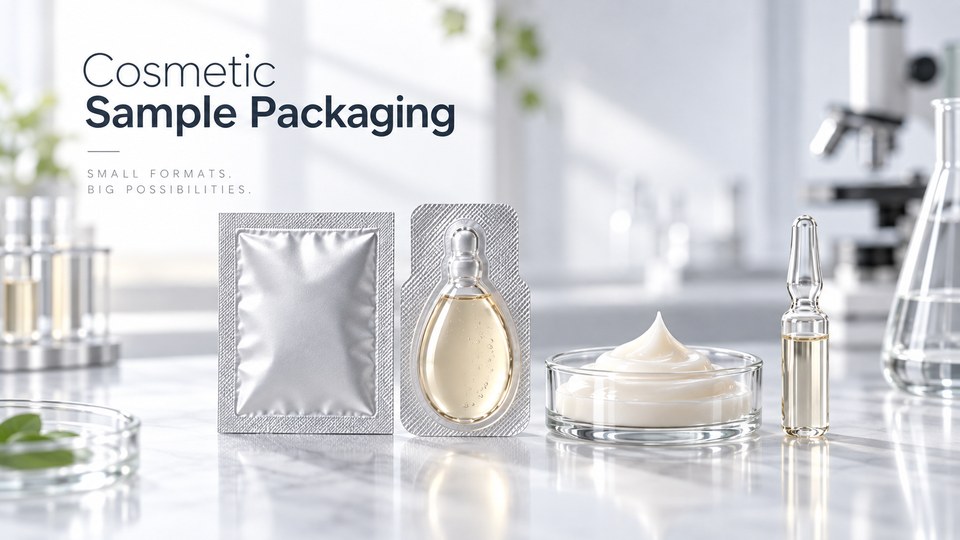
Cosmetic sample packaging should be selected from formula behavior, target dose, intended use, material protection, filling method, sealing or closing requirements, and production conditions. A serum, essence, lotion, cream, gel, oil, or fragrance may be packed in a sachet, blister, ampoule, mini tube, or mini bottle, but the best format is the one that can be filled consistently, protect the formula, open as intended, and run reliably at the required scale.
Use this decision sequence:
formula → target dose → filling method → package format → material and seal/closure → production trial
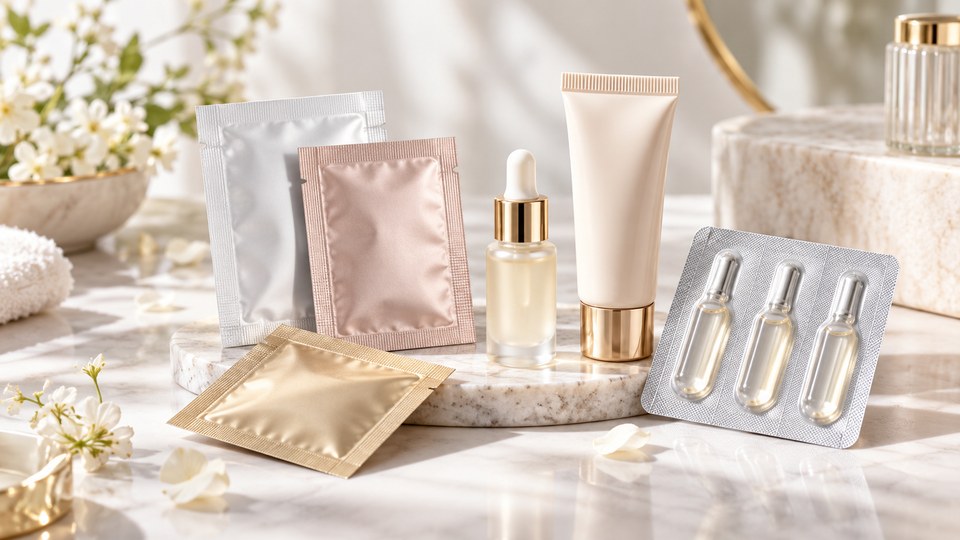
The main formats are flexible sachets, thermoformed liquid blisters, ampoules, mini tubes, and mini bottles. The choice changes not only the consumer experience but also the filling system, material structure, tooling, sealing method, and changeover work.
|
Format |
Typical Role |
Package Structure |
Production Logic |
Main Selection Issue |
|
Sachet / sample packet |
Single-use or small trial sample |
Flexible film or multilayer structure |
Forming and initial sealing → filling → closing seal → cutting |
Product flow, film, seal format, seal-zone cleanliness |
|
Liquid blister / pod |
Defined single-use cavity |
Formed web + lidding material |
Forming → filling → heat sealing → punching |
Cavity geometry, filling system, tooling, material pair |
|
Ampoule |
Individual small container |
Container-based |
Technology-dependent |
Dose, compatibility, opening/dispensing |
|
Mini tube |
Small multi-use trial |
Collapsible container |
Technology-dependent |
Product flow, closure, number of uses |
|
Mini bottle |
Small multi-use trial |
Rigid container + closure |
Technology-dependent |
Closure, dispensing, repeated use |
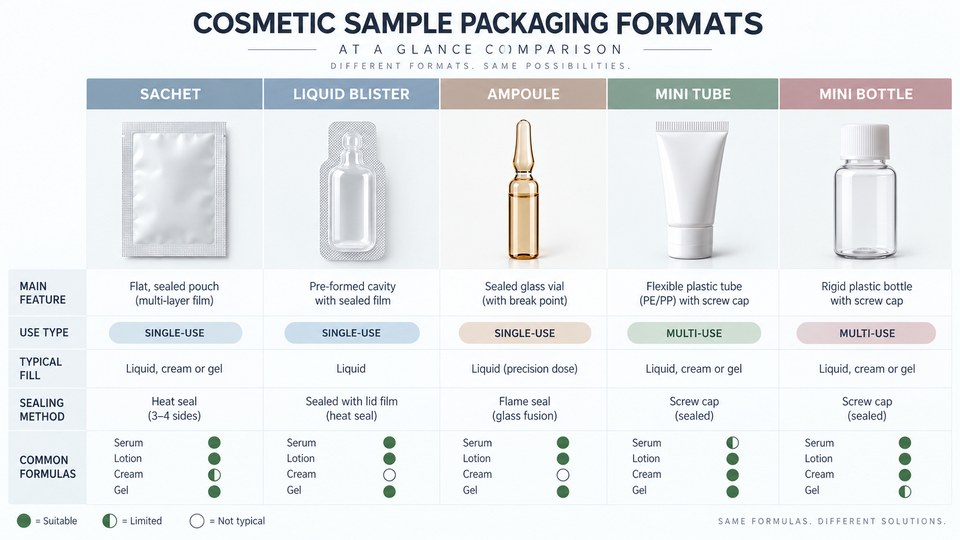
A cosmetic sample sachet is a strong choice when the sample needs to be flat, lightweight, compact to distribute, and easy to print. Sachets can handle liquids, creams, gels, and pastes when the filling system and film structure are matched to the product.
The film may be a simple structure or a multilayer combination that provides printing, strength, barrier, and heat-sealing functions. Three-side-seal, four-side-seal, and back-seal sachets use different film paths and sealing arrangements, so sachet design affects the required machine setup.
For deeper guidance on sachet structures and manufacturing, see What Is a Sachet? A Complete Guide to Sachet Packaging.
Choose a liquid blister when a defined three-dimensional cavity provides a functional advantage over a flat packet. A liquid blister system separates forming, filling, heat sealing, and punching into connected stations.
Cavity dimensions affect tooling and available fill space. Formula behavior affects the filling configuration. Forming and lidding materials determine the sealing window. The final outline determines punching tooling.
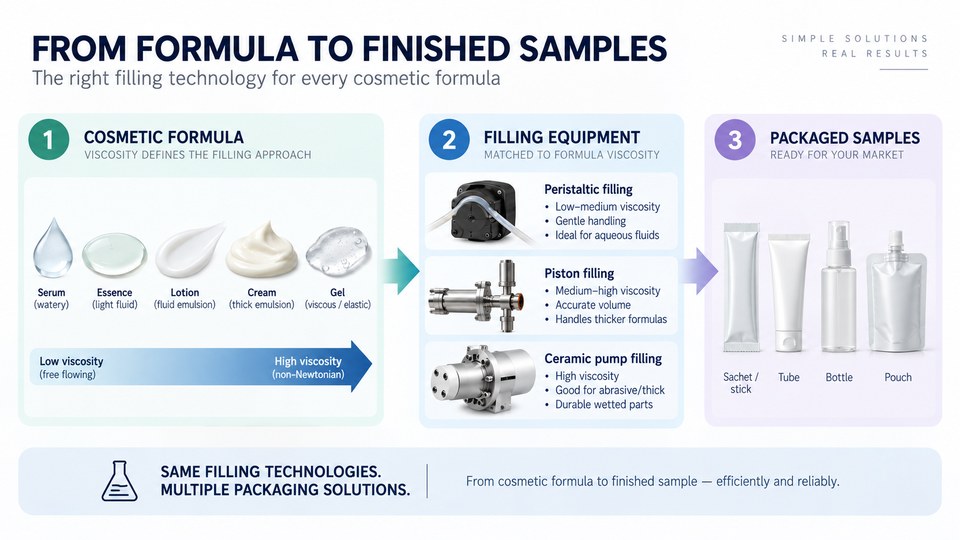
Liquid blister equipment can be configured with different metering systems. Peristaltic filling is a practical option for good-flowing liquids, piston filling for more viscous products, and ceramic pumps where higher dosing precision is required. These are starting configurations, not universal formula-to-pump rules; the actual formula and target dose should confirm the final choice.
For a deeper process explanation, see liquid blister packing machine and how blister packaging machines pack cosmetics.
These formats are most useful when an individual container, controlled dispensing method, or several applications matter more than flat-pack efficiency.
Their detailed production routes depend on the specific container technology, so they should be compared first by:
dose → number of uses → compatibility → barrier needs → dispensing method → production volume
Start with the formula and dose, then ask what the package must do during filling, sealing, distribution, and use.
|
Formula |
Main Packaging Question |
Sachet |
Liquid Blister |
Other Option |
|
Serum / essence |
Can a small dose be metered and kept away from the seal area? |
Strong option |
Strong option |
Ampoule or mini bottle |
|
Lotion / emulsion |
Is filling stable and compatible with the chosen material? |
Strong option |
Strong option |
Mini tube/bottle |
|
Cream |
Can the filler handle higher viscosity cleanly? |
Suitable with matched filling |
Suitable with matched filling |
Mini tube |
|
Gel |
Can filling and cut-off remain controlled? |
Suitable with matched filling |
Suitable with matched filling |
Tube/container |
|
Oil / fragrance |
Are compatibility, containment, and dispensing suitable? |
Project-dependent |
Project-dependent |
Mini bottle/ampoule |
For serum and essence, compare target dose, barrier need, material compatibility, opening method, number of uses, and production volume.
A sachet favors flat distribution and print area; a blister favors a defined cavity; an individual container favors controlled dispensing or repeated use.
Lotion, cream, and gel require the filling method and package geometry to work together. Higher-viscosity products need filling systems capable of delivering the target amount without excessive product entering the seal area.
In liquid blister production, piston filling can be a practical starting point for more viscous products. Where formula viscosity changes materially with temperature, temperature-controlled product feeding may help stabilize flow. It should only be used within the formulation’s approved processing range and should not compensate for an unsuitable filling system.
Oil and fragrance projects should place particular attention on material compatibility, containment, dose control, and dispensing. The material structure and filling configuration should be confirmed with the actual formula rather than selected from product category alone.
Use the package format to solve the project requirement, not as a visual choice made before process review.
|
Decision Factor |
Sachet |
Liquid Blister |
Ampoule |
|
Flat, compact distribution |
Strong |
Limited |
Limited |
|
Defined cavity/container |
Limited |
Strong |
Strong |
|
Single-use sample |
Strong |
Strong |
Strong |
|
Printable area |
Large |
Moderate |
Limited |
|
Tooling dependence |
Lower to moderate, format-dependent |
Higher, cavity/tooling-dependent |
Container-system dependent |
|
SKU changeover |
Size, film-path and filler dependent |
Strongly mold/setup dependent |
Container-dependent |
|
Main advantage |
Flexible compact sample |
Defined formed dose |
Individual dispensing container |
Choose a sachet when flat distribution, print area, low package volume, and flexible roll-film production are priorities.
Choose a liquid blister when a formed cavity, controlled presentation, or differentiated shape provides enough functional value to justify additional tooling.
Choose an ampoule when the project specifically needs an individual dispensing container.
For related concepts, see unit dose packaging and blister packaging in the beauty industry.
The packaging route matters because each format creates different points where filling, material, sealing, and tooling interact.
Commercial sachets are commonly produced from roll film. The required package structure and initial seals are created before product filling; the pack then receives its closing seal before cutting and discharge.
In a typical back-seal VFFS cycle, the longitudinal seal forms the tube and the bottom cross seal is created before dosing. Three-side- and four-side-seal systems use different web arrangements and sealing sequences.
The important relationship is:
product behavior → filling method → sachet format → film structure → sealing conditions → production trial
ASTM F88/F88M-23 measures seal strength in flexible barrier materials. It should not be treated as proof that a package has no leaks. Where applicable to the package and test objective, ASTM F2096 can be used to detect gross leaks in tray and pouch packages.
For the complete manufacturing sequence, use the sachet packaging guide. For broader flexible material choices, use the flexible packaging guide.
A typical liquid blister sequence is:
material feeding → cavity forming → filling → lidding and heat sealing → punching → discharge
This route is more tooling-dependent than a flexible sachet. A change in cavity size or depth can affect the forming mold, available fill space, seal area, and punching tool. Deeper cavities may require secondary forming.
The filling system must also match the formula, while the forming and lidding materials must provide a workable sealing combination.
For material-specific background, see blister packaging materials.
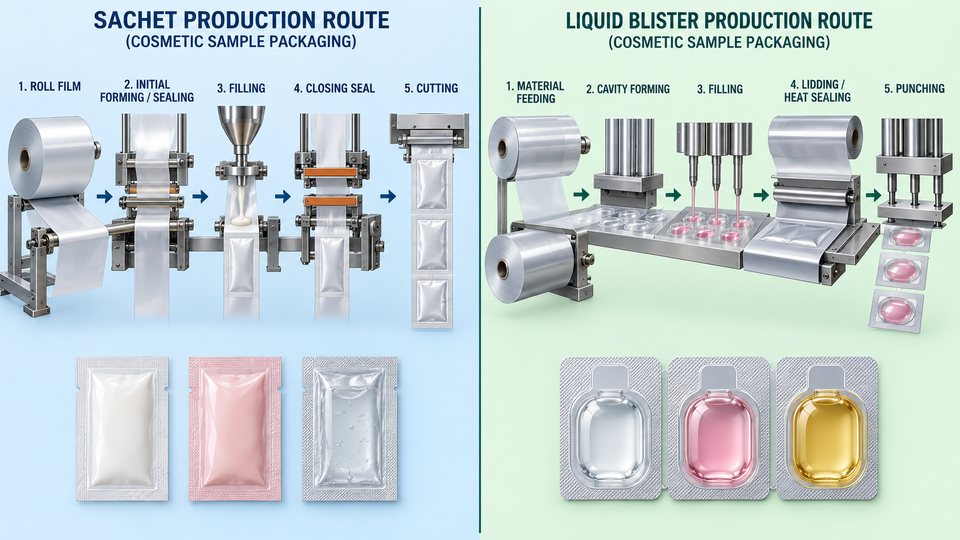
The equipment should match the selected package format, formula behavior, target dose, packaging material, required output, and changeover needs. A sachet, liquid blister, mini tube, or mini bottle may package a similar cosmetic formula, but each format requires a different filling and packaging setup.
A sachet packaging machine or stick packing machine combines film feeding, forming, filling, sealing, cutting, and discharge according to the selected package structure.
For liquid, serum, cream, or gel samples, the filling system must match product flow and viscosity while keeping excess product away from the sealing area. Back-seal, three-side-seal, and four-side-seal formats also require different film paths and sealing arrangements.
A liquid blister packaging machine combines cavity forming, product filling, lidding and heat sealing, punching, and discharge.
Cavity dimensions affect the forming mold and available fill volume. Formula behavior affects the filling system, while the forming and lidding materials determine the workable sealing conditions.
For deeper cavities, secondary forming may be required. Tooling design also becomes important when one machine must handle several cavity sizes or sample formats.
Other cosmetic sample formats use container-specific equipment rather than roll-film or thermoforming systems. The machine should follow the container type, closure method, target dose, and product behavior.
|
Sample Format |
Typical Equipment |
Main Use |
|
Ampoule |
Ampoule filling and sealing machine |
Serum, essence, and concentrated liquid samples |
|
Mini tube |
Tube filling and sealing machine |
Cream, lotion, and gel samples |
|
Mini bottle |
Bottle filling and capping machine |
Serum, oil, toner, and fragrance samples |
The exact filling, closing, and changeover configuration depends on the selected container system.
After primary packaging, coding systems, conveyors or transfer systems, inspection equipment, and cartoning machines may be added according to the finished pack and line layout. Sachet cartoning machines and blister cartoning machines can automate secondary packaging when sample packs need to be loaded into cartons. For container-based samples, labeling equipment may also be added where required.
A filling system is a metering module that can be integrated into different packaging machines when the machine architecture and product-contact design support it. The cosmetic filling machine or liquid filling system should therefore be selected from product behavior, target dose, cleaning requirements, and required accuracy rather than product name alone.
Peristaltic filling systems can suit good-flowing liquids, piston filling systems are practical for more viscous products, and ceramic pump filling systems can be used where higher dosing precision is required. These filling principles can be applied across different packaging machines where the equipment design supports them. Temperature-controlled product feeding can also be considered when viscosity changes significantly with temperature.
A production trial should confirm that the formula, packaging material, filling system, sealing process, tooling, and required output work together under realistic operating conditions.
|
Input to Confirm |
What It Determines |
|
Formula behavior |
Product feeding and filling principle |
|
Target dose |
Metering range |
|
Package format |
Machine architecture |
|
Packaging material |
Forming and sealing compatibility |
|
Required output |
Practical production capacity |
|
Number of SKUs |
Changeover requirements |
|
Cleaning method |
Product-contact design and procedure |
The trial should check fill repeatability, seal-zone cleanliness, seal or closure performance, package opening, tooling fit, practical output, and changeover using the actual formula and intended packaging material.
Rich Packing provides liquid filling solutions for sachet packaging equipment, liquid blister packaging systems and other cosmetic packaging system. Machine configuration can be matched to the formula, target dose, package structure, sealing method, and required output.
Compliance Note
Compliance requirements support the production system but do not determine whether a sachet, blister, or another format is the best choice. ISO 22716:2007 provides GMP guidance for cosmetic production, control, storage, and shipment, while ISO 22715:2006 covers cosmetic packaging and labelling. For products marketed in the United States, applicable FDA cosmetic labeling requirements and MoCRA facility-registration and product-listing obligations should also be reviewed.
There is no universal best format. Sachets suit compact flexible samples, blisters provide defined cavities, and ampoules, tubes, or mini bottles provide container-based alternatives. Formula, dose, intended use, material requirements, and production route should decide the format.
Serum can use sachets, blisters, ampoules, or mini bottles. Compare target dose, material compatibility, barrier requirement, opening method, number of uses, production volume, and available filling technology.
Yes. Creams, gels, and pastes can use sachets when the filling system handles the product consistently and keeps excess material away from the sealing area.
Yes. The filling system, cavity, forming material, lidding material, and sealing process must be matched to the actual formula.
A sachet is generally stronger for flat distribution, print area, and roll-film efficiency. A blister is more appropriate when a defined cavity provides a functional or presentation benefit that justifies additional tooling.
The package structure and necessary initial seals are created before filling. Product is dosed into the prepared package section, by the closing seal, cutting, and discharge. The exact film path depends on the sachet format.
Liquid blisters typically pass through forming, filling, lidding and heat sealing, punching, and discharge. Cavity geometry, filling configuration, materials, and tooling are selected around the formula and finished pack.
Sachets can use plastic films, aluminum-containing laminates, paper-containing structures, and other multilayer materials selected for barrier, sealing, printing, mechanical, and product-contact requirements.
Start with the actual formula and target dose. Evaluate flow behavior, viscosity, temperature sensitivity, required precision, cut-off behavior, cleaning, and output, then confirm the filling system through a production trial.
Test fill repeatability, material compatibility, seal or closure performance, opening behavior, tooling fit, production output, and changeover using the actual formula and intended packaging material.
Conclusion
The right cosmetic sample packaging is the format that matches the formula, dose, filling method, material, sealing or closing system, and production conditions.
Sachets are efficient for flexible samples when film, filling, and sealing are matched correctly. Liquid blisters add a defined cavity but also add forming, tooling, and sealing dependencies. Container-based formats should be selected after their dispensing and use requirements are clear.
References
ISO 22715:2006 — Cosmetics — Packaging and labelling.
ASTM F88/F88M-23 — Standard Test Method for Seal Strength of Flexible Barrier Materials.

29+ years in pharmaceutical machinery, covering capsule filling, tablet pressing, blister packaging, tablet and capsule counting, cartoning, GMP production, and overseas machine service.

Email : manager@richpacking.cn
Building D, No. 226, Beishan Qiaotou Street, Haizhu District, Guangzhou City, Guangdong Province, China


 IPv6 network supported