< img height="1" width="1" style="display:none" src="https://www.facebook.com/tr?id=860012012932429&ev=PageView&noscript=1" />
capsule counting machine
  • Jul 08, 2026 Capsule Packaging Compared: Practical Choices Between Blister Packs, Bottles, and Strip Packs
      Choosing capsule packaging is a practical business decision, not only a packaging design choice. Blister packs, bottles, and strip packs all protect capsules, but they create different results for shelf life, material cost, production speed, line layout, and user experience. A format that works well for one supplement, OTC product, or pharmaceutical capsule can be inefficient or risky for another.   This comparison looks at each solution through the factors that matter in real production: moisture protection, SKU flexibility, labeling space, machine fit, secondary packaging, and market use. The goal is to help teams choose between blister packs, bottles, and strip packs before investing in tooling, materials, or equipment.   1. Why Capsule Packaging Choice Affects Shelf Life, Cost, and Production   Capsule packaging affects shelf life because each format controls moisture, oxygen, light, and user exposure differently. A blister pack seals capsules in individual pockets, so each dose stays protected until it is opened. A bottle holds many capsules in one shared container, so protection depends more on the bottle material, induction seal, desiccant, and how often the user opens it. A strip pack can provide strong foil-laminate protection, but it usually gives less product visibility and less space for printed information.   It also affects cost because each solution uses different materials, tooling, and changeover logic. Blister packs often need forming tools, lidding foil, cartons, and planned format changes. Bottles need caps, seals, desiccants, labels, and accurate counting, but they can support more count sizes with the same basic packaging concept. Strip packs can be compact and protective, while film structure, sealing control, and cutting accuracy still affect total production cost.   Production planning changes as well. The right format determines whether a factory needs a blister packaging machine for capsules, a capsule counting and bottling line, or a strip packing machine for capsules. It also affects inspection points, coding position, cartoning, labeling, and secondary packaging. That is why capsule packaging should be chosen by product risk and market use first, then matched to the machine solution.   For pharmaceutical, nutraceutical, and health product lines, blister packs give unit-dose visibility, bottles give count flexibility, and strip packs give compact barrier protection.   2. Blister Packs for Capsules: Unit-Dose Protection and Retail Clarity   Blister packs hold each capsule in an individual pocket, usually formed from PVC, PVDC-coated PVC, Aclar, PET, or aluminum-based material, then sealed with lidding foil. For capsules that need clear unit-dose organization, blister packaging is often a strong retail and compliance-friendly format.   Blister packs work well when each capsule should stay separated until use. This helps reduce repeated contact with the rest of the prod...
    View More

  • Jul 08, 2026 Why Does Aluminum Foil Wrinkle on a Blister Packing Machine? 8 Causes and Solutions
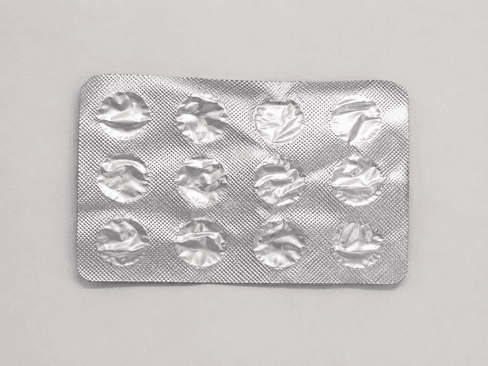
        1. Introduction   In blister packaging production, aluminum foil wrinkling is one of the common issues that may affect the final package quality. For pharmaceutical, nutraceutical, and healthcare products, a smooth and well-sealed blister pack is not only important for appearance, but also for product protection, sealing performance, and production efficiency.   When wrinkles appear on the aluminum foil, the package may look unprofessional. In more serious cases, wrinkles can also lead to poor sealing, air leakage, unstable cutting, or higher material waste. This is why operators need to identify the cause as early as possible and adjust the blister packing machine before the problem affects large-scale production.   In most cases, aluminum foil wrinkling is not caused by a single factor. It may be related to improper web tension, poor material alignment, excessive sealing temperature, uneven sealing pressure, poor material quality, or unsynchronized machine movement.   Today’s article will guide you through the common causes of aluminum foil wrinkling on a blister packing machine, practical ways to troubleshoot the problem, and why the right machine setup matters for stable blister packaging production. 2. 8 Main Causes of Aluminum Foil Wrinkling and How to Fix Them   Before adjusting the blister packing machine, operators should first observe when and where the aluminum foil wrinkles appear.   If the foil is already wrinkled before sealing, the problem is usually related to foil tension, web guiding, material roll quality, or feeding alignment. If the wrinkles appear after sealing, the cause may be connected with sealing temperature, sealing pressure, sealing surface condition, or machine synchronization.   The wrinkle pattern also matters. One-side wrinkles often indicate uneven tension, poor alignment, or unbalanced sealing pressure. Random wrinkles may suggest unstable material feeding or poor foil quality. Fixed-position wrinkles are more likely related to the sealing mold, guide roller, or mechanical adjustment.   After this quick observation, operators can check the following common causes one by one.   1. Unstable Foil Tension or Poor Web Guiding       Improper foil tension and poor web guiding are two of the most common reasons for aluminum foil wrinkling before sealing.   If the aluminum foil is too loose, it may swing from side to side or form small waves before entering the sealing station. Once these waves are pressed and heated, they can become visible wrinkles on the finished blister pack.   However, excessive tension can also cause problems. When the foil is pulled too tightly, it may be stretched before sealing. During heat sealing, the material may shrink or deform, especially when the sealing temperature is high.   Foil misalignment can make the problem worse. During operation, the aluminum foil must enter the sealing station in...
    View More
  • Jul 03, 2026 Honey Packaging Explained: Popular Types and the Machines Behind Them
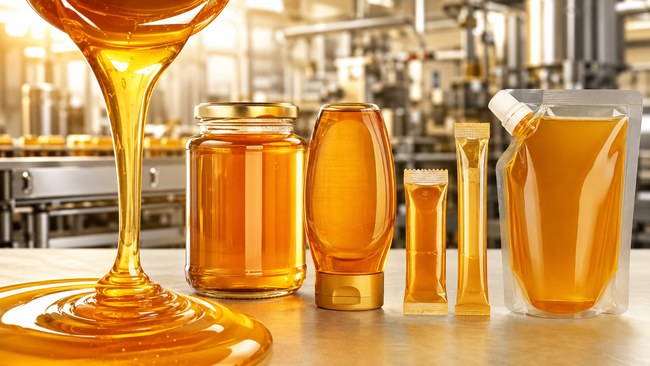
    Honey appears in many familiar packs. A glass jar on a gift shelf. A plastic squeeze bottle in a family kitchen. A small sachet beside hotel breakfast bread. A slim stick pack next to tea or coffee. The product is still honey, but the way people open it, pour it, carry it, store it, and share it changes with the pack.   This is why honey packaging is more than choosing a container. The pack has to protect the honey, show the product clearly, fit the selling channel, and work with the filling and sealing process behind it. A jar, a bottle, a sachet, a stick pack, and a pouch all create different production needs.   Honey also has its own behavior. It is thick, slow to flow, sensitive to moisture, and affected by temperature. These qualities influence the packaging type and the machine used to fill it. A honey filling machine for jars does not work the same way as a honey sachet packing machine or a stick packing machine. Each pack tells a small story about how the honey will be used.   What Honey Packaging Includes   Honey packaging starts with the pack people see, but it includes several steps before the product reaches a shelf, cafe table, hotel tray, or shipping carton.   The first step is choosing the pack type. Glass jars, plastic bottles, squeeze bottles, sachets, stick packs, spouted pouches, and portion packs each serve a different use. A family-size jar is made for repeated use at home. A sachet is made for one clean serving. A stick pack is narrow, portable, and easy to place beside tea, coffee, or sample products. A pouch gives more surface area for branding and can reduce transport weight compared with rigid containers.   The second step is choosing the material. Honey touches the inside of the package, so the material must be suitable for food contact. The FDA describes food-contact substances as materials that contact food through packaging, storage, handling, or processing equipment, including packaging components such as coatings, colorants, and adhesives.   The third step is filling and closing. Jars and bottles usually need a honey filling machine, followed by capping, sealing, labeling, and sometimes cartoning. Sachets and stick packs are made from roll film, filled with a measured amount of honey, sealed, and cut. Pouches need opening, filling, sealing, and often coding before they are packed for sale.   The last step is presentation and distribution. A retail jar may need a label and outer box. A carton of honey sticks may need counting and grouping. A pouch may need a spout, cap, and printed film. Honey packaging decides how the product is held, opened, shipped, displayed, and remembered.   Popular Types of Honey Packaging   Glass jars are one of the most familiar choices. They show the color and clarity of honey, which is useful for premium retail, gift packs, and specialty products. Glass feels traditional and gives the product a strong shelf presence. Its main limits are we...
    View More
  • Jul 01, 2026 IQ OQ PQ Validation: 7 Critical Checks for Pharmaceutical Equipment Qualification
    IQ OQ PQ validation gives pharmaceutical teams documented evidence that equipment is installed correctly, operates within defined limits, and performs consistently under real production conditions. In pharmaceutical equipment qualification, this evidence matters before a machine is released for GMP production, before a new packaging line starts batch work, and before QA signs off on equipment that can affect product quality, traceability, or batch release.   The three stages have different jobs. IQ confirms that the equipment is installed as specified. OQ confirms that the machine functions across its intended operating range. PQ confirms that the equipment performs reliably with real product, real packaging materials, trained operators, and approved procedures.   This sequence applies to capsule filling machine, tablet press, blister packaging machine, tablet and capsule counting machine, cartoning machine, induction sealing machine, labeling system, inspection unit, and other production or packaging equipment. The details change by machine type, but the qualification logic stays the same: prove the equipment is suitable for its intended use, and document the proof clearly enough for production, QA, engineering, and audit review.     1. What IQ OQ PQ Validation Means in Pharmaceutical Equipment Qualification   In pharma, qualification is the documented process of showing that equipment, utilities, systems, or facilities are suitable for their intended use. IQ OQ PQ validation sits inside that wider qualification and validation lifecycle. It does not replace process validation, cleaning validation, preventive maintenance, batch records, or daily GMP checks. It creates the equipment evidence that those later controls depend on.   A useful qualification plan starts with one question: what does this equipment need to do in real production?   A capsule filling machine needs to dose powder, pellets, or granules into capsules within acceptable limits. A tablet press needs to compress tablets at the required hardness, thickness, weight, and output speed. A blister packaging machine needs to form cavities, feed products, seal lidding material, print or code correctly, and cut finished blister cards. A counting line needs to separate, count, fill, cap, seal, label, and reject bottles accurately. A cartoning machine needs to open cartons, insert products and leaflets, close cartons, and maintain code readability.   Because each machine has different quality risks, pharmaceutical equipment qualification should not be copied from one project to another. The acceptance criteria should match the product, packaging material, machine design, output target, inspection points, and GMP risk level.   2. 7 Critical Checks in IQ OQ PQ Validation   The title promises 7 critical checks, so the qualification logic should be clear from the start. These checks are not separate from IQ, OQ, and PQ. They are the practical poi...
    View More
  • Jun 30, 2026 How to Prevent Wrinkling Issues During Blister Packaging Production
    1. Introduction   In pharmaceutical, food, and daily chemical packaging production, blister hot sealing wrinkles are one of the most common and troublesome quality issues. Many manufacturers are plagued by uneven sealing surfaces, oblique creases, and irregular folds during high-volume blister packaging production. These subtle yet problematic wrinkles not only ruin the aesthetic appearance of finished products but also lead to a series of practical production losses. Worse still, unqualified sealing quality may fail industrial standard inspections, affect product compliance, and damage brand credibility in the long run. Most conventional aluminum PVC blister packing machines cannot solve the wrinkle problem fundamentally. Their unstable mechanical performance and outdated structural design make production highly dependent on skilled workers’ manual debugging and operating experience. Production quality fluctuates greatly, and it is difficult to maintain consistent, wrinkle-free sealing results in long-term continuous operation. 2. Root Causes of Blister Sealing Wrinkles   Aluminum foil wrinkle   To fundamentally eliminate wrinkles, it is essential to figure out why they occur during the hot sealing process. The main reasons are summarized as follows:   2.1 Unstable and uneven heating temperature:   Traditional tablet blister packing machines adopt single-point heating or simple plate heating structures without precise regional temperature calibration. During continuous high-speed production, the sealing plate suffers from obvious temperature fluctuation, local overheating or insufficient heating. Different packaging materials including medicinal aluminum foil, rigid PVC and barrier PVDC films have distinct thermal expansion coefficients. Uneven heat distribution leads to inconsistent melting and softening degrees across the sealing area. Overheated areas produce excessive material shrinkage, while underheated areas fail to bond evenly, eventually forming irregular thermal wrinkles and wavy sealing edges.   2.2 Cumbersome manual pressure adjustment and unbalanced stress   Traditional blister sealing stations are difficult to achieve uniform and balanced pressure across the entire sealing surface. Uneven pressing force leads to partial over-extrusion and partial insufficient lamination during hot sealing. Unstable mechanical pressure directly causes extrusion creases, unclear sealing texture and irreversible pressure wrinkles, which cannot be completely eliminated by repeated manual debugging. 2.3 Unfixed aluminum foil tension caused by variable roll diameter   Aluminum foil features high density and heavy self-weight, making its unwinding tension extremely sensitive to roll diameter changes. During continuous production, the aluminum foil roll diameter gradually decreases, bringing continuous changes to unwinding gravity and traction resistance. Traditional fixed-tension structures cannot output adapt...
    View More
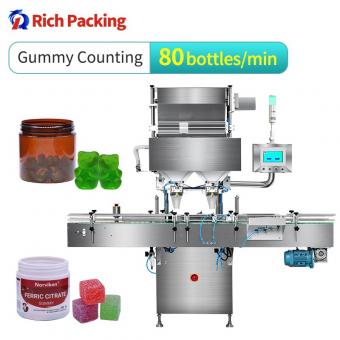
  • Jun 25, 2026 From Gummy Bears to Gummy Counting Machine: How Accurate Counting Is Ensured
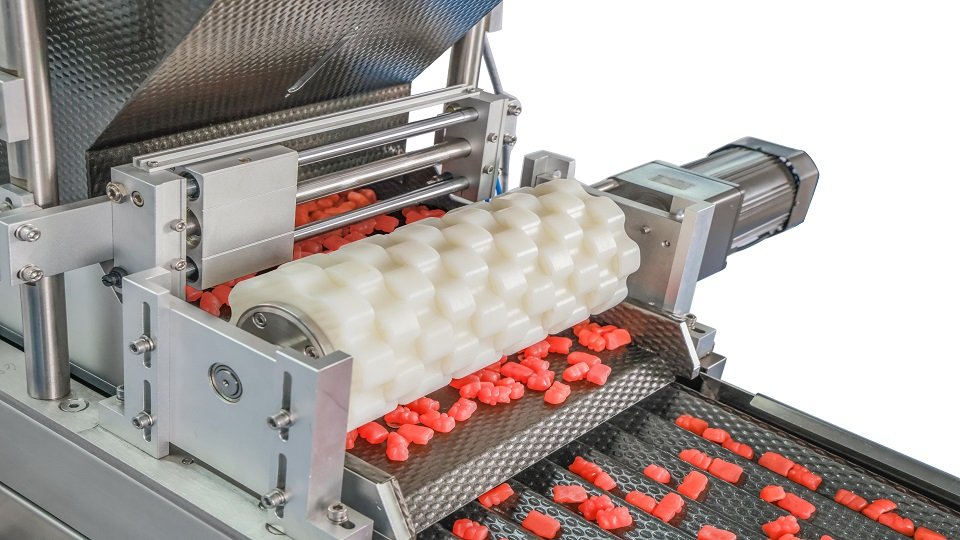
    Do you like eating gummy bears? Think about the last time you ate a gummy bear. Maybe it was a handful of colorful candies from a bag, or perhaps a daily vitamin gummy that has become part of your morning routine. No matter the form, nowadays gummies are everywhere in our life. You can find them in supermarkets, pharmacies, convenience stores, and even on your desk as a quick sweet treat. Their soft texture, vibrant colors, and various flavors make them a favorite among both children and adults.   But have you ever wondered how manufacturers ensure that every bottle contains exactly the right number of gummies? Whether purchasing a bottle of multivitamin gummies or a package of gummy bears, we consumers always expect accurate counts, consistent quality, and hygienic packaging. Behind this seemingly simple process lies a significant manufacturing challenge. In this article, you’ll discover how gummy counting machines work, what challenges this process faces, and why outstanding supplier of counting machine for gummies can provide perfect solutions.   1. Why Are Gummy Bears So Popular?   When you think of gummy bears, colorful fruit-flavored candies probably come to mind. Originally developed as a confectionery treat, gummy bears have been enjoyed for generations thanks to their chewy texture, appealing appearance, and wide variety of flavors. Today, however, gummies have evolved far beyond the candy aisle and become one of the fastest-growing product formats in the global health and wellness market.   Categories of Gummies in Terms of Function     From a functional perspective, gummy can be divided into several categories: Confectionery Gummies: Traditional sweet treats enjoyed as snacks. Vitamin Gummies: Containing vitamins such as Vitamin C, Vitamin D, and B-complex vitamins. Multivitamin Gummies: Providing a combination of essential nutrients in a convenient format. Probiotic Gummies: Supporting digestive and gut health. Functional Nutrition Gummies: Designed for immunity, energy, stress relief, cognitive support, and other wellness goals.   Different gummy products   Reasons for Success of Gummies    One of the biggest reasons for the success of gummies is their convenience. Unlike traditional tablets and capsules, gummies are easy to consume and often provide a more enjoyable user experience. Many consumers find swallowing pills difficult or unpleasant, while gummies offer familiar flavors and textures that make daily supplementation feel less like a chore. For children, gummies can improve compliance with vitamin routines. For adults, they provide a convenient and portable way to maintain wellness habits. As health-conscious consumers increasingly seek products that combine effectiveness with convenience, gummies have emerged as an attractive delivery format. In addition, gummy products offer tremendous flexibility for manufacturers and brands. They can be produced in countless sha...
    View More
  • Jun 24, 2026 What Affects Pill and Capsule Dissolution Time? 8 Factors from Formulation to Manufacturing
    Two pills can look almost identical yet follow very different paths after swallowing. When people search "how long for pills to dissolve," they usually expect one simple number. Yet one pill may break apart soon after contacting stomach fluid, while another remains intact until it reaches a different environment in the digestive tract. Appearance alone reveals little about what controls the difference.   Inside each product is a deliberately designed structure. Tablet compression force changes the pore spaces through which fluid must travel. Capsule shell material and shell moisture affect how a hard capsule responds. Tablet coatings, binders, disintegrants, particle properties, and capsule fill materials determine what happens after the outer structure begins to open.   Pill and capsule dissolution time is therefore shaped across the entire product journey, from formulation and tablet compression or capsule filling to coating, storage, packaging, and the conditions encountered after swallowing.     No Single Clock Starts When You Swallow   People often expect a simple answer: ten minutes, twenty minutes, perhaps an hour. The useful answer is less tidy. A swallowed product may first soften, split, swell, or allow fluid through microscopic pores before its active ingredient begins entering solution. That sequence creates three separate milestones: Stage What you would observe What it does not prove Disintegration The tablet or capsule breaks into smaller parts That all active ingredient has dissolved Dissolution Active ingredient enters surrounding fluid That it has already been absorbed Absorption Dissolved material crosses into the body That every person will respond identically A capsule shell opening is not the finish line, and a tablet disappearing is not proof that every ingredient has entered solution. The intended release design controls what follows.   Factor 1: The Dosage Form Sets the First Route   Imagine a conventional tablet, a hard capsule, and a softgel placed beside one another. The tablet is a compact of compressed particles. The hard capsule is a two-piece shell holding powder, granules, or pellets. The softgel is a flexible sealed shell around a liquid or semi-solid fill. They may be swallowed in the same way, but fluid reaches their contents through three different structures.   A conventional tablet must become wet internally and lose enough structural strength to break apart. A hard capsule shell must hydrate before exposing its fill. A softgel shell must lose integrity while remaining compatible with the material sealed inside it. Modified-release products add another route. Enteric-coated forms are designed to resist the acidic stomach environment. Extended-release tablets or capsules may use polymer matrices or coated pellets to spread release across a longer period. A delayed start is not automatically a defect; sometimes it is the central purpose of the product. Dosage form First ...
    View More
  • Jun 22, 2026 How to Choose Desiccant Inserter for Tablet Counting?
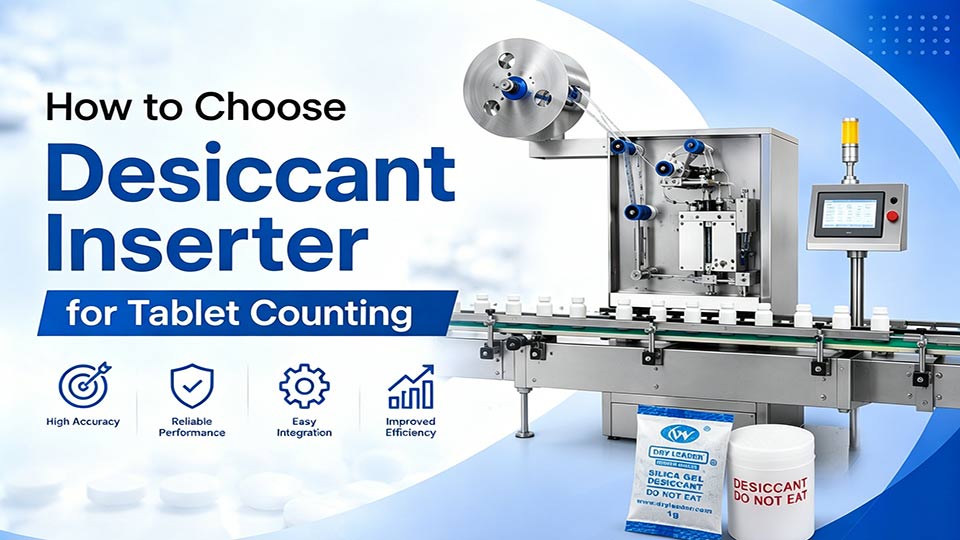
    1. Introduction   In pharmaceutical packaging production, every tiny process detail determines the final product quality and market compliance level. While most manufacturers focus on upgrading core equipment such as tablet counting machines, bottle unscramblers and capping machines, they often overlook the critical supporting link: desiccant insertion. As a key barrier against moisture, oxidation and microbial contamination, desiccants effectively stabilize the efficacy of tablets and capsules, extending product shelf life and reducing scrap rates.   However, mismatched desiccant inserting machine has become a common bottleneck restricting pharmaceutical production efficiency. Many pharmaceutical and health product enterprises face recurring problems in actual production: low line running speed, high desiccant breakage rate and debris contamination risks. These issues not only increase production and maintenance costs but also cause hidden dangers for GMP compliance and product quality stability.   Currently, the pharmaceutical counting line market is dominated by three mainstream desiccant insertion solutions: roll stock cutting type, pre-cut single pouch type, and cylindrical type. Each type has unique working principles, performance characteristics and applicable production scenarios. Let's take a look at which type of deoxidizer inserting machine is the best for you.   2. Working Principles and Core Characteristics   To select the most suitable equipment for personalized production needs, it is necessary to first clarify the structural logic and core positioning of the three types of desiccant inserting machines. Different design concepts fundamentally determine their differences in efficiency, cost, stability and applicability.   2.1 Roll Stock Cutting Desiccant Inserter   The roll stock cutting desiccant pouch inserter is designed for continuous and large-scale automated production, adopting integrated coiled desiccant without pre-cutting or manual sorting. The machine drives the continuous desiccant roll through a high-precision stepping motor, realizing stable and uniform feeding. Equipped with a real-time detection of the highest and lowest points of the desiccant, it achieves accurate fixed-length positioning, and the customized high-hardness cutter completes instantaneous cutting and separation. The whole process of feeding, cutting and inserting is highly coordinated, perfectly matching the high-speed operation rhythm of pharmaceutical counting lines.   Its core feature is one-stop integrated automatic processing. It eliminates the intermediate link of manual or mechanical sorting of finished desiccants, reduces equipment stations and failure points, and realizes seamless connection from desiccant to bottle. The cutting length can be freely adjusted according to production needs, adapting to multiple desiccant dosage specifications, with strong production flexibility for standardized products. ...
    View More
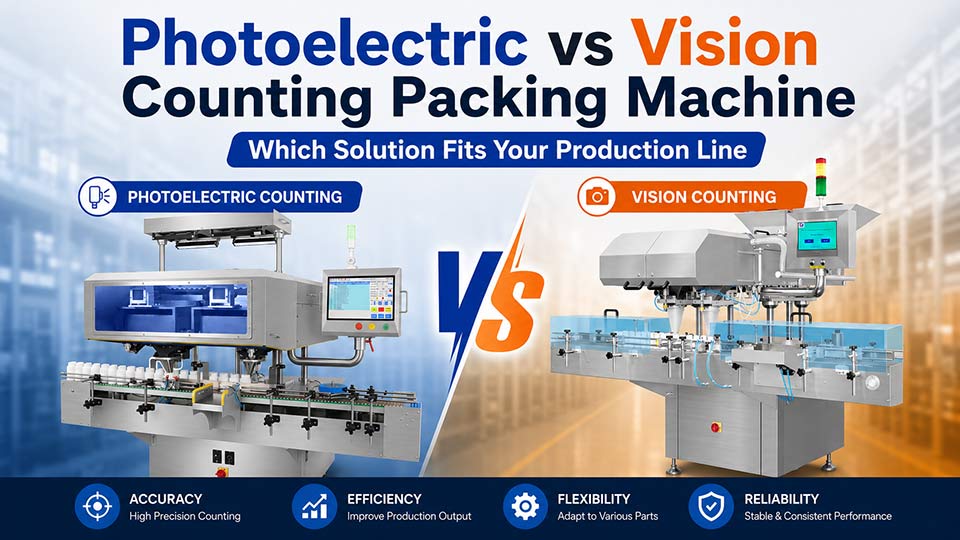
  • Jun 22, 2026 Photoelectric vs Vision Counting Packing Machine: Which Solution Fits Your Production Line?
    1. Introduction: Why Counting & Inspection Technology Matters for Modern Packaging    1.1 Strict Global Regulatory and Quality Requirements   In the global pharmaceutical, nutraceutical, and food packaging industries, precise counting and zero-defect quality control are no longer optional advantages—they are mandatory standards. With increasingly stringent cGMP, FDA, and CE regulatory requirements, manufacturers are facing unprecedented pressure to eliminate counting errors, reduce defective product rate, and achieve full-process production traceability. Even a small number of miscounted bottles or mixed defective particles can lead to huge economic losses and irreversible damage to brand reputation.   1.2 Common Production Pain Points in Traditional Counting Lines   For decades, automatic counting machines have replaced inefficient error-prone manual counting and become the core equipment of bottle packaging lines. However, many production managers still struggle with equipment selection confusion. Traditional photoelectric capsule counting machines and emerging vision counting packing machines dominate the current market, yet most enterprises cannot accurately distinguish their applicable scenarios, technical limitations, and long-term value. Choosing inappropriate equipment often results in low production efficiency, frequent quality risks, and wasted investment costs.   2. Working Principle: Essential Differences Between Traditional Induction and AI Intelligent Recognition   The fundamental performance gap between photoelectric counting and AI vision counting stems from their completely different underlying technical logic. Understanding the working mechanism is the premise of accurate equipment selection, as it directly determines the equipment’s detection limit, functional boundary, and production adaptability.   2.1 Technical Logic of Photoelectric Counting Technology   RQ-DSL-16H photoelectric tablet counter machine adopts mature and stable infrared laser photoelectric induction technology, which has been optimized and iterated for decades in the packaging industry. The equipment is equipped with imported high-sensitivity independent photoelectric sensors for each detection channel, forming a stable and continuous laser detection light beam. When materials such as tablets and capsules fall vertically through the detection channel, the particles will instantly block the laser beam, causing real-time changes in the optical signal received by the sensor. The high-stability Panasonic PLC system quickly converts the optical signal fluctuation into electronic pulse signals, completes accurate single-particle counting through algorithm logic judgment, and cooperates with the pneumatic system to realize quantitative bottling. photoelectric counting module   2.2 Technical Upgrade Logic of Rich Packing Vision Counting Packing Machine   Completely different from the single-functi...
    View More
1 2 3 4 5 6 ... 25

A total of 25 pages

Leave A Message
Leave A Message
Please tell us your requirements such as product, model, speed, etc. We will contact you immediately and give you equipment information and quotation。

Service Online

WhatsApp

Email