






 Home
Home Products
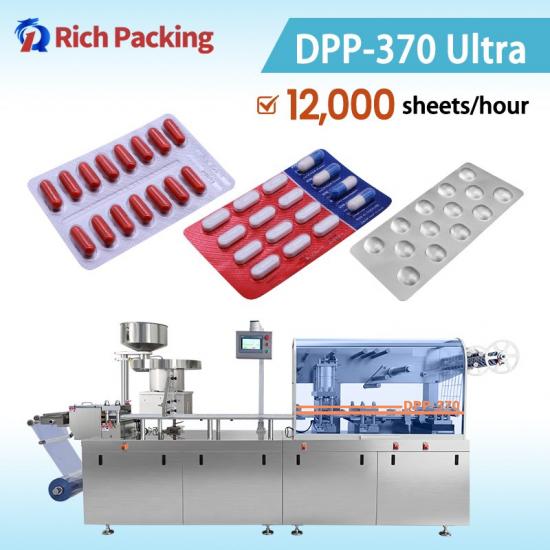
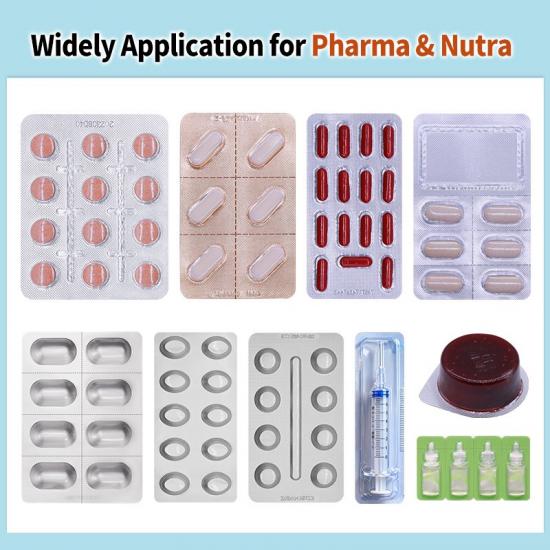
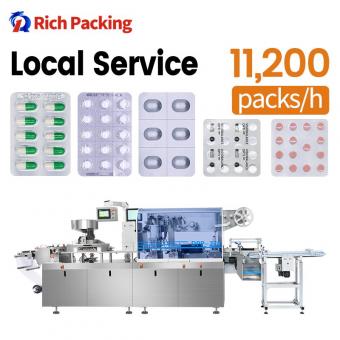
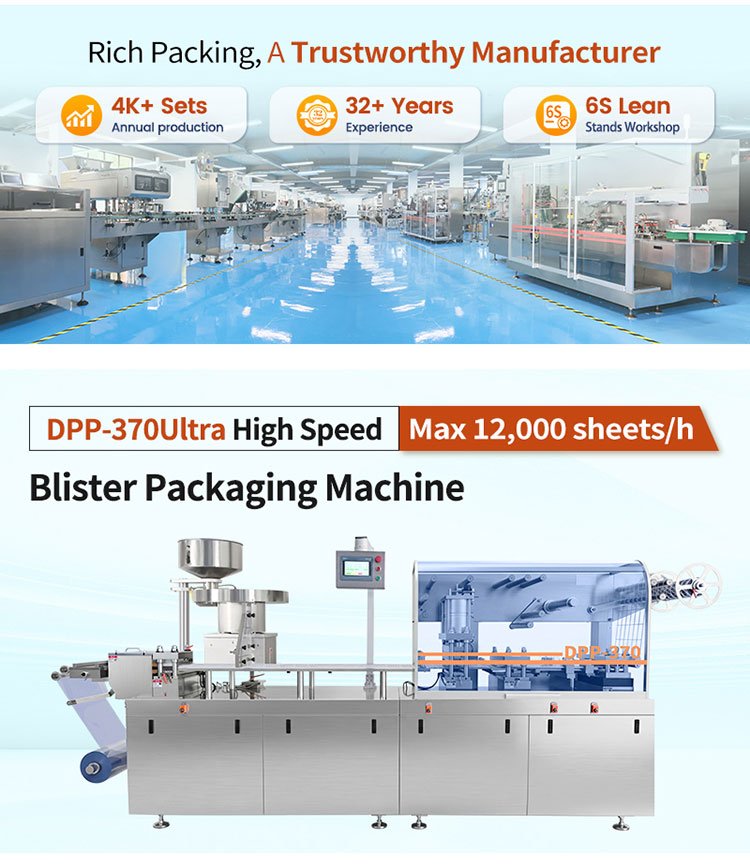
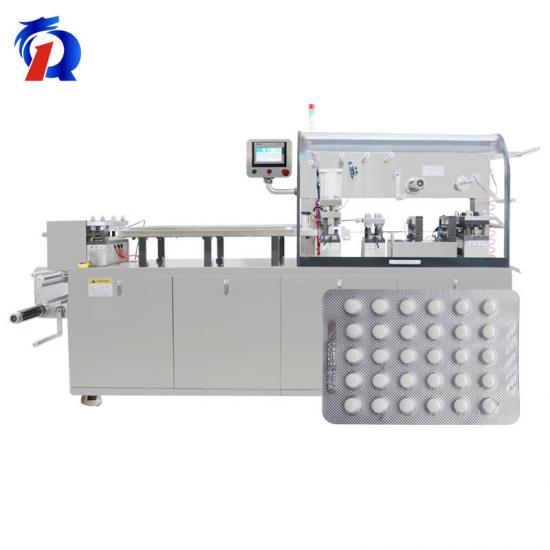
DPP-370Ultra Blister Packaging Machine

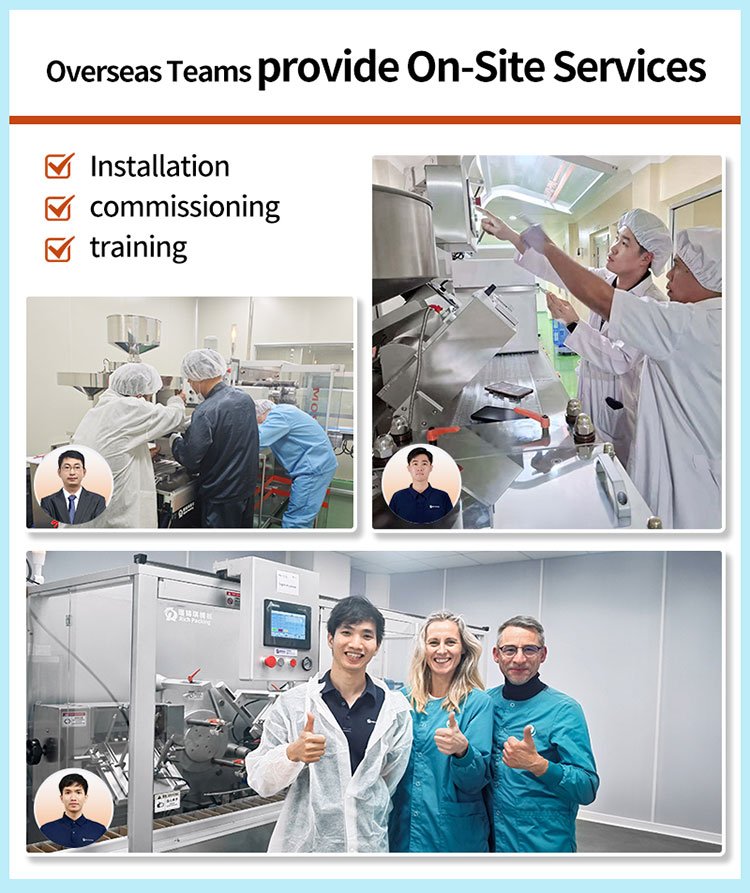
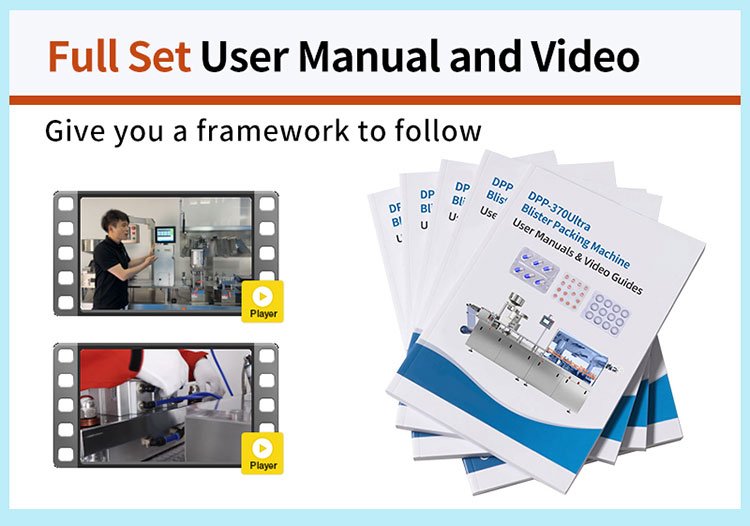
*** Technical parameter
| model | DPP-370Ultra |
| production capacity | 12,000 blisters/h |
| total power | 11.5kW |
| power supply | 380V/220V/50Hz |
| machine weight | 3050 kg |
| Dimensions | 4470 mm × 820mm ×1900 mm |
Want to know about this product?
Feel free to contact me, and I will be more than happy to answer all of your questions.
What Can DPP-370Ultra Blister Packaging Machine Brings To You in Pharma and Nutra
Technical Parameter Blueprint: High-Capacity Solid Dosage Encapsulation
When evaluating machinery for automated secondary solid-dosage packaging lines, procurement committees and validation engineers look past superficial claims to analyze exact physical capacities and dimensional thresholds. The DPP-370Ultra Tablet Capsule Blister Machine platform is engineered to bridge the gap between high-velocity output and wide-format flexibility. Below is the verified engineering data outlining the machine's primary processing capabilities:
|
Technical Performance Metric |
Manufacturing Specification & Operational Standard |
|
Cutting Frequency / Production Capacity |
Up to 40 cuts per minute (Ultraimum velocity under optimal load) |
|
Alu-PVC Output Yield |
200 plates per minute (Calculated using standard 80*57mm blister) |
|
Alu-Alu (Cold-Form) Output Yield |
160 plates per minute (Calculated using standard 80*57mm blister) |
|
Ultraimum Forming Area |
120 mm * 360 mm (Extended wide-format matrix layout) |
|
Standard Pocket Forming Depth |
15 mm (Optimal for standard tablets, hard gelatin, and softgel capsules) |
|
Ultraimum Custom Forming Depth |
Up to 26 mm (Customized mechanical tooling configurations for large vials/syringes) |
Introduction: Elevating Throughput and Quality in Large-Scale Blister Packaging
For high-volume pharmaceutical manufacturing plants, busy nutritional supplement companies, and contract packaging organizations (CMOs), maintaining an efficient solid-dosage line requires equipment that balances rapid output with precise operational control. As market demands shift toward high-mix, low-volume contract manufacturing alongside massive block-buster drug campaigns, packaging floors face a difficult dual challenge: achieving ultra-high linear output speeds while minimizing tool-intensive product changeover downtime. Outdated blister thermoformers and older mechanical link-belt machines frequently fail to meet these modern standards, leading to cumulative timing errors, high material waste during web splicing, and long setup times that lower Overall Equipment Effectiveness (OEE).
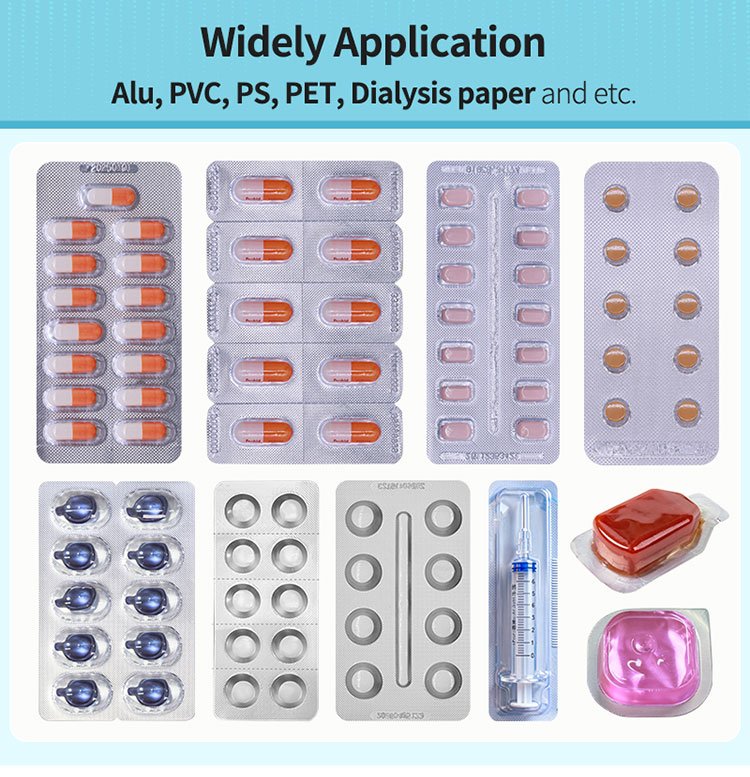
The DPP-370Ultra Blister Packaging Machine offers a high-performance alternative to traditional mechanical-cam systems. Designed with an extended 120*360mm active forming area, this platform allows for multi-row, multi-blister pack layout patterns that optimize material utilization on every single cut. Whether running thermoformable plastic laminates like Alu-PVC, high-barrier PVDC, Aclar, or cold-form aluminum matrices (Alu-Alu), the system maintains uniform pressure distribution and absolute sealing integrity. By focusing on modular, tool-less mechanical sub-assemblies and digital control loops, the machine eliminates the common pain points of loose powder leaks, pocket wall thinning, and slow format adjustments.
Technical Decoupling: How the DPP-370Ultra Platform Optimizes the Packing Lifecycle
To truly appreciate the operational reliability of the DPP-370Ultra platform, one must examine the step-by-step passage of materials through its continuous processing stations:
The process begins at the automated unwind station, where base plastic or cold-form aluminum films are fed into the flat plate packaging blister machine. The film passes over an integrated splicing table and enters the flat-plate heating station. Here, dual contact plates apply perfectly uniform thermal energy across the plastic sheet, softening it without causing localized hot spots or material degradation. Once heated, the web advances into the flat-plate forming station. Using a combination of positive compressed air, the plastic is formed into precise cavities up to 15mm deep (or up to 26mm for custom profiles), ensuring highly uniform pocket wall thickness across the entire 120mm * 360mm matrix.
Next, the formed cavities enter the feeding zone, where a customized, material-specific feeding system fills every pocket with absolute precision. The filled web then moves to the flat-plate sealing station, where the aluminum lidding foil is bonded to the base laminate under tightly controlled pressure and temperature. A high-resolution vision system inspects the sealed web in real-time, checking for empty cavities or broken products. Finally, the web is advanced by an independent servo motor traction assembly to the cutting station. Operating at speeds up to 40 cuts per minute, the cutter separates the web into perfectly finished blister blister packs, automatically diverting any defective packs into a secure reject bin.
9 Core Engineering Innovations of the DPP-370Ultra Platform
The impressive output capacity and daily operational flexibility of the DPP-370Ultra Large Capacity Blister Packing Machine are built upon 9 core engineering innovations. Each feature is designed to address a specific real-world production bottleneck:
1. World-Class Core Component Integration (Siemens, Schneider, Omron)
Relying on generic or unbranded electrical automation components introduces significant operational risks, including unpredictable control latency, premature component failure, and long wait times for international replacement parts.
● The Mechanical Solution: The entire automation, drive, and control architecture of the DPP-370Ultra is built using premium components sourced from world-renowned brands, including Siemens, Schneider, and Omron.
● The Technical Benefit: The central Siemens PLC handles high-speed data processing and coordinates processing stations over a fast digital bus. Schneider contactors and Omron sensors ensure exceptional electrical reliability and high noise immunity, reducing unplanned electrical downtime and ensuring easy access to standard spare parts worldwide.
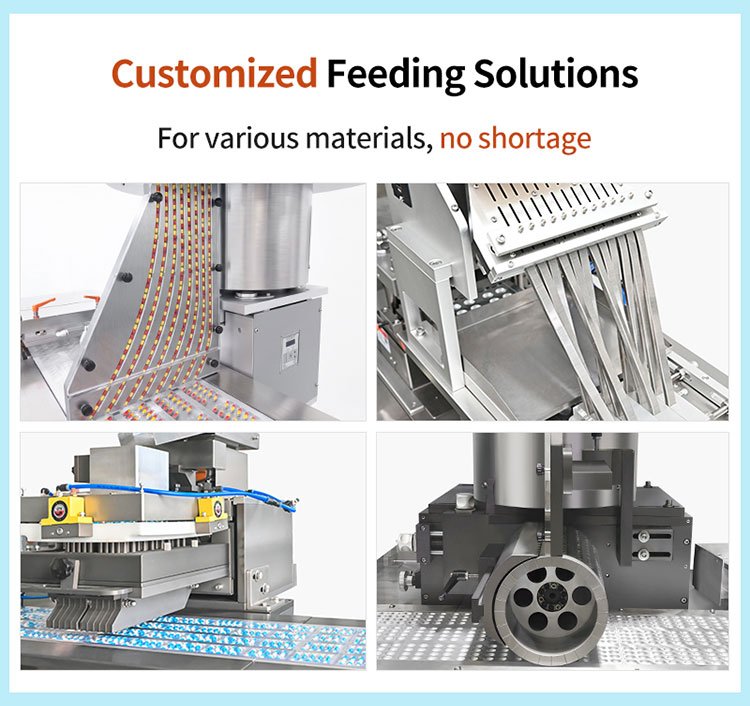
2. Advanced Tailored Feeding Configurations for Zero Missing Pockets
Processing diverse solid dosage forms—such as slippery softgels, uniquely shaped oblong tablets, or brittle hard-gelatin capsules—requires specialized material handling to prevent empty blister cavities.
● The Mechanical Solution: The full automatic blister packing machine moves away from generic, one-size-fits-all gravity drop tracks, instead offering customized feeding solutions tailored to the unique physical geometries and surface friction of your product.
● The Technical Benefit: By utilizing a range of option-optimized systems—including Waterfall-type track feeders, oscillating tube configurations, or specialized direct-track configurations—the platform ensures a 100% fill rate. This precise feeding eliminates missing pockets, optimizes line yield, and maintains seamless product flow at Ultraimum line speeds.
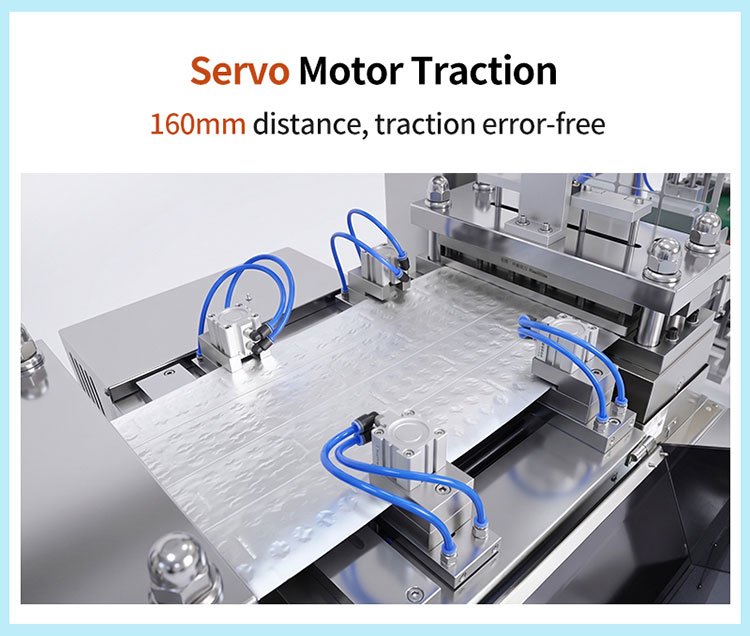
3. Precision Servo Motor Traction System (160mm Distance Standard)
Due to chain elongation and gear backlash, traditional mechanical web-advancing systems are highly prone to stepping errors after prolonged operation, causing the cutter to slice through text or blister pockets.
● The Mechanical Solution: The film indexing sequence is driven by an independent, high-torque servo motor traction network capable of maintaining a precise 160mm index distance.
● The Technical Benefit: The servo drive calculates the exact web position down to the micrometer on every cycle, completely eliminating cumulative index errors. This digital precision keeps pockets perfectly centered within the sealing and cutting tools, reducing material waste and ensuring flawless blister pack alignment even during high-speed, continuous 40 cuts-per-minute production runs.
Servo Traction Registration Accuracy Comparison
● Mechanical Cam Indexing: Cumulative Backlash Position Drift High Blister Pack Scrap Rate.
● DPP-370Ultra Servo Drive: Real-Time Micro-Adjustments 160mm Fixed Index Zero Deflection.
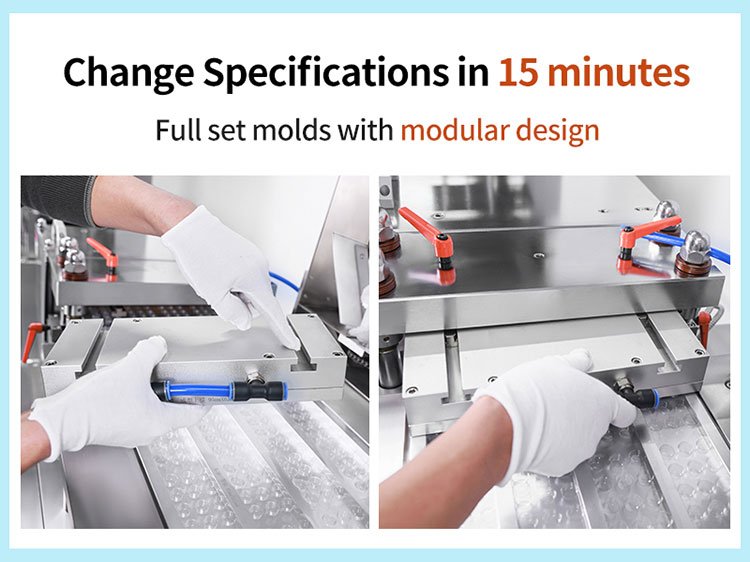
4. 15-Minute Modular Drawer-Style Format Swap Architecture
Extended downtime during batch changeovers can severely impact overall factory profitability, especially when switching between different tablet profiles or shifting from Alu-PVC to Alu-Alu blistering configurations.
● The Structural Solution: The forming, sealing, and cutting assemblies are engineered using an advanced drawer-style modular mold configuration.
● The Technical Benefit: Tool sets are mounted on ultra-smooth horizontal slide tracks and secured using quick-acting locking mechanisms and integrated dowel alignment pins. This allows a single line operator to slide out the old format and lock in the new size matrix within 15 minutes without needing a set of tools, dramatically improving your OEE.
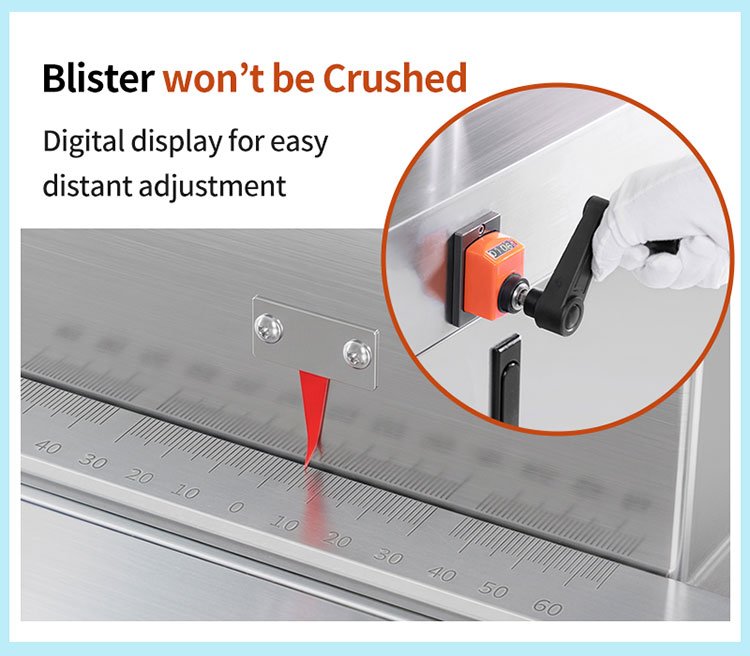
5. Micro-Adjustable External Handwheel Distance Calibration
Fine-tuning the indexing distance on an internal mechanical rail system often requires operators to halt production, open safety guards, and perform tedious manual trial-and-error adjustments.
● The Structural Solution: This DPP series pill blister packing machine frame features an ergonomic, calibrated external handwheel connected directly to the primary indexing axis.
● The Technical Benefit: Operators can safely make precise, real-time adjustments to the process positioning while the machine remains operational. This external design keeps adjustments intuitive, protects operator safety, and allows for instant alignment fine-tuning to compensate for subtle material variations without stopping the line.
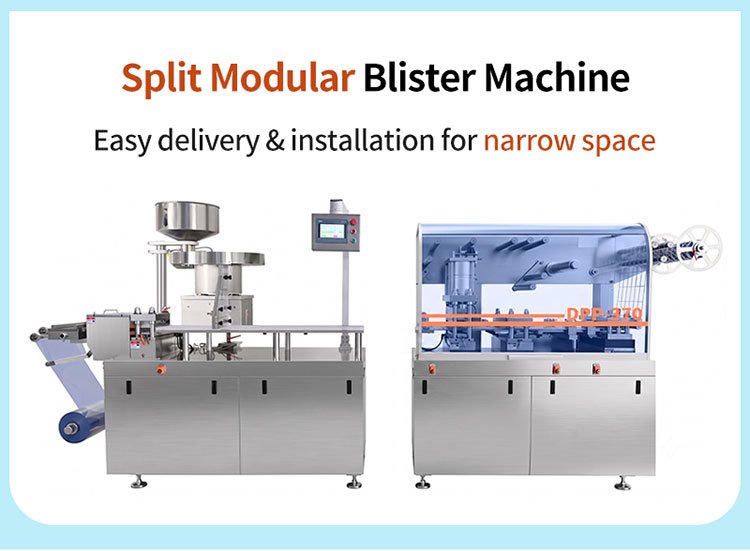
6. Modular Split-Frame Architecture for Tight Clearances
Rigid, single-frame industrial packaging machinery can be incredibly difficult to maneuver through narrow corridors, standard elevators, and tight airlock doors during cleanroom installation.
● The Structural Solution: The chassis utilizes a smart, structurally secure split-design frame that allows the machine to be disassembled into transportable modules.
● The Technical Benefit: This 370Ultra modular layout makes transportation and installation remarkably easy in facilities with tight physical access or limited cleanroom footprints. The separate frame components can be rolled through standard doorways independently and reassembled on-site with perfect structural alignment, saving thousands of dollars in facility modification costs.
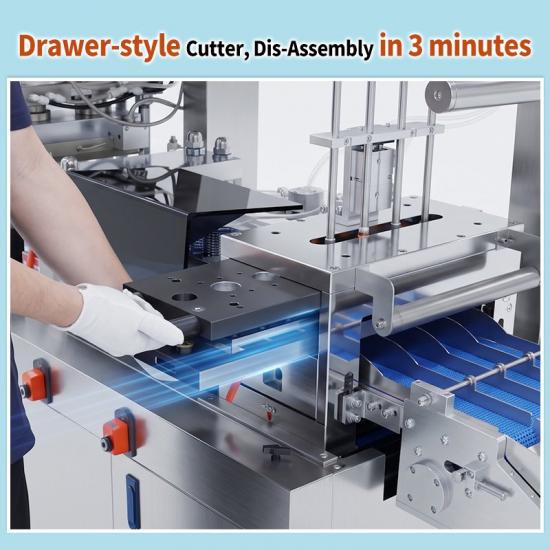
7. 3-Minute Rapid Pull-Out Cutting Mechanics
The cutting punch station handles intense mechanical impact on every stroke, making cutter maintenance, blade inspection, and format cleaning common operational bottlenecks.
● The Structural Solution: The heavy-duty die cutting assembly is built with a specialized pull-out cutter tracking mechanism.
● The Technical Benefit: By releasing two quick-clamp handles, the entire cutter module slides completely forward out of the machine frame. This open configuration allows a technician to complete complete blade inspections, cleaning, or full assembly swaps within 3 minutes, minimizing downtime at the final stage of the packaging line.
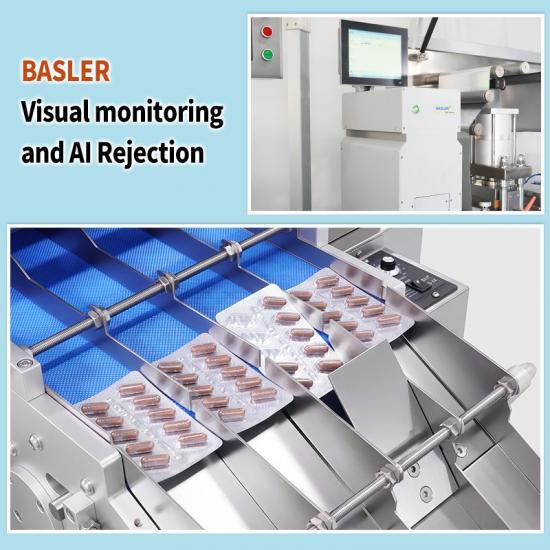
8. Real-Time Automated Vision Inspection & Defect Rejection Systems
Manual quality checks cannot keep pace with high-speed lines running at 200 plates per minute, creating a risk that empty blisters or damaged tablets slip through into final commercial cartons.
● The Electronic Solution: The line integrates an industrial-grade vision monitoring camera system positioned directly after the product feeding zone, paired with an automated pneumatic rejection station.
● The Technical Benefit: The system of automatic blister packing and sealing machine scans every pocket on every stroke, instantly flags missing products, incorrect colors, broken fragments, or deep-seated contamination, and automatically rejects the defective blister pack into a secure bin without slowing down the line. This automated inspection protects your brand reputation and ensures full compliance with strict pharmaceutical validation standards.
9. Integrated PVC Splicing Platform for Fast Web Replacement
When a raw material roll runs out, manually threading a new film roll through a complex series of tension rollers causes significant delays and leads to unheated, wasted material sections.
● The Structural Solution: Located immediately following the film unwind reel is a dedicated, flat-surface PVC splicing platform equipped with dual pneumatic film clamps and an integrated straight-edge cutting guide.
● The Technical Benefit: When a film roll runs out, the operator clamps the trailing edge of the old web alongside the leading edge of the new roll, makes a clean cut, and tapes them together in seconds. This integrated platform keeps the material perfectly aligned, shortens material replacement downtime, and prevents film wrinkling or tracking errors when production resumes.
Technical Specification Comparison: Standard vs. DPP-370Ultra
To help production directors and corporate purchasing agents evaluate line performance, the data matrix below compares the operational capacity of the DPP-370Ultra thermoforming blister packing machine against standard mid-tier blister packaging machinery:
|
Manufacturing Capability Parameter |
Standard Mid-Tier Blister Machinery |
Rich Packing DPP-370Ultra Platform |
|
Ultra Thermoforming Web Width |
250 mm (Restricted layout options) |
370 mm (Extended wide-format matrix) |
|
Ultraimum Active Forming Area |
250 * 140 mm |
120 mm * 360 mm |
|
Alu-PVC Production Output |
80 to 120 plates/min |
Up to 200 plates/min (Based on $80 \times 57\text{ mm}$ blister pack) |
|
Alu-Alu Cold-Form Output |
60 to 90 plates/min |
Up to 160 plates/min (Based on $80 \times 57\text{ mm}$ blister pack) |
|
Ultraimum Practical Deep Pocket Depth |
10 mm to 12 mm Ultra |
15 mm standard / 26 mm Ultraimum custom depth |
|
Indexing Traction Drive Type |
Mechanical chain/cam (Prone to stretch) |
Independent Servo Motor Traction (160mm range) |
|
Format Changeover Downtime |
1.5 to 3 hours (requires heavy tools) |
Under 15 minutes (Drawer-style modular molds) |
|
Cutter Module Maintenance Access |
Fixed internal bolts (hard to clean) |
3-Minute Pull-out rapid slide track module |
DPP-370Ultra Automatic Blister Machine is Your Blister Blister Pack Production Choice
When investing in a large-scale DPP-370Ultra Blister Packaging Machine, forward-thinking operations managers look past the initial capital expenditure and evaluate the Total Cost of Ownership (TCO) and long-term return on investment (ROI). Machinery that relies on traditional mechanical linkages often generates hidden operating costs, including excessive material scrap from indexing drift, lost production hours during multi-tool changeovers, and ongoing maintenance expenses for worn mechanical cams.
The DPP-370Ultra directly eliminates these financial inefficiencies. By restricting the indexing tolerance to a zero-error servo drive and optimizing the cutting layout to reduce edge trim waste, the system slashes monthly foil consumption costs by up to 12% to 15%. Furthermore, reducing format changeover times from hours down to a 15-minute tool-less process allows facilities running high-mix, short-batch schedules to regain valuable production hours every single week.
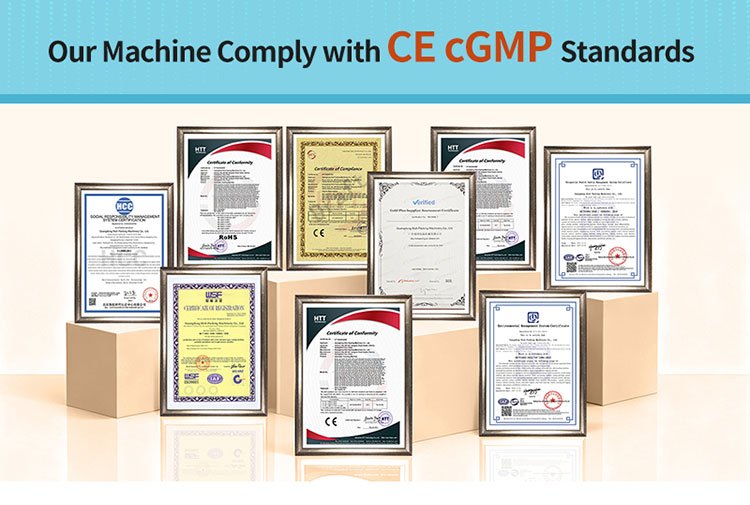
In addition, our manufacturing platform simplifies international regulatory compliance. Rich Packing ensures that the DPP-370Ultra is built from the ground up to satisfy the stringent validation requirements of the FDA, EMA, and WHO-GMP. Every high-speed machine leaves our factory accompanied by a comprehensive, native-English validation documentation package. This package provides pre-articulated templates for Installation Qualification (IQ), Operational Qualification (OQ), and Performance Qualification (PQ). By delivering verified wiring diagrams, material certificates for SUS316L stainless steel contact points, and step-by-step calibration protocols, we help your internal Quality Assurance (QA) team drastically reduce validation costs and get your new line up and running quickly.
Comprehensive Technical FAQ of DPP High Speed Blister Packing Machine
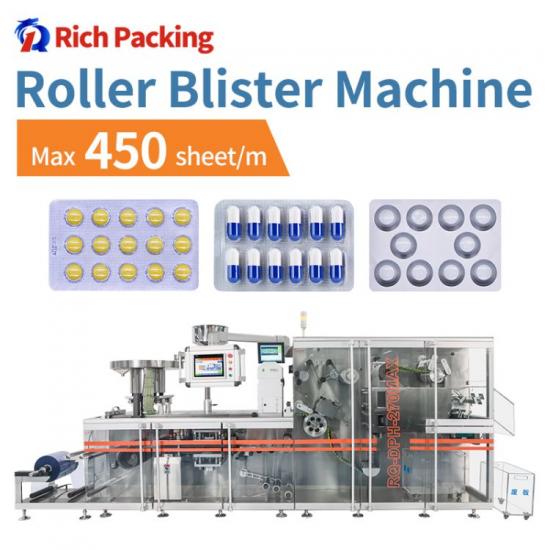
Q1: How does the DPP-370Ultra flat plate architecture achieve a deeper forming capacity compared to rotary roller blister machines?
A: Rotary roller blister packaging systems form pockets during continuous rolling contact, which limits the available forming time and can unevenly stretch material over deep pockets. The DPP-370Ultra utilizes a flat-plate thermoforming configuration where the film remains stationary during the positive air pressure phase. This uniform pressure distribution allows for a standard 15 mm forming depth and supports custom depths up to 26 mm without thinning or tearing the film walls, making it ideal for large tablets, deep softgels, and medical devices.
Q2: What is the mechanical logic behind the 3-minute pull-out cutter, and how does it improve line safety?
A: Traditional cutting punch dies are bolted deep within the machine frame, requiring technicians to lean into the mechanism with specialized tools to perform cleaning or size adjustments. The DPP-370Ultra automatic blistering machine pull-out cutter is mounted on heavy-duty, linear slide tracks. By releasing two ergonomic quick-clamp handles, the entire cutting assembly slides completely forward out of the machine chassis. This open design allows for fast blade inspections and tool-less maintenance within 3 minutes while protecting technicians from injury.
Q3: How does the servo motor traction handle switching between standard Alu-PVC films and rigid Alu-Alu cold-form laminates?
A: Cold-form aluminum (Alu-Alu) has no thermal elasticity and requires higher mechanical traction force and modified feeding strokes compared to thermoformable plastics. The DPP-370Ultra uses an independent, high-torque Siemens servo motor traction network that maintains a perfect 160mm index distance. When switching materials, the operator simply selects the pre-configured Alu-Alu profile on the touchscreen HMI. The servo drive automatically adjusts its torque limits and stroke profiles digitally, eliminating the need for physical gear swaps or structural modifications.
Q4: Why is a split-frame design important, and does it compromise the machine's structural rigidity during high-speed 40 cuts/min runs?
A: The split-frame design allows the machine to be separated into modular sections for easy transport through narrow cleanroom corridors and standard elevators. It does not compromise structural rigidity because the modules are aligned using high-precision industrial keys and secured with heavy-duty structural steel bolts. Once reassembled, the frame forms a single, highly rigid chassis that easily absorbs the kinetic forces generated during high-speed, 40 cuts-per-minute production runs.
Q5: Can the automated vision system detect partial tablet breakages or surface discolored contaminants inside the pocket?
A: Yes. The integrated vision monitoring platform uses a high-resolution industrial camera paired with adjustable LED lighting arrays linked to a dedicated image-processing module. The software analyzes every pocket in real-time, checking for missing items, empty cavities, color variations, and dimensional changes down to fractions of a millimeter. If a partially broken tablet or foreign contaminant is detected, the system tracks the specific blister pack and rejects it automatically at the discharge station without interrupting the continuous 200 plates-per-minute output.

 IPv6 network supported